
-
 Argentina
-
 Australia
-
 Austria
-
 Belgium
-
 Brazil
-
 Canada
-
 China
China
-
 Czech Republic
-
 Denmark
-
 Finland
-
 France
-
 Germany
-
 Greece
-
 Hong Kong
-
 Hungary
-
 Iceland
-
 India
India
-
 Ireland
-
 Israel
-
 Italy
Italy
-
 Japan
Japan
-
 Korea
Korea
-
 Luxembourg
-
 Malaysia
-
 Netherlands
-
 New Zealand
-
 Norway
-
 Poland
-
 Qatar
Qatar
-
 Romania
-
 Saudi Arabia
-
 Singapore
-
 Spain
Spain
-
 Sweden
-
 Switzerland
-
 Taiwan
-
 Turkey
-
 United Kingdom
-
 United States
research use only
Dexamethasone palmitate Glucocorticoid Receptor agonist
Cat.No.S5184
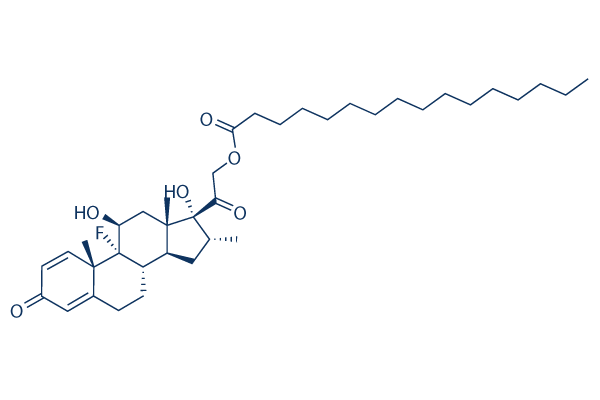
Chemical Structure
Molecular Weight: 630.87
Quality Control
| Related Targets | Adrenergic Receptor Estrogen/progestogen Receptor GPR Androgen Receptor ACE RAAS Progesterone Receptor Opioid Receptor THR PGES |
|---|---|
| Other Glucocorticoid Receptor Inhibitors | Relacorilant (CORT125134) Corticosterone AL082D06 (20S)-Protopanaxatriol Cortodoxone |
Solubility
|
In vitro |
DMSO
: 100 mg/mL
(158.51 mM)
Ethanol : 100 mg/mL Water : Insoluble |
Molarity Calculator
|
In vivo |
|||||
In vivo Formulation Calculator (Clear solution)
Step 1: Enter information below (Recommended: An additional animal making an allowance for loss during the experiment)
Step 2: Enter the in vivo formulation (This is only the calculator, not formulation. Please contact us first if there is no in vivo formulation at the solubility Section.)
Calculation results:
Working concentration: mg/ml;
Method for preparing DMSO master liquid: mg drug pre-dissolved in μL DMSO ( Master liquid concentration mg/mL, Please contact us first if the concentration exceeds the DMSO solubility of the batch of drug. )
Method for preparing in vivo formulation: Take μL DMSO master liquid, next addμL PEG300, mix and clarify, next addμL Tween 80, mix and clarify, next add μL ddH2O, mix and clarify.
Method for preparing in vivo formulation: Take μL DMSO master liquid, next add μL Corn oil, mix and clarify.
Note: 1. Please make sure the liquid is clear before adding the next solvent.
2. Be sure to add the solvent(s) in order. You must ensure that the solution obtained, in the previous addition, is a clear solution before proceeding to add the next solvent. Physical methods such
as vortex, ultrasound or hot water bath can be used to aid dissolving.
Chemical Information, Storage & Stability
| Molecular Weight | 630.87 | Formula | C38H59FO6 |
Storage (From the date of receipt) | 3 years -20°C powder |
|---|---|---|---|---|---|
| CAS No. | 14899-36-6 | -- | Storage of Stock Solutions |
|
|
| Synonyms | DXP | Smiles | CCCCCCCCCCCCCCCC(=O)OCC(=O)C1(O)C(C)CC2C3CCC4=CC(=O)C=CC4(C)C3(F)C(O)CC12C | ||
Mechanism of Action
| Targets/IC50/Ki |
Glucocorticoid receptor
|
|---|---|
| In vitro |
Dexamethasone palmitate results in decrease in transmonolayer paracellular permeability mainly to sucrose, fluorescein and dextrans of up to 20 KDa in an immortalised rat brain endothelial cell line (GPNT). This compound results in filamentous actin and the cytoskeleton associated protein cortactin being highly concentrated in the regions of cell-cell contact with few F-actin stress fibres visible within the cytoplasm in cultured rat brain endothelial cells, an observation consistent with a more differentiated barrier phenotype induced by this chemical. This compound treatment has been shown to strongly stimulate the level of the Id-1 protein, which is a serum-inducible helix-loop-helix transcriptional repressor, involved in cell differentiation, and this effect was shown to be associated with reorganisation of ZO-1 to the cell periphery in Con8 mammary epithelial tumor cells. This chemical prevents cytokine-induced enhanced expression of MMP-9 and alterations in the expression of ZO-1 in untreated GPNT monolayers. It depletes both basal and TNF-alpha-stimulated GSH levels by down-regulating the gamma-GCS-heavy subunit transcription via a mechanism involving AP-1 (c-Jun) in alveolar epithelial cells. This compound decreases both basal and stimulated GSH levels (TNF-α-treated) in alveolar epithelial cells (A549), without any change in GSSG. |
| In vivo |
Dexamethasone palmitate is administered i.m. to pregnant ewes, leads to the following results (1) blood pressure is unchanged; (2) as previously reported in the fetus, sensitivity to endothelin-1 (ET) is increased; (3) acetylcholine-induced relaxation is increased; (4) L-NAME suppressible vasodilatory response to ET is abolished; (5) there is no change in endothelium-independent vasodilatation; and (6) there is no change in eNOS RNA and protein levels, when compared to saline treated controls. |
References |
|
Clinical Trial Information
(data from https://clinicaltrials.gov, updated on 2024-05-22)
| NCT Number | Recruitment | Conditions | Sponsor/Collaborators | Start Date | Phases |
|---|---|---|---|---|---|
| NCT04669262 | Completed | Healthy |
BeiGene |
December 9 2020 | Phase 1 |
| NCT04551898 | Completed | Covid19 |
BeiGene |
December 2 2020 | Phase 2 |
| NCT04532294 | Completed | Covid19 |
BeiGene |
September 8 2020 | Phase 1 |
Tech Support
Tel: +1-832-582-8158 Ext:3
If you have any other enquiries, please leave a message.

Products are for research use only. Not for human use. We do not sell to patients.
©Copyright 2013 Selleck Chemicals. All Rights Reserved.