
-
 Argentina
-
 Australia
-
 Austria
-
 Belgium
-
 Brazil
-
 Canada
-
 China
China
-
 Czech Republic
-
 Denmark
-
 Finland
-
 France
-
 Germany
-
 Greece
-
 Hong Kong
-
 Hungary
-
 Iceland
-
 India
India
-
 Ireland
-
 Israel
-
 Italy
Italy
-
 Japan
Japan
-
 Korea
Korea
-
 Luxembourg
-
 Malaysia
-
 Netherlands
-
 New Zealand
-
 Norway
-
 Poland
-
 Portugal
-
 Qatar
Qatar
-
 Romania
-
 Saudi Arabia
-
 Singapore
-
 Spain
Spain
-
 Sweden
-
 Switzerland
-
 Taiwan
-
 Turkey
-
 United Kingdom
-
 United States
research use only
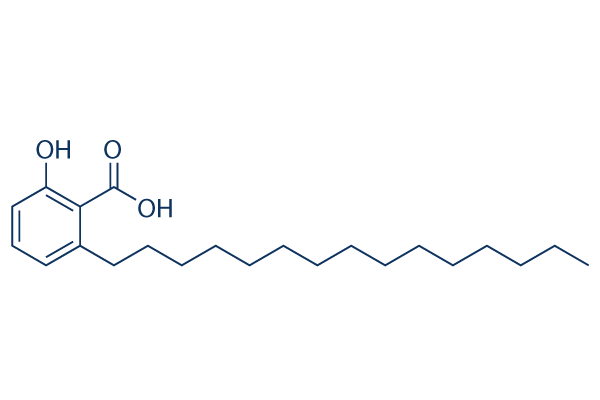
Anacardic Acid p300/CBP inhibitor
Cat.No.S7582
Quality Control
| Related Targets | HDAC JAK BET Histone Methyltransferase PKC PARP HIF PRMT EZH2 AMPK |
|---|---|
| Other p300/CBP Inhibitors | Inobrodib (CCS-1477) A-485 Curcumin (Diferuloylmethane) SGC-CBP30 CPI-637 E7386 I-CBP112 GNE-049 Histone Acetyltransferase Inhibitor II TTK21 |
Cell Culture, Treatment & Working Concentration
| Cell Lines | Assay Type | Concentration | Incubation Time | Formulation | Activity Description | PMID |
|---|---|---|---|---|---|---|
| Hi5 cells | Function assay | Non-competitive inhibition of human recombinant His-GST tagged VCP expressed in baculovirus infected Hi5 cells | ||||
| HCT116 cells | Cytotoxicity assay | 72 h | Cytotoxicity against human HCT116 cells after 72 hrs by luciferase reporter gene assay, IC50=0.38 μM | |||
| Hi5 cells | Function assay | Inhibition of human recombinant His-GST tagged VCP expressed in baculovirus infected Hi5 cells assessed as ADP formation incubated for 20 mins proir to substrate addition measured after 90 mins by NADH coupled assay, IC50=0.024 μM | ||||
| Click to View More Cell Line Experimental Data | ||||||
Solubility
|
In vitro |
DMSO
: 69 mg/mL
(197.98 mM)
Ethanol : 69 mg/mL Water : Insoluble |
Molarity Calculator
|
In vivo |
|||||
In vivo Formulation Calculator (Clear solution)
Step 1: Enter information below (Recommended: An additional animal making an allowance for loss during the experiment)
Step 2: Enter the in vivo formulation (This is only the calculator, not formulation. Please contact us first if there is no in vivo formulation at the solubility Section.)
Calculation results:
Working concentration: mg/ml;
Method for preparing DMSO master liquid: mg drug pre-dissolved in μL DMSO ( Master liquid concentration mg/mL, Please contact us first if the concentration exceeds the DMSO solubility of the batch of drug. )
Method for preparing in vivo formulation: Take μL DMSO master liquid, next addμL PEG300, mix and clarify, next addμL Tween 80, mix and clarify, next add μL ddH2O, mix and clarify.
Method for preparing in vivo formulation: Take μL DMSO master liquid, next add μL Corn oil, mix and clarify.
Note: 1. Please make sure the liquid is clear before adding the next solvent.
2. Be sure to add the solvent(s) in order. You must ensure that the solution obtained, in the previous addition, is a clear solution before proceeding to add the next solvent. Physical methods such
as vortex, ultrasound or hot water bath can be used to aid dissolving.
Chemical Information, Storage & Stability
| Molecular Weight | 348.52 | Formula | C22H36O3 |
Storage (From the date of receipt) | |
|---|---|---|---|---|---|
| CAS No. | 16611-84-0 | Download SDF | Storage of Stock Solutions |
|
|
Read more about storage stability stock solution CAS number
Mechanism of Action
| Targets/IC50/Ki |
Tip60
(Cell-free assay) PCAF
(Cell-free assay) 5 μM
p300/CBP
(Cell-free assay) 8.5 μM
|
|---|---|
| In vitro |
Anacardic acid is found to be a common inhibitor of several clinically targeted enzymes such as NFkB kinase, histone acetyltransferase (HATs), lipoxygenase (LOX-1), xanthine oxidase, tyrosinase and ureases. Anacardic acid is also an efficient inhibitor of Tip60 in vitro.It inhibits the Tip60-dependent acetylation and activation of the ATM protein kinase in HeLa cells, and sensitizes the cells to the cytotoxic effects of radiation. Anacardic acid can effectively prevent cell damage induced by H2O2 because this can be converted to ROS, hydroxyl radicals, in the presence of metal ions.
|
| Kinase Assay |
HAT and HDAC Activity Assays
|
|
After homogenization of cardiac tissues, nucleoproteins are extracted using a Nuclear Extract Kit according to the manufacturer's instructions. HAT and HDAC activities of the nuclear protein extracts are determined using a colorimetric assay included in the HAT and HDAC assay kits.
|
|
| In vivo |
Anacardic acid attenuates over-expression of Gata4, α-MHC and cTnT in fetal mouse hearts exposed to ethanol. Anacardic acid inhibits binding of P300, PCAF to the promoter of Gata4.
|
References |
|
Applications
| Methods | Biomarkers | Images | PMID |
|---|---|---|---|
| Growth inhibition assay | Cell viability |

|
30210681 |
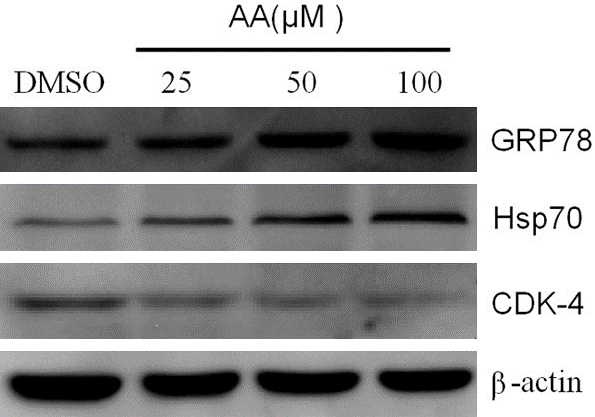
| Western blot | GRP78 / Hsp70 / CDK4 E-cadherin / Vimentin / MMP-9 ErbB2 |
|
30210681 |
Tech Support
Tel: +1-832-582-8158 Ext:3
If you have any other enquiries, please leave a message.

Products are for research use only. Not for human use. We do not sell to patients.
©Copyright 2013 Selleck Chemicals. All Rights Reserved.