
-
 Argentina
-
 Australia
-
 Austria
-
 Belgium
-
 Brazil
-
 Canada
-
 China
China
-
 Czech Republic
-
 Denmark
-
 Finland
-
 France
-
 Germany
-
 Greece
-
 Hong Kong
-
 Hungary
-
 Iceland
-
 India
India
-
 Ireland
-
 Israel
-
 Italy
Italy
-
 Japan
Japan
-
 Korea
Korea
-
 Luxembourg
-
 Malaysia
-
 Netherlands
-
 New Zealand
-
 Norway
-
 Poland
-
 Portugal
-
 Qatar
Qatar
-
 Romania
-
 Saudi Arabia
-
 Singapore
-
 Spain
Spain
-
 Sweden
-
 Switzerland
-
 Taiwan
-
 Turkey
-
 United Kingdom
-
 United States
research use only
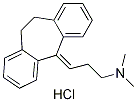
Amitriptyline HCl Serotonin Transporter inhibitor
Cat.No.S3183
Quality Control
| Related Targets | Adrenergic Receptor AChR 5-HT Receptor COX Calcium Channel Histamine Receptor Dopamine Receptor GABA Receptor TRP Channel Cholinesterase (ChE) |
|---|---|
| Other Serotonin Transporter Inhibitors | Dapoxetine |
Solubility
|
In vitro |
DMSO
: 63 mg/mL
(200.72 mM)
Ethanol : 63 mg/mL Water : 15 mg/mL |
Molarity Calculator
|
In vivo |
|||||
In vivo Formulation Calculator (Clear solution)
Step 1: Enter information below (Recommended: An additional animal making an allowance for loss during the experiment)
Step 2: Enter the in vivo formulation (This is only the calculator, not formulation. Please contact us first if there is no in vivo formulation at the solubility Section.)
Calculation results:
Working concentration: mg/ml;
Method for preparing DMSO master liquid: mg drug pre-dissolved in μL DMSO ( Master liquid concentration mg/mL, Please contact us first if the concentration exceeds the DMSO solubility of the batch of drug. )
Method for preparing in vivo formulation: Take μL DMSO master liquid, next addμL PEG300, mix and clarify, next addμL Tween 80, mix and clarify, next add μL ddH2O, mix and clarify.
Method for preparing in vivo formulation: Take μL DMSO master liquid, next add μL Corn oil, mix and clarify.
Note: 1. Please make sure the liquid is clear before adding the next solvent.
2. Be sure to add the solvent(s) in order. You must ensure that the solution obtained, in the previous addition, is a clear solution before proceeding to add the next solvent. Physical methods such
as vortex, ultrasound or hot water bath can be used to aid dissolving.
Chemical Information, Storage & Stability
| Molecular Weight | 313.86 | Formula | C20H23N.HCl |
Storage (From the date of receipt) | |
|---|---|---|---|---|---|
| CAS No. | 549-18-8 | Download SDF | Storage of Stock Solutions |
|
|
| Synonyms | N/A | SMILES | CN(C)CCC=C1C2=CC=CC=C2CCC3=CC=CC=C31.Cl | ||
Read more about storage stability stock solution CAS number SMILES
Mechanism of Action
| Targets/IC50/Ki |
Histamine Receptor H1
0.5 nM(Ki)
SERT
3.45 nM(Ki)
Histamine receptor H4
7.31 nM(Ki)
NET
13.3 nM(Ki)
5-HT2
235 nM(Ki)
Sigma 1 receptor
287 nM(Ki)
|
|---|---|
| In vitro |
Amitriptyline inhibits Forskolin-stimulated cyclic AMP accumulation with EC50 values of 16.2 μM in intact CHO/DOR cells. This compound causes a concentration-dependent stimulation of ERK1/2 and GSK-3β phosphorylation with EC50 values of 9.0 μM in CHO/DOR cells. It (15 μM) causes a stimulation of ERK1/2 phosphorylation in C6 cells. This chemical (30 μM) inhibits Forskolin-stimulated adenylyl cyclase activity and antagonizes (−)-U50,488 inhibitory effect in rat nucleus accumbens. It binds the extracellular domain of both TrkA and TrkB and promotes TrkA-TrkB receptor heterodimerization. This compound (< 500 nM) promotes TrkA autophosphorylation in primary neurons and induces neurite outgrowth in PC12 cells. It selectively protects T17 cells from apoptosis with EC50 of 50 nM. |
| In vivo |
Amitriptyline (15 mg/kg, i.p.) activates TrkA and TrkB receptors and significantly reduces kainic acid-triggered neuronal cell death in mice. This compound (15 mg/kg and 30 mg/kg, i.p.) dose-dependently decreases the immobility time in the forced swimming test (FST) of mice. This chemical (15 mg/kg, i.p.) shows a significant 24-h rhythm in the immobility time in the forced swimming test (FST) of mice. It (1 mg/kg and 3 mg/kg) significantly increases the total distance travelled of mice in novel cages. This compound (10 mg/kg p.o., twice daily) considerably attenuates the hypothermic response to 8-OHDPAT and mCPP in mice. It (10 mg/kg p.o., twice daily) significantly reduces serotonin transporter density by approximately 20% in cortex of mice. |
References |
|
Clinical Trial Information
(data from https://clinicaltrials.gov, updated on 2024-05-22)
| NCT Number | Recruitment | Conditions | Sponsor/Collaborators | Start Date | Phases |
|---|---|---|---|---|---|
| NCT06312813 | Recruiting | Rosacea |
Wright State University |
2024-02-27 | Phase 2 |
| NCT02519400 | Unknown status | Depression |
Asan Medical Center |
2015-08 | Phase 1 |
| NCT02101892 | Completed | Migraine|Preventive Treatment |
Rambam Health Care Campus|Migraine Research Foundation |
2014-04 | Not Applicable |
| NCT00516503 | Completed | Chronic Myeloproliferative Disorders|Leukemia|Lymphoma|Lymphoproliferative Disorder|Multiple Myeloma and Plasma Cell Neoplasm|Myelodysplastic Syndromes|Myelodysplastic/Myeloproliferative Neoplasms|Neurotoxicity|Pain|Unspecified Adult Solid Tumor Protocol Specific |
Alliance for Clinical Trials in Oncology|National Cancer Institute (NCI) |
2008-02 | Phase 3 |
Read more about Clinical Trials
Tech Support
Tel: +1-832-582-8158 Ext:3
If you have any other enquiries, please leave a message.

Products are for research use only. Not for human use. We do not sell to patients.
©Copyright 2013 Selleck Chemicals. All Rights Reserved.