
-
 Australia
-
 Austria
-
 Belgium
-
 Brazil
-
 Canada
-
 China
China
-
 Czech Republic
-
 Denmark
-
 Finland
-
 France
-
 Germany
-
 Greece
-
 Hong Kong
-
 Hungary
-
 Iceland
-
 India
India
-
 Ireland
-
 Israel
-
 Italy
Italy
-
 Japan
Japan
-
 Korea
Korea
-
 Luxembourg
-
 Malaysia
-
 Netherlands
-
 New Zealand
-
 Norway
-
 Poland
-
 Qatar
Qatar
-
 Romania
-
 Saudi Arabia
-
 Singapore
-
 Spain
Spain
-
 Sweden
-
 Switzerland
-
 Taiwan
-
 Turkey
-
 United Kingdom
-
 United States
research use only
Guaifenesin
Cat.No.S1740
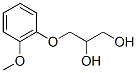
Chemical Structure
Molecular Weight: 198.22
Quality Control
Solubility
|
In vitro |
DMSO
: 40 mg/mL
(201.79 mM)
Ethanol : 40 mg/mL Water : 25 mg/mL |
Molarity Calculator
|
In vivo |
|||||
In vivo Formulation Calculator (Clear solution)
Step 1: Enter information below (Recommended: An additional animal making an allowance for loss during the experiment)
Step 2: Enter the in vivo formulation (This is only the calculator, not formulation. Please contact us first if there is no in vivo formulation at the solubility Section.)
Calculation results:
Working concentration: mg/ml;
Method for preparing DMSO master liquid: mg drug pre-dissolved in μL DMSO ( Master liquid concentration mg/mL, Please contact us first if the concentration exceeds the DMSO solubility of the batch of drug. )
Method for preparing in vivo formulation: Take μL DMSO master liquid, next addμL PEG300, mix and clarify, next addμL Tween 80, mix and clarify, next add μL ddH2O, mix and clarify.
Method for preparing in vivo formulation: Take μL DMSO master liquid, next add μL Corn oil, mix and clarify.
Note: 1. Please make sure the liquid is clear before adding the next solvent.
2. Be sure to add the solvent(s) in order. You must ensure that the solution obtained, in the previous addition, is a clear solution before proceeding to add the next solvent. Physical methods such
as vortex, ultrasound or hot water bath can be used to aid dissolving.
Chemical Information, Storage & Stability
| Molecular Weight | 198.22 | Formula | C10H14O4 |
Storage (From the date of receipt) | |
|---|---|---|---|---|---|
| CAS No. | 93-14-1 | Download SDF | Storage of Stock Solutions |
|
|
| Synonyms | N/A | Smiles | COC1=CC=CC=C1OCC(CO)O | ||
Mechanism of Action
| In vivo |
Guaifenesin (200 mg/kg, intravenously) combined with ketamine (50 mg/kg, intramuscularly) produces effective and safe surgical anesthesia for over 30 minutes in New Zealand white rabbits. This compound (200 mg/kg, intravenously) combined with ketamine (50 mg/kg, intramuscularly) mildly depresses respiratory rate but heart rate and arterial blood pressure are not significantly affected. It (200 mg/kg, intravenously) is combined with sodium pentobarbital (20 mg/kg, intravenously) to produce surgical anesthesia for a period of more than 30 minutes. This chemical (50 mg/mL) combined Xylazine (0.1 mg/mL) and Ketamine (1.0 mg/mL) results in excellent anesthetic induction and maintenance with cardiopulmonary alterations similar to those associated with isoflurane in mechanically ventilated calves. It (150 mg/kg) decreases spectral edge frequency (SEF) and total power in pigs. This compound prevents adverse anesthetic induction events caused by Propofol in horse. It (90 mg/kg) followed by Propofol (3 mg/kg) should be sufficient to immobilize > 99% of calm healthy adult horses. This chemical (100 mg/kg) produces moderate behavioral changes in the social conflict test in mice. It (200 mg/kg) combined with Paracetamol (200 mg/kg) causes significantly more pronounced analgesic effects that the corresponding doses of paracetamol alone in mice.
|
References |
|
|---|
Clinical Trial Information
(data from https://clinicaltrials.gov, updated on 2024-05-22)
| NCT Number | Recruitment | Conditions | Sponsor/Collaborators | Start Date | Phases |
|---|---|---|---|---|---|
| NCT03642262 | Completed | Healthy Subjects |
Reckitt Benckiser Inc.|Reckitt Benckiser LLC |
June 2 2013 | Phase 1 |
| NCT03649750 | Completed | Healthy Subjects |
Reckitt Benckiser LLC |
May 29 2013 | Phase 1 |
| NCT03633487 | Completed | Healthy Subjects |
Reckitt Benckiser LLC |
October 11 2011 | Phase 1 |
Tech Support
Tel: +1-832-582-8158 Ext:3
If you have any other enquiries, please leave a message.

Products are for research use only. Not for human use. We do not sell to patients.
©Copyright 2013 Selleck Chemicals. All Rights Reserved.