
-
 Australia
-
 Austria
-
 Belgium
-
 Brazil
-
 Canada
-
 China
China
-
 Czech Republic
-
 Denmark
-
 Finland
-
 France
-
 Germany
-
 Greece
-
 Hong Kong
-
 Hungary
-
 Iceland
-
 India
India
-
 Ireland
-
 Israel
-
 Italy
Italy
-
 Japan
Japan
-
 Korea
Korea
-
 Luxembourg
-
 Malaysia
-
 Netherlands
-
 New Zealand
-
 Norway
-
 Poland
-
 Qatar
Qatar
-
 Romania
-
 Saudi Arabia
-
 Singapore
-
 Spain
Spain
-
 Sweden
-
 Switzerland
-
 Taiwan
-
 Turkey
-
 United Kingdom
-
 United States
research use only
Zinc Pyrithione Proton Pump inhibitor
Cat.No.S4075
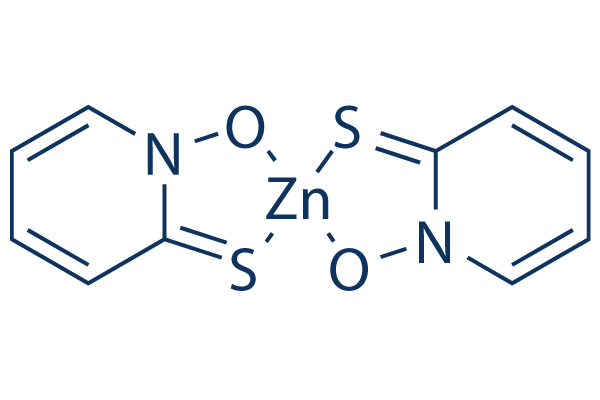
Chemical Structure
Molecular Weight: 317.7
Quality Control
| Related Targets | CFTR CRM1 CD markers AChR Calcium Channel Sodium Channel Potassium Channel GABA Receptor TRP Channel ATPase |
|---|---|
| Other Proton Pump Inhibitors | Bafilomycin A1 (Baf-A1) Ilaprazole Tenatoprazole Ilaprazole sodium Revaprazan Hydrochloride PF-3716556 Ufiprazole |
Solubility
|
In vitro |
DMSO
: 30 mg/mL
(94.42 mM)
Water : Insoluble Ethanol : Insoluble |
Molarity Calculator
|
In vivo |
|||||
In vivo Formulation Calculator (Clear solution)
Step 1: Enter information below (Recommended: An additional animal making an allowance for loss during the experiment)
Step 2: Enter the in vivo formulation (This is only the calculator, not formulation. Please contact us first if there is no in vivo formulation at the solubility Section.)
Calculation results:
Working concentration: mg/ml;
Method for preparing DMSO master liquid: mg drug pre-dissolved in μL DMSO ( Master liquid concentration mg/mL, Please contact us first if the concentration exceeds the DMSO solubility of the batch of drug. )
Method for preparing in vivo formulation: Take μL DMSO master liquid, next addμL PEG300, mix and clarify, next addμL Tween 80, mix and clarify, next add μL ddH2O, mix and clarify.
Method for preparing in vivo formulation: Take μL DMSO master liquid, next add μL Corn oil, mix and clarify.
Note: 1. Please make sure the liquid is clear before adding the next solvent.
2. Be sure to add the solvent(s) in order. You must ensure that the solution obtained, in the previous addition, is a clear solution before proceeding to add the next solvent. Physical methods such
as vortex, ultrasound or hot water bath can be used to aid dissolving.
Chemical Information, Storage & Stability
| Molecular Weight | 317.7 | Formula | C10H8N2O2S2Zn |
Storage (From the date of receipt) | |
|---|---|---|---|---|---|
| CAS No. | 13463-41-7 | Download SDF | Storage of Stock Solutions |
|
|
| Synonyms | OM-1563 | Smiles | C1=CC=[N+](C(=C1)[S-])[O-].C1=CC=[N+](C(=C1)[S-])[O-].[Zn+2] | ||
Mechanism of Action
| Targets/IC50/Ki |
Proton pump
|
|---|---|
| In vitro |
Zinc pyrithione is considered as a coordination complex of zinc. The pyrithione ligands, which are formally monoanions, are chelated to Zn 2+ via oxygen and sulfur centers. In the crystalline state, zinc pyrithione exists as a centrosymmetric dimer, where each zinc is bonded to two sulfur and three oxygen centers. In solution, however, the dimers dissociate via scission of one Zn-O bond. Zinc pyrithione, which is a dimer but is probably biologically active as a monomer, induces plasma membrane depolarization with half-maximal effect (K1/2) of about 0.3 mM. Zinc pyrithione is an unusual synthetic potentiator that potently activates both heterologous and native M channels by inducing channel opening at the resting potential.
|
| In vivo |
Zinc pyrithione rapidly accumulated in the tissues of the exposed mussels, proportionately to both exposure concentration and time. Even though the 7-d median lethal concentration (LC50) = 8.27 μM established here appears high with respect to reported ZnPT environmental concentrations, the results indicate that this biocide could represent a threat for marine organisms in coastal environments and that further investigations on its biological effects at sublethal doses are needed.
|
References |
|
Tech Support
Tel: +1-832-582-8158 Ext:3
If you have any other enquiries, please leave a message.
Signaling Pathway Map

Products are for research use only. Not for human use. We do not sell to patients.
©Copyright 2013 Selleck Chemicals. All Rights Reserved.