
-
 Australia
-
 Austria
-
 Belgium
-
 Brazil
-
 Canada
-
 China
China
-
 Czech Republic
-
 Denmark
-
 Finland
-
 France
-
 Germany
-
 Greece
-
 Hong Kong
-
 Hungary
-
 Iceland
-
 India
India
-
 Ireland
-
 Israel
-
 Italy
Italy
-
 Japan
Japan
-
 Korea
Korea
-
 Luxembourg
-
 Malaysia
-
 Netherlands
-
 New Zealand
-
 Norway
-
 Poland
-
 Qatar
Qatar
-
 Romania
-
 Saudi Arabia
-
 Singapore
-
 Spain
Spain
-
 Sweden
-
 Switzerland
-
 Taiwan
-
 Turkey
-
 United Kingdom
-
 United States
research use only
Bacitracin Selection Antibiotics for Transfected Cell inhibitor
Cat.No.S4146
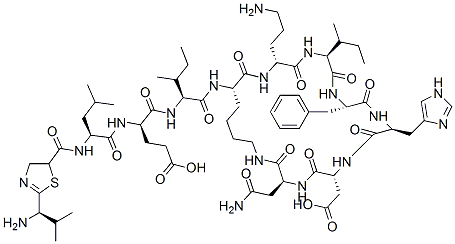
Chemical Structure
Molecular Weight: 1408.67
Quality Control
| Related Targets | Integrase Bacterial Antibiotics Anti-infection Fungal Antiviral COVID-19 Parasite Reverse Transcriptase HIV |
|---|---|
| Other Selection Antibiotics for Transfected Cell Inhibitors | Blasticidin S Hydrochloride Ribostamycin Sulfate D-Cycloserine |
Molarity Calculator
|
In vivo |
|||||
In vivo Formulation Calculator (Clear solution)
Step 1: Enter information below (Recommended: An additional animal making an allowance for loss during the experiment)
Step 2: Enter the in vivo formulation (This is only the calculator, not formulation. Please contact us first if there is no in vivo formulation at the solubility Section.)
Calculation results:
Working concentration: mg/ml;
Method for preparing DMSO master liquid: mg drug pre-dissolved in μL DMSO ( Master liquid concentration mg/mL, Please contact us first if the concentration exceeds the DMSO solubility of the batch of drug. )
Method for preparing in vivo formulation: Take μL DMSO master liquid, next addμL PEG300, mix and clarify, next addμL Tween 80, mix and clarify, next add μL ddH2O, mix and clarify.
Method for preparing in vivo formulation: Take μL DMSO master liquid, next add μL Corn oil, mix and clarify.
Note: 1. Please make sure the liquid is clear before adding the next solvent.
2. Be sure to add the solvent(s) in order. You must ensure that the solution obtained, in the previous addition, is a clear solution before proceeding to add the next solvent. Physical methods such
as vortex, ultrasound or hot water bath can be used to aid dissolving.
Chemical Information, Storage & Stability
| Molecular Weight | 1408.67 | Formula | C65H101N17O16S |
Storage (From the date of receipt) | |
|---|---|---|---|---|---|
| CAS No. | 1405-87-4 | Download SDF | Storage of Stock Solutions |
|
|
| Synonyms | N/A | Smiles | CCC(C)C1C(=O)NC(C(=O)NC(C(=O)NC(C(=O)NC(C(=O)NCCCCC(C(=O)NC(C(=O)N1)CCCN)NC(=O)C(C(C)CC)NC(=O)C(CCC(=O)O)NC(=O)C(CC(C)C)NC(=O)C2CSC(=N2)C(C(C)CC)N)CC(=O)N)CC(=O)O)CC3=CN=CN3)CC4=CC=CC=C4 | ||
Mechanism of Action
| In vitro |
Bacitracin is a potent antibiotic against gram-positive cocci, staphlococci, streptococci, corynebacteria, Treponema pallidum, T. vincenti, Actinomyces israeli, anaerobic cocci, clostridia, neisseria, most gonococci and meingococci, but it is relatively ineffective against most other gram-negative bacteria. Archaebacteria is also sensitive to this compound. Of this group, Methanobacterium arbophilicum, M. M.O.H., M. O.H.G. and M. formicium showed inhibition by this antibiotic while Methanospirilum and Methanosarcina are insensitive to it. This compound affects a number of biochemical processes in bacteria, including metal ion transport, peptidoglycan synthesis, membrane permeability, and biosynthesis of inducible enzymes. Many of the biological properties of this chemical can be attributed to its high affinity for polyisoprenyl pyrophosphates. Aside from the antibiotic activity of the Bacitracins, these peptides have proven useful as a tool for investigating lipid-protein interactions at the molecular level.
It is also a known inhibitor of insulin degradation by both isolated cells and subcellular organelles, which inhibits the ability of purified glutathione-insulin transhydrogenase to split insulin into its constituent A and B chains. At concentrations of 90 and 300μM, this compound inhibits 50 and 90%, respectively, of the degrading activity of the purified enzyme. Similarly, degradation by crude liver lysates is inhibited 50 and 90% by 70 and 250 μM of this chemical, respectively. It decreases both the Vmax and affinity of the enzyme for insulin.
This agent is able to inhibit the reductive function of the plasma membrane by against protein disulfide-isomerase. It is able to induce inhibition of the cleavage of a disulfide-linked iodotyramine/poly(D-lysine) conjugate which bounds nonspecifically to the surface of CHO cells. It also inhibits the cytotoxicity of diphtheria toxin, adisulfide-linked heterodimer that binds to a specific surface receptor and must undergo chain separation to exert its cytotoxicity.
|
References |
|
|---|
Tech Support
Tel: +1-832-582-8158 Ext:3
If you have any other enquiries, please leave a message.

Products are for research use only. Not for human use. We do not sell to patients.
©Copyright 2013 Selleck Chemicals. All Rights Reserved.