
Why is Tamoxifen causing pregnancy loss during Cre-ERT2 embryonic lineage tracing in female mice?
Quick Answer
Recommended ApproachTo prevent pregnancy loss during embryonic lineage tracing, co-administer exogenous progesterone to maintain uterine quiescence, titrate tamoxifen to the minimum effective dose, avoid administration during the hypersensitive early gastrulation window (E6.5–E7.5), and consider refined voluntary oral delivery or whole-embryo culture.
Common CausesTamoxifen acts as a selective estrogen receptor modulator that competitively inhibits maternal estrogen receptor signaling, inducing luteal regression, catastrophic progesterone withdrawal, and myometrial contractions, while directly exerting developmental toxicity on developing embryos.
How Should It Be Done Correctly?
Parameter Optimization for Gestational Lineage Tracing
| Operational Parameter | Recommended Specification | Experimental Rationale |
|---|---|---|
| Endocrine Rescue Agent | Progesterone co-administration (subcutaneous or intraperitoneal) | Counteracts luteolysis and maintains myometrial quiescence [1] |
| Gestational Timing | E8.5 or later (avoiding E6.5–E7.5) | Bypasses peak developmental lethality and structural sensitivity [2] |
| In Vivo Dosing | Lowest titrated pulse yielding sufficient reporter excision | Prevents maternal distress and pup non-viability [2, 3] |
| In Vitro Alternative | Whole-embryo culture with 4-hydroxytamoxifen (4-OHT) | Completely circumvents maternal pregnancy complications [2] |
| Dosing Administration | Pipette feeding or stress-minimized oral gavage | Reduces physical handling trauma relative to repeated injection [2, 3] |
Step-by-Step Gestational Induction and Rescue Protocol
- Timed Mating and Gestational Staging: Pair mature Cre-ERT2 driver mice with conditional reporter or floxed females overnight. Check for vaginal plugs at 07:00–08:00; noon of the day a plug is identified is defined as embryonic day 0.5 (E0.5). Schedule tamoxifen pulses for developmental stages after neural tube initiation (≥E8.5) whenever experimental aims allow [2].
- Hormonal Rescue Preparation: Because tamoxifen disrupts maternal progesterone maintenance, prepare progesterone in sterile sesame or corn oil alongside the tamoxifen vehicle. Dissolve tamoxifen in vehicle (e.g., peanut oil or corn oil) with gentle heating (55–60°C) and light protection [2, 4].
- Refined Administration and Co-treatment: Administer tamoxifen via voluntary pipette feeding to minimize animal restraint stress [2]. Administer exogenous progesterone simultaneously to sustain corpus luteum function and prevent fetal loss [1]. If using intraperitoneal injections, use a fresh sterile needle for every dam to avoid uterine irritation or infection.
- Post-Dosing Monitoring and Labor Management: Inspect treated dams twice daily for vaginal bleeding, hunched posture, lethargy, or loss of body condition, which frequently precede resorption or dystocia [1, 3]. If the experiment requires viable postnatal pups, prepare for Caesarean delivery (C-section) at E19.5 followed by cross-fostering with synchronized surrogate wild-type mothers, as tamoxifen induces severe labor abnormalities and stillbirth [3].
- Ex Vivo Alternative for Early Stages: When recombination must occur during gastrulation (E6.5–E7.5), harvest embryos and maintain them in rotating whole-embryo culture bottles exposed briefly to 4-OHT rather than dosing the pregnant dam directly [2].
What Went Wrong?
Copy code to add this image to your page Copy Code
Unmitigated High-Dose Tamoxifen Administration
A standard protocol often involves administering high doses of tamoxifen (e.g., repeated maternal intraperitoneal injections of >3 mg/dam or >100–200 mg/kg) without hormonal rescue to ensure efficient genomic recombination in target embryos [3, 4]. Furthermore, researchers frequently administer these treatments during early post-implantation or gastrulation windows (E6.5–E7.5) without anticipating that pregnancy maintenance is acutely dependent on delicate endocrine feedback [1, 2].
Luteal Collapse, Uterine Contraction, and Direct Embryotoxicity
Administering tamoxifen without concurrent progesterone supplementation produces maternal systemic toxicity, fetal resorption, abortion, or failure of labor progression [1, 3]. In pregnant mice, high-dose tamoxifen exposure triggers maternal distress 5–7 days post-injection [1], extensive embryonic resorption, pericardial edema, neural tube defects, and structural limb or craniofacial malformations [2, 4]. In late gestation, tamoxifen impairs normal myometrial contractility and labor dynamics, resulting in premature delivery or stillbirth [3].
Molecular Mechanism of SERM-Mediated Pregnancy Termination
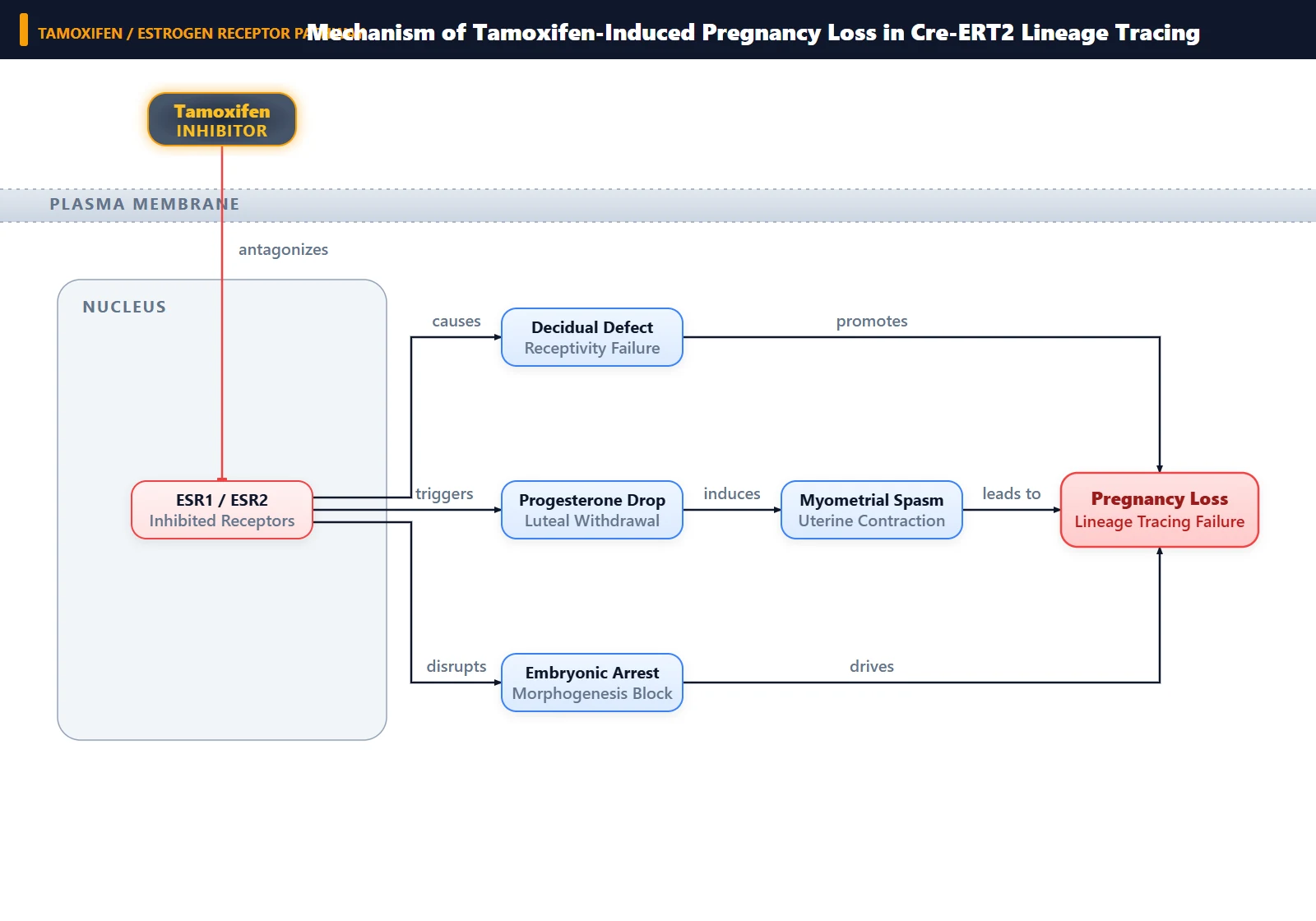
Tamoxifen is a non-steroidal selective estrogen receptor modulator (SERM) that acts as a competitive antagonist of estrogen receptor alpha (ESR1) and beta (ESR2) in rodent reproductive tissues.
In pregnant rodents, embryonic implantation and maintenance of pregnancy require a continuous, tightly regulated balance between estrogen and progesterone. Estrogen signaling through ESR1 in the maternal ovary and endometrium supports the survival of the corpus luteum, which synthesizes progesterone to maintain uterine decidualization and uterine quiescence. When tamoxifen competitively occupies ESR1, it disrupts this trophic feedback loop, resulting in functional luteolysis and a sharp drop in serum progesterone levels [1]. The resulting progesterone withdrawal destabilizes the decidual-placental interface, unleashes premature myometrial prostaglandin synthesis, and stimulates uterine contractions that lead to embryo expulsion or resorption [1, 3].
Simultaneously, tamoxifen and its active metabolites (such as 4-hydroxytamoxifen and N-desmethyltamoxifen) cross the placenta and directly disrupt estrogen-dependent developmental cascades in embryonic tissues [3]. During early organogenesis (E7.5–E9.5), this exposure causes severe morphogenetic disruptions, cellular arrest, cardiovascular failure, and pericardial edema, rendering embryos non-viable independently of maternal distress [2, 4].
How Can I Avoid This in Future Experiments?
To prevent pregnancy loss in future Cre-ERT2 lineage tracing cohorts, always establish the lowest effective tamoxifen dose through reporter calibration before embarking on large experimental groups [2, 3]. Incorporate progesterone supplementation as a standard co-treatment whenever in vivo maternal dosing is required, particularly for mid-gestation experiments [1]. For experiments investigating critical early-lineage decisions (prior to E8.0), transition to whole-embryo ex vivo culture or consider constitutively active driver lines and ultrasound-guided localized recombinase microinjection (such as TAT-Cre) to avoid systemic endocrine toxicity completely [2].
References
- [1]Ved N, et al. Laboratory animals. 2019 Dec;53(6):630-633.[IF: 1.495]
- [2]Savery D, et al. Birth defects research. 2020 Jan;112(2):196-204.[IF: 2.344]
- [3]Ilchuk LA, et al. International journal of molecular sciences. 2022 Nov;23(22).[IF: 5.6]
- [4]Miranda R. Sun, Austin C. Steward, Emma A. Sweet, Alexander A. Martin, Robert J. Lipinski, et al. PloS one..