
Why did light-exposed Tamoxifen stock solutions lose potency in my ER-positive cell proliferation assay?
Quick Answer
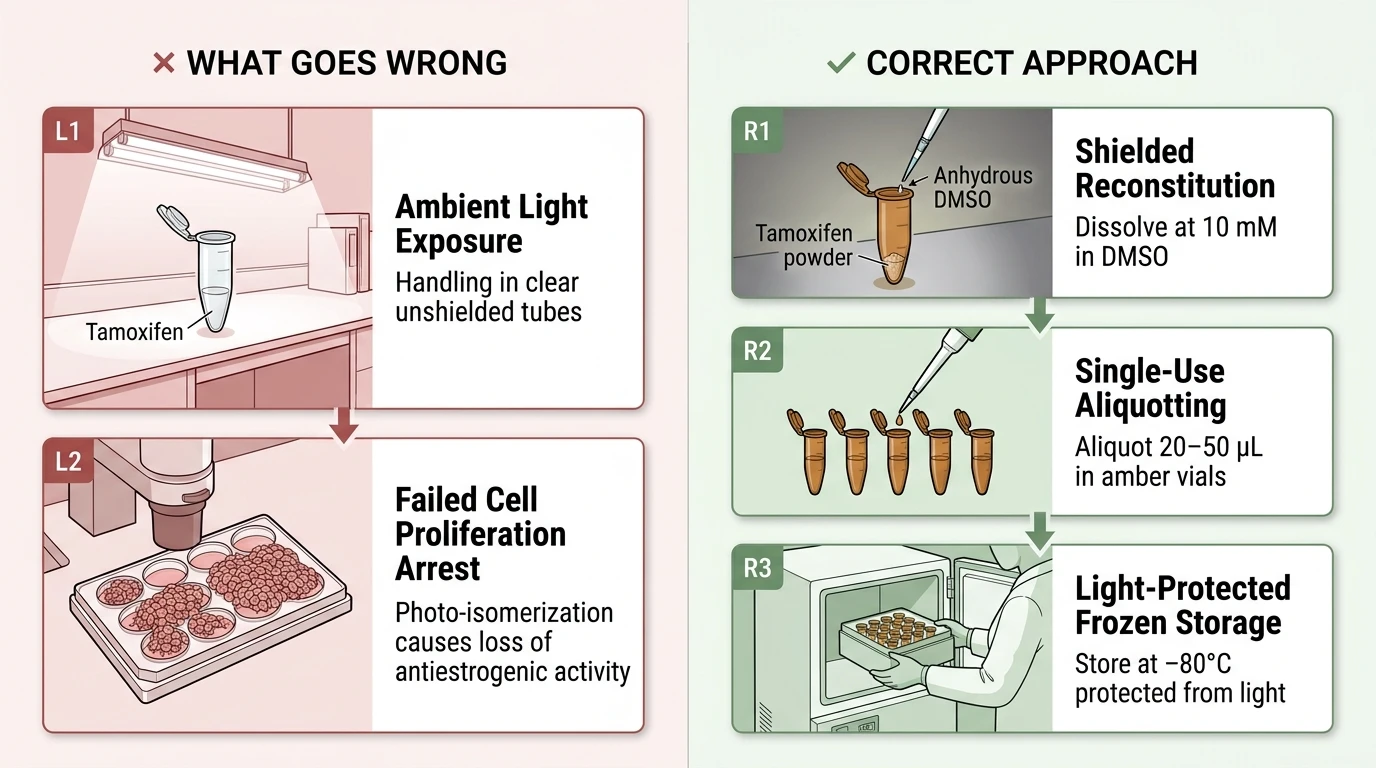
Recommended ApproachDissolve Tamoxifen at 10 mM in anhydrous DMSO within amber or foil-wrapped vials, aliquot into single-use volumes, and store protected from light at -80°C for up to 1 year or -20°C for up to 1 month.
Common CausesExposing Tamoxifen stock solutions to ambient light triggered photochemical geometric isomerization and degradation, converting active antiestrogenic (Z)-tamoxifen into the weakly active (E)-isomer and photoproducts that fail to antagonize estrogen receptor-alpha.
How Should It Be Done Correctly?
Copy code to add this image to your page Copy Code
Optimized Stock Formulation and Light-Protection Parameters
To ensure consistent receptor engagement and antiproliferative efficacy in estrogen receptor-positive (ER+) cell culture assays, Tamoxifen stocks must be prepared in high-grade anhydrous solvent and strictly protected from actinic light at every operational phase.
Standardized Light-Shielded Reconstitution and Dosing Protocol
- Environment Setup and Weighing: Minimize ambient lighting in the laboratory by turning off direct overhead fluorescent lamps or working in a dedicated biosafety cabinet with illumination turned down or yellow-filtered [Source: ResearchGate]. Accurately weigh solid Tamoxifen powder (MW 371.51) and transfer into an amber or aluminum foil-wrapped tube.
- Solubilization: Add high-purity anhydrous DMSO to achieve the recommended 10 mM stock concentration (3.7151 mg powder per 1 mL DMSO). Vortex thoroughly for 30–60 seconds until the solution is completely clear and free of particulate matter. Tamoxifen exhibits robust DMSO solubility up to 74 mg/mL, making 10 mM readily achievable without aggressive sonication or excessive heating.
- Aliquotting and Long-Term Storage: Rapidly dispense the 10 mM stock into single-use working aliquots (e.g., 20–50 µL) in amber tubes or black microcentrifuge tubes. Purge the headspace with inert gas (nitrogen or argon) if available, seal tightly, and transfer immediately to -80°C for storage up to 1 year, or -20°C for up to 1 month. Avoid repeated freeze-thaw cycles, which introduce atmospheric moisture into hygroscopic DMSO.
- Assay Plate Dosing: On the day of the antiproliferative assay (e.g., MTS, MTT, or direct cell counting), thaw an aliquot protected from light at room temperature for 10–15 minutes. Prepare an intermediate dilution in pre-warmed (37°C) culture medium immediately before administration to ensure the compound does not precipitate upon entering the aqueous phase. Keep the drug-containing medium shielded from light while dosing cells [1, 2].
| Parameter | Recommended Specification | Functional Rationale |
|---|---|---|
| Stock Concentration | 10 mM in DMSO (3.7151 mg/mL) | Maximizes solution stability while minimizing vehicle solvent toxicity (final DMSO ≤ 0.1% v/v in culture) |
| Vehicle Solvent | Anhydrous DMSO (max solubility 74 mg/mL) | Ensures complete solubility; ethanol (74 mg/mL) is an alternative, whereas water is insoluble (<1 mg/mL) |
| Stock Container | Amber microcentrifuge tubes or foil-wrapped polypropylene tubes | Blocks ultraviolet and short-wavelength visible light that catalyzes double-bond isomerization |
| Storage Condition (-80°C) | -80°C, light-sealed, rated shelf life 1 year | Long-term archive preventing thermal degradation and solvent sublimation |
| Storage Condition (-20°C) | -20°C, light-sealed, rated shelf life 1 month | Short-term working storage; limits moisture condensation and chemical shifts |
| Aliquot Volume | 20–50 µL single-use aliquots | Eliminates repeated freeze-thaw cycles and frequent room-light re-exposure |
| Dosing Dilution | Dilute directly into pre-warmed culture medium immediately before assay | Prevents sub-micron precipitation in aqueous medium prior to cell dosing |
What Went Wrong?
Unshielded Handling and Storage in Transparent Consumables
The primary procedural error was the preparation, dilution, or storage of Tamoxifen stock solutions in clear, non-opaque plastic or glass containers exposed to ambient light (natural sunlight or laboratory fluorescent lighting) on the benchtop or inside cold rooms. Unlike stable aliphatic compounds, triphenylethylene derivatives are photosensitive and prone to photo-induced rearrangement when left unshielded.
Loss of Receptor Antagonism and Elevated Proliferative Readouts
Tamoxifen exerts its antiproliferative effect in ER-positive breast carcinoma cell models (such as MCF-7 or T47D) by binding competitively to ER-alpha (ERα), actively displacing helix 12 (H12) from the hormone-binding pocket, disrupting coactivator recruitment, downregulating cell-cycle drivers (such as Cyclin D1 and phospho-Rb), and arresting cells in the G1 phase [1, 2, 3, 4]. When Tamoxifen stock solutions undergo light-induced conversion, the effective concentration of intact antiestrogenic Tamoxifen drops precipitously. The compromised ligand mix exhibits markedly reduced affinity for ERα and fails to downregulate estrogenic signaling markers (such as pS2, GREB1, and PGR) or arrest proliferation [1, 2, 4, 5]. Consequently, the ER-positive cells continue to proliferate under standard media conditions, resulting in an apparent loss of drug potency and elevated cell viability.
Photochemical Isomerization and Photocyclization Mechanisms
Tamoxifen is clinically and pharmacologically formulated as the (Z)-isomer (trans-conformation relative to the two key aromatic rings), which possesses potent estrogen-antagonistic properties in breast tissue. Molecular modeling shows that (Z)-tamoxifen binds within the ERα ligand-binding domain such that its bulky dimethylaminoethoxy side chain physically protrudes from the binding cavity, preventing the H12 helix from sealing over the pocket into an active transcription-activating conformation [2].
Upon exposure to near-ultraviolet or visible light, the central carbon-carbon double bond of the stilbene-like triphenylethylene core absorbs photons and undergoes reversible photo-isomerization, reaching a photostationary state with its geometric (E)-isomer. The resulting (E)-tamoxifen possesses an inverted spatial orientation where the dimethylaminoethoxy side chain no longer correctly displaces helix 12. Consequently, (E)-tamoxifen exhibits weak partial or pure estrogen receptor agonist activity rather than robust antagonism [2]. Furthermore, prolonged photolysis promotes irreversible photocyclization into phenanthrene-like polycyclic aromatic photoproducts. These degradation products lack high-affinity binding to ERα, causing an almost complete failure to suppress ER-driven proliferation in hormone-sensitive cells [1, 2, 4].
How Can I Avoid This in Future Experiments?
To prevent photolytic loss of potency, standardize light-protection measures across your entire experimental workflow. Always enclose clear stock tubes in multiple layers of aluminum foil if amber microcentrifuge tubes are unavailable. During pipetting, serial dilution, and media formulation, extinguish overhead laminar flow hood lights and use indirect room illumination.
Additionally, prepare stock solutions strictly at 10 mM in anhydrous DMSO, store them divided into small single-use aliquots at -80°C (stable for 1 year) or -20°C (stable for 1 month), and discard any thawed aliquot rather than re-freezing it [Source: r/labrats]. When conducting proliferation or viability assays across multiple days, ensure incubator door openings are minimized or use black-walled cell culture plates with opaque lids to safeguard the dosing media throughout the incubation period [1, 2, 4].
References
- [1]Liu M, et al. BMC complementary and alternative medicine. 2013 Jan;13:11.[IF: 1.877]
- [2]Rossini E, et al. Biomedicines. 2021 Jun;9(6).[IF: 4.757]
- [3]Rossini E, et al. Frontiers in endocrinology. 2021 Jan;12:669426.[IF: 6.055]
- [4]Zhang J, et al. Cancer biology & medicine. 2018 Feb;15(1):29-38.[IF: 4.467]
- [5]Yang H, et al. Frontiers in oncology. 2021 Jan;11:638751.[IF: 5.738]