
Why are Cre-ERT2 mice dying of acute gastric toxicity following daily 100 mg/kg Tamoxifen gavages?
Quick Answer
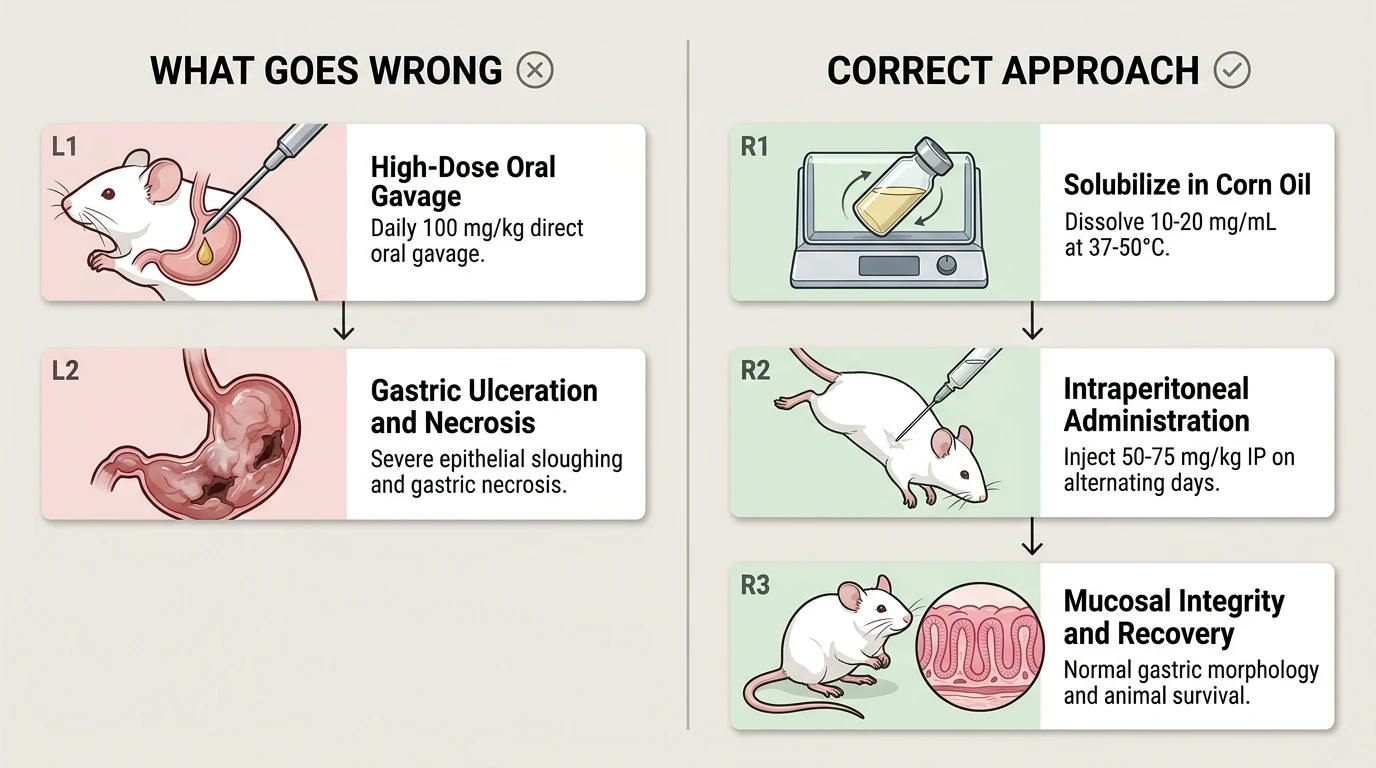
Recommended ApproachSwitch from high-dose daily oral gavage to intraperitoneal injections of 50–75 mg/kg tamoxifen in corn oil administered on alternating days or for a limited 5-day cycle to bypass direct gastric mucosal contact while controlling Cre-ERT2 nuclear translocation.
Common CausesAdministering daily 100 mg/kg oral gavages causes severe direct chemical irritation and parietal cell necrosis in the stomach lining, which is compounded by Cre-ERT2-mediated off-target genomic double-strand breaks that deplete rapidly dividing gastric progenitor cells and prevent mucosal regeneration.
How Should It Be Done Correctly?
Copy code to add this image to your page Copy Code
Recommended Dosing Regimens and Physiological Impact
Comparison of tamoxifen administration parameters, gastric exposure, Cre-ERT2 off-target burden, and animal survival outcomes in mice.
- Tamoxifen working solutions for in vivo administration are typically prepared at 10–20 mg/mL in sterile corn oil [1, 2].
- To ensure full solubilization without precipitation, tamoxifen powder can first be wetted in a small volume of 100% ethanol (up to 5–10% final volume) prior to adding warm corn oil [2, 3].
Step-by-Step Induction Protocol and Protective Handling
-
Reagent Preparation and Solubilization: Weigh tamoxifen powder and suspend in sterile corn oil to a working concentration of 10–20 mg/mL [2]. Agitate the mixture at 37–50°C in a light-protected container on a shaker or rotating wheel until the compound is completely dissolved into a clear, amber-yellow solution without visible suspended particles [2, 3]. Prepare fresh or store single-use working aliquots light-protected at 4°C for up to 1 week or at -20°C for up to 1 month.
-
Route Selection and Injection Technique: Administer tamoxifen via the intraperitoneal (IP) route rather than oral gavage to eliminate direct contact between high-concentration tamoxifen boluses and the gastric mucosa [1, 3]. Use a 27G or 29G needle, delivering the oil solution into the lower left or right abdominal quadrant while holding the mouse in a slight head-down tilt to avoid cecal or visceral perforation.
-
Dose Optimization and Staggered Scheduling: Limit the adult mouse dosage to 50–75 mg/kg body weight per injection (typically 1.0–1.5 mg per adult 20–25 g mouse) [1, 2, 4]. Adopt an alternating schedule (e.g., injections on days 1, 3, and 5) or a 5-consecutive-day schedule followed by a mandatory wash-out period [1, 2]. Staggering administrations prevents continuous peak serum concentrations and allows tissue recovery [1, 4].
-
Post-Dosing Monitoring and Humane Endpoints: Track individual animal body weights daily throughout the induction window and for 10 days post-treatment [1, 2, 4]. Provide thermal support, gel-based hydration packs, and softened food on the cage floor during the acute induction phase. If any mouse displays sustained weight loss exceeding 15–20%, lethargy, or abdominal rigidity, suspend dosing immediately [1].
| Parameter | Toxic Oral Gavage Protocol | Recommended Intraperitoneal (IP) Protocol | Optimized Low-Dose Oral Protocol |
|---|---|---|---|
| Daily Dosage | 100 mg/kg (~2.0–2.5 mg/mouse) | 40–75 mg/kg (~1.0–1.5 mg/mouse) | 40–50 mg/kg (~1.0 mg/mouse) |
| Administration Route | Daily intragastric gavage | Intraperitoneal (IP) injection | Oral gavage with plastic tip |
| Dosing Schedule | 5–7 consecutive days (no rest) | Every other day for 3 doses or 5 days | Alternating days (e.g., days 1, 3, 5) |
| Vehicle Matrix | High-concentration oil suspension | Corn oil or sunflower oil (10–20 mg/mL) | Corn oil (10 mg/mL, warmed) |
| Gastric Mucosal Exposure | Direct high-concentration bolus | None (absorbed via peritoneal cavity) | Moderate, intermittent bolus |
| Cre-ERT2 Off-Target DSBs | Severe (excessive nuclear translocation) | Low to moderate (dose-dependent) | Controlled and transient |
| Expected Animal Outcome | Severe weight loss, gastric necrosis, death | Transient weight drop, full recovery | Good tolerance, high survival |
What Went Wrong?
Excessive Dosing and Direct Oral Administration
The protocol employed a daily gavage of 100 mg/kg, which is an excessive dose that delivers approximately 2.0 to 2.5 mg of concentrated, lipophilic tamoxifen directly into the murine gastric lumen every 24 hours without recovery intervals. Tamoxifen is poorly soluble in aqueous media and was delivered as a concentrated oily bolus. This chronic high-dose gavage directly exposes the delicate gastric mucosa to massive local drug concentrations [1, 3].
Severe Mucosal Chemical Sloughing and Gastric Hypomotility
At high luminal concentrations, tamoxifen exerts severe, direct cytotoxicity on the gastric epithelium. Because tamoxifen is a weakly basic, highly lipophilic molecule, it acts as a lysosomotropic and membranolytic agent in epithelial cells, triggering rapid mitochondrial uncoupling, acute cellular swelling, and parietal cell necrosis. Concurrently, high-dose tamoxifen and its metabolites exert off-target inhibitory actions on gastrointestinal smooth muscle motility, causing profound pylorospasm and delayed gastric emptying. The stagnant, acidic gastric contents combined with the unabsorbed oily drug pool cause extensive mucosal erosion, mucosal sloughing, and acute gastric dilation/impaction, leaving the stomach wall severely thinned and vulnerable to transmural ulceration.
Cre-ERT2-Induced Genotoxicity in Regenerative Gastric Progenitors
In standard wild-type mice, the gastric epithelium can partially compensate for chemical irritation through rapid stem cell proliferation. However, in Cre-ERT2 transgenic mice, the systemic surge of tamoxifen drives high levels of Cre-ERT2 fusion protein out of the cytoplasm and into the nucleus [4, 5]. Once inside the nucleus, excessive Cre recombinase exhibits off-target endonuclease activity by recognizing and cleaving cryptic pseudo-loxP sites naturally present across the mammalian genome [4, 5].
This illegitimate cleavage produces extensive DNA double-strand breaks (DSBs), triggering p53 activation, cell-cycle arrest, and widespread apoptosis [4, 5]. Because the stem and progenitor cells residing in the gastric isthmus and neck regions have a very high basal turnover rate, they are exquisitely vulnerable to this Cre-mediated genotoxicity [4]. The ablation of dividing progenitor cells completely paralyzes the regenerative machinery of the gastric mucosa. Unable to replace the chemically damaged parietal and surface mucus cells, the stomach undergoes acute ulceration, necrosis, sepsis, and animal death within days [1, 4].
How Can I Avoid This in Future Experiments?
To prevent acute gastric toxicity in future cohorts, always perform a preliminary pilot dose-titration in your specific Cre-ERT2 strain. Recombination efficiency and Cre-mediated toxicity vary substantially depending on the driving promoter and locus; ubiquitous promoters (such as Rosa26 or CAG) and lines with high basal recombinase expression require lower tamoxifen exposures (e.g., 25–50 mg/kg) to achieve complete recombination without crossing the off-target genotoxic threshold [1, 4].
Always incorporate a Cre-ERT2-positive, vehicle-only control group and a Cre-negative, tamoxifen-treated control group into your study design [2, 4]. This setup isolates direct drug-related chemical toxicity from Cre-dependent genotoxic effects. If oral administration is strictly required for your scientific model, use flexible plastic gavage needles, reduce the dose to 40 mg/kg, and provide alternating 48-hour rest intervals between doses to allow gastric epithelial replenishment.
References
- [1]Donocoff RS, et al. Scientific reports. 2020 Sep;10(1):15244.[IF: 4.379]
- [2]Jun Liu, Shuya Kasai, Yota Tatara, Hiromi Yamazaki, Junsei Mimura, Seiya Mizuno, Fumihiro Sugiyama, Satoru Takahashi, Tsubasa Sato, Taku Ozaki, Kunikazu Tanji, Koichi Wakabayashi, Hayato Maeda, Hiroki Mizukami, Yasuhiro Shinkai, Yoshito Kumagai, Hirofumi Tomita and Ken Itoh, et al. International journal of molecular sciences..
- [3]Ilchuk LA, et al. International journal of molecular sciences. 2022 Nov;23(22).[IF: 5.6]
- [4]Rossi M, et al. Scientific reports. 2023 Apr;13(1):5976.[IF: 3.8]
- [5]Unknown, et al. Animal welfare (South Mimms, England)..