
Why does my 10 mM Tamoxifen DMSO stock precipitate when directly diluted into aqueous culture medium?
Quick Answer
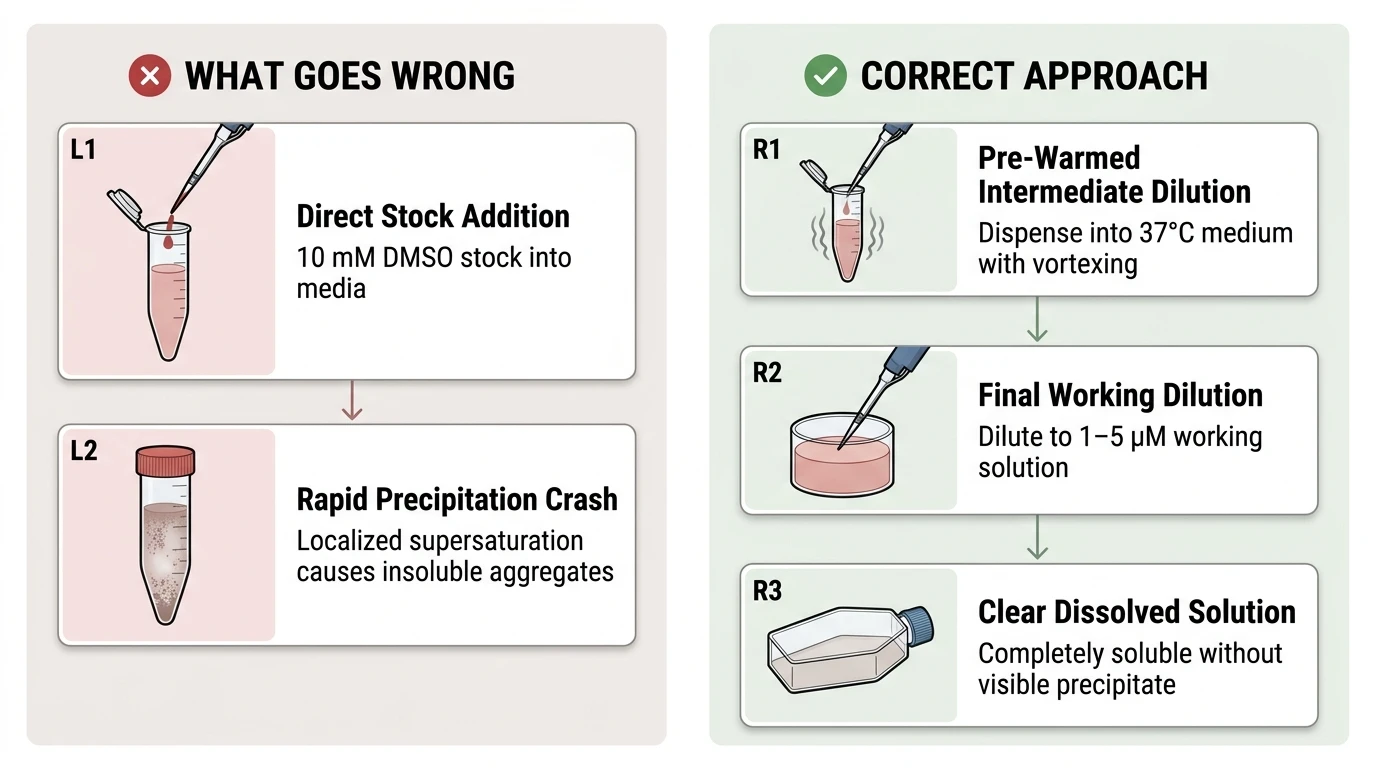
Recommended ApproachPerform a rapid, pre-warmed intermediate dilution (100–200 µM) with immediate vortex mixing before diluting to the final working concentration (1–5 µM) in warm medium.
Common CausesDirectly pipetting a 10 mM DMSO stock into aqueous medium causes rapid solvent dissipation, creating localized supersaturation that forces lipophilic tamoxifen to precipitate.
How Should It Be Done Correctly?
Copy code to add this image to your page Copy Code
Operational Parameters and Dilution Guidelines
Recommended physical parameters and working specifications for handling tamoxifen in cell culture. [1]
Stepwise Preparation and Dispersion Workflow
Direct, bulk introduction of a 10 mM stock solution into an aqueous volume generates a localized microenvironment of extreme supersaturation. Follow this sequential protocol to ensure complete dissolution and prevent micro-crystallization:
-
Equilibrate Reagents: Remove a frozen 10 mM tamoxifen DMSO aliquot from -80°C or -20°C storage and allow it to thaw completely at room temperature (20–25°C). Inspect visually to confirm that no residual solute remains settled at the bottom of the vial. Pre-warm the aqueous base medium to 37°C in a water bath, as cold media dramatically accelerates hydrophobic phase separation.
-
Prepare an Intermediate Working Dilution: Rather than pipetting the 10 mM stock directly into the final culture volume, perform an intermediate dilution step. Pipette the necessary volume of the 10 mM stock into a microcentrifuge tube containing pre-warmed culture medium (or serum-free base) to create a intermediate solution (e.g., 100–200 µM).
-
Active Vortexing and Rapid Mixing: When dispensing the DMSO stock into the pre-warmed medium, submerge the pipette tip slightly beneath the surface and eject the stock while vortexing or immediately vortex for 10–15 seconds at high speed. Immediate convective shear prevents the formation of localized high-concentration DMSO-water boundaries.
-
Final Working Solution Preparation: Dilute the intermediate solution further into the final experimental culture volume to achieve the desired treatment concentration (typically 1–5 µM) [1, 2]. Invert or gently swirl the container to homogenize.
-
Optical Inspection: Examine the final solution under an inverted phase-contrast microscope at 10× or 20× magnification before adding it to cell monolayers. The solution must remain clear and free of needle-shaped micro-aggregates or colloidal haziness.
| Parameter | Specification | Practical Handling Note |
|---|---|---|
| Stock Concentration | 10 mM in anhydrous DMSO | Reconstitute powder at 3.715 mg/mL; store in single-use aliquots protected from light |
| Working Concentration | 1–5 µM in culture medium | Dilute from stock to maintain final DMSO concentration at ≤0.1% (v/v) to avoid vehicle toxicity [1] |
| Aqueous Solubility Limit | <1 mg/mL (<2.69 mM) | Tamoxifen is practically insoluble in pure water; requires rapid dispersion |
| Intermediate Dilution Medium | Serum-free or low-serum medium | Pre-warm to 37°C before introducing DMSO stock to prevent thermal and solvent shock |
| Vehicle Alternative | 100% Ethanol (EtOH) | Dissolves readily up to 74 mg/mL and may provide better aqueous dispersion kinetics [2] |
| Stock Storage Conditions | -80°C (1 year) or -20°C (1 month) | Keep tightly desiccated; avoid repetitive freeze-thaw cycles |
What Went Wrong?
Direct Addition of Highly Concentrated Organic Stock
The primary procedural error was adding an undiluted 10 mM DMSO stock solution directly into aqueous culture media in a single pipetting motion without vigorous mixing or intermediate pre-dilution. Because the researcher introduced a concentrated organic droplet directly into an aqueous bulk phase, the local concentration at the liquid-liquid boundary momentarily reached tens to hundreds of times above the equilibrium aqueous solubility threshold of tamoxifen.
Localized Solvent Dissipation and Supersaturation Crash
DMSO is completely miscible with water and exhibits an extremely fast diffusion coefficient in aqueous solutions. When a droplet of 10 mM tamoxifen in DMSO contacts aqueous medium, DMSO molecules rapidly disperse and hydrate into the bulk water phase far faster than tamoxifen can diffuse or solvate. Consequently, tamoxifen molecules are instantly stripped of their organic solvation shell at the boundary layer, leading to sudden localized supersaturation that exceeds the metastable limit and causes the compound to crash out of solution as an insoluble precipitate.
Hydrophobic Aggregation Kinetics and Low Aqueous Affinity
Tamoxifen is a highly lipophilic triphenylethylene derivative with a high octanol-water partition coefficient (logP ~ 6.3) and an official aqueous solubility of <1 mg/mL (<2.69 mM), classifying it as practically insoluble in pure aqueous systems. In pure DMSO or ethanol, tamoxifen reaches high solubility (up to 74 mg/mL) [2], but in an aqueous environment, water molecules form structured clathrate-like hydrogen-bonded cages around the hydrophobic stilbene and phenyl rings. Thermodynamically, this creates a strong entropic penalty that drives rapid self-assembly and nucleated precipitation of tamoxifen molecules via π-π stacking and hydrophobic interactions. Without immediate intermediate dilution and high-shear dispersion, crystal nucleation proceeds irreversibly, yielding visible micro-particulates.
How Can I Avoid This in Future Experiments?
To prevent recurrence of tamoxifen precipitation, adopt an intermediate dilution protocol where stock solutions are stepped down sequentially (e.g., 10 mM stock diluted 1:50 or 1:100 into medium with continuous vortexing before the final dosing dilution). Additionally, ensure that culture media are thoroughly warmed to 37°C prior to any compound addition, as lower temperatures reduce the critical kinetic solubility threshold and accelerate crystal nucleation. If precipitation persists with DMSO, consider preparing stock solutions in absolute ethanol, which exhibits alternative surface tension properties and dispersion kinetics in aqueous matrices [2, 3].
References
- [1]Baker R, et al. PloS one. 2024 Jan;19(2):e0297080.[IF: 2.6]
- [2]Ho Tsoi, Ellen P. S. Man, Ka Man Chau and Ui-Soon Khoo, et al. Cancers..
- [3]Ohlsson C, et al. The Journal of endocrinology. 2018 May;237(2):113-122.[IF: 4.381]