
Why did my Tamoxifen DMSO stock lose Cre-ERT2 induction efficacy after 4 months stored at -20°C?
Quick Answer
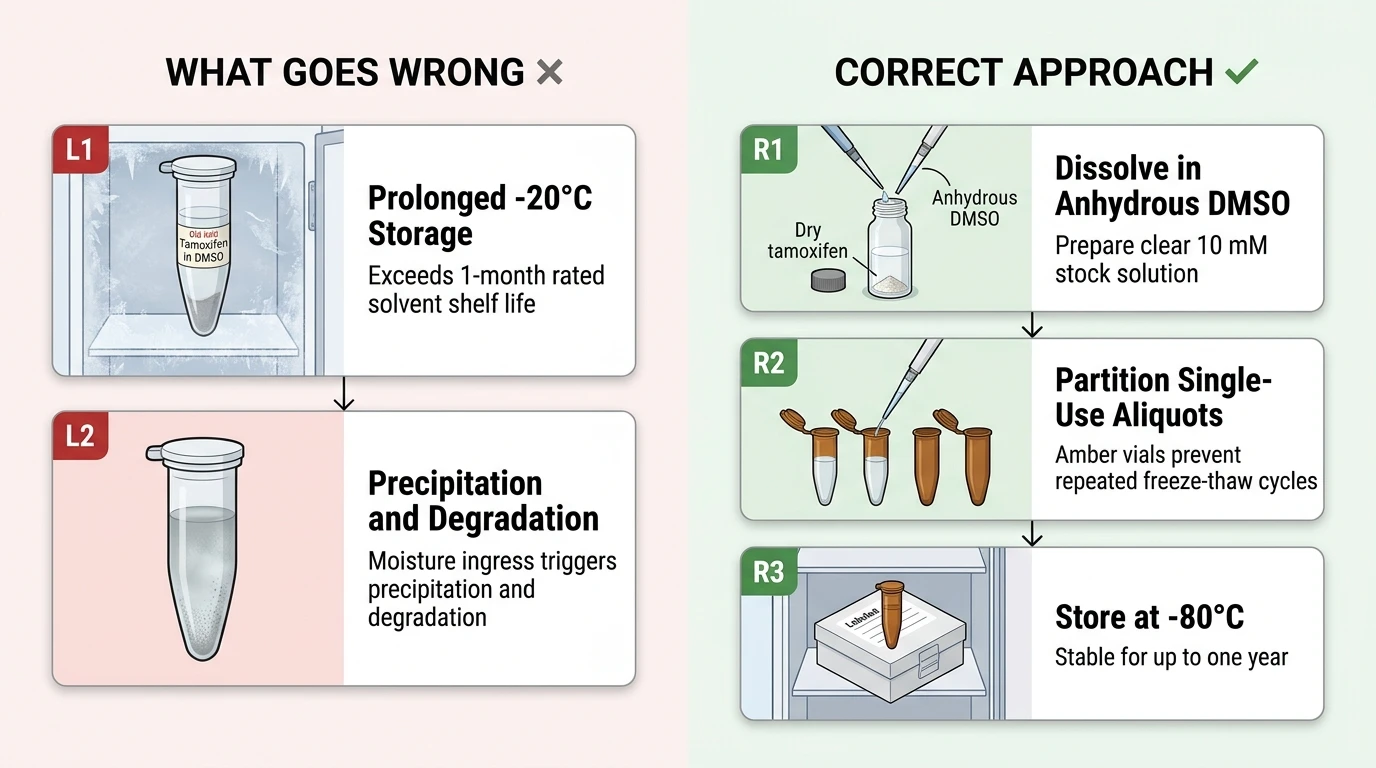
Recommended ApproachPrepare tamoxifen stock solutions at 10 mM in anhydrous DMSO, aliquot into single-use amber vials, and store at -80°C for up to 1 year or at -20°C for a maximum of 1 month.
Common CausesThe DMSO stock solution was kept at -20°C for 4 months, which significantly exceeds the manufacturer-defined 1-month shelf life in solvent at this temperature, resulting in progressive hydrolytic degradation, photo-oxidation, and precipitation upon repeated freeze-thaw cycles.
How Should It Be Done Correctly?
Copy code to add this image to your page Copy Code
Official Storage Specifications and Preparation Parameters
Manufacturer-defined physical specifications, recommended solvent systems, and temperature-dependent stability limits for tamoxifen stocks. [1]
Standard Reconstitution, Aliquoting, and Working Dilution Workflow
To ensure maximal and reproducible Cre-ERT2 recombinase induction, tamoxifen stocks must be prepared under conditions that eliminate moisture accumulation, photolytic cleavage, and repeated freeze-thaw cycles.
- Equilibration and Weighing: Bring the lyophilized tamoxifen powder vial to ambient room temperature inside a desiccator for at least 30 minutes before opening to prevent atmospheric water condensation onto the cold powder.
- Solubilization: Dissolve the powder in high-grade, anhydrous DMSO to achieve the recommended standard concentration of 10 mM (3.7151 mg of tamoxifen per 1 mL of DMSO). Vortex thoroughly for 1–2 minutes until the solution is completely clear and free of any visible particulate matter.
- Aliquot Partitioning: Immediately partition the freshly dissolved stock into small, single-use aliquots (e.g., 20–50 µL) in amber, low-binding microcentrifuge tubes or light-shielded cryogenic vials to avoid subsequent freeze-thaw cycles and light exposure.
- Storage Assignment: For long-term availability, place aliquots immediately into a -80°C ultra-low freezer where the solution remains fully stable for up to 1 year. If stored at -20°C, strictly label the tubes with an expiration date set to 1 month from the preparation date.
- Thawing and Administration Prep: Thaw individual aliquots completely at room temperature or in a 37°C water bath with gentle mixing until fully redissolved, confirming visual clarity. Never return a thawed aliquot back into the freezer. When preparing working formulations for animal delivery—whether for oral gavage, sweetened milk emulsions [3], or corn oil intraperitoneal injection [4, 5, 6]—prepare dilutions immediately prior to administration.
| Parameter | Specification / Recommendation | Operational Notes |
|---|---|---|
| Chemical Identity | MW 371.51; CAS 10540-29-1 | Non-steroidal selective estrogen receptor modulator (SERM) [2] |
| Recommended Solvent | Anhydrous DMSO | Achieves clear dissolution; high purity solvent prevents hydrolysis |
| Maximum DMSO Solubility | 74 mg/mL | High operational ceiling relative to working stock requirements |
| Recommended Stock Concentration | 10 mM (3.7151 mg/mL) | Balances complete dissolution with minimal final DMSO vehicle exposure |
| Storage (Powder Form) | -20°C (3-year shelf life) | Keep desiccated, sealed tightly, and protected from light |
| Storage (In Solvent at -80°C) | -80°C (1-year shelf life) | Store in desiccated, single-use, airtight aliquots |
| Storage (In Solvent at -20°C) | -20°C (1-month shelf life) | Discard any solution exceeding 30 days of storage |
What Went Wrong?
Deviation Beyond Rated Solvent Storage Life
The tamoxifen stock solution was maintained at -20°C for 4 months. According to manufacturer stability standards, tamoxifen dissolved in solvent possesses a maximum rated shelf life of exactly 1 month when stored at -20°C. Storing dissolved tamoxifen at -20°C for four times the certified storage duration directly leads to loss of compound integrity and chemical breakdown, rendering the stock incapable of activating the inducible Cre-ERT2 driver [2, 4].
Moisture Absorption and Sub-Visual Phase Separation
DMSO is an extremely hygroscopic solvent that readily draws ambient moisture from the air during routine tube opening and closure cycles, as well as across standard microtube seals during prolonged -20°C storage [Source: ResearchGate]. As the water content within the stock vial increases over several months, the solubility of tamoxifen declines sharply because its aqueous solubility is negligible (<1 mg/mL). This moisture ingress promotes micro-precipitation and sub-visual crystal nucleation, drastically diminishing the effective dissolved concentration delivered to experimental animals or cultured cells [1, 3].
Impairment of Cre-ERT2 Nuclear Translocation
Inducible Cre-ERT2 transgenes rely on the intracellular availability of tamoxifen or its high-affinity active metabolite, 4-hydroxytamoxifen (4-OHT), to bind the mutated estrogen receptor domain and liberate the Cre recombinase from cytoplasmic heat-shock protein sequestration [2, 5]. When a degraded or precipitated stock is administered, the in vivo bioavailable exposure falls beneath the activation threshold required for genomic loxP recombination [4, 6]. Insufficient ligand-receptor occupancy halts nuclear translocation of the Cre enzyme, manifesting experimentally as a total loss of reporter gene activation or conditional target gene excision [2, 7].
How Can I Avoid This in Future Experiments?
Transition exclusively to a single-use aliquoting protocol stored in an ultra-low temperature freezer (-80°C), which extends solvent shelf life to 1 year. Implement color-coded labeling on all aliquots indicating the exact dissolution date and the strict disposal deadline (30 days for -20°C; 365 days for -80°C). Always inspect thawed DMSO stocks under direct light against a dark background prior to formulation; if any cloudiness, turbidity, or flocculent precipitate is observed, discard the aliquot immediately. For critical lineage-tracing or gene-knockout cohorts, synthesize working oil or emulsion delivery formulations freshly on the day of treatment rather than storing diluted mixtures [3, 5].
References
- [1]Miranda R. Sun, Austin C. Steward, Emma A. Sweet, Alexander A. Martin, Robert J. Lipinski, et al. PloS one..
- [2]Patel SH, et al. Scientific reports. 2017 Aug;7(1):8991.[IF: 4.122]
- [3]Vanhecke D, et al. Lab animal. 2024 Aug;53(8):205-214.[IF: 3.9]
- [4]Ilchuk LA, et al. International journal of molecular sciences. 2022 Nov;23(22).[IF: 5.6]
- [5]Donocoff RS, et al. Scientific reports. 2020 Sep;10(1):15244.[IF: 4.379]
- [6]Reinert RB, et al. PloS one. 2012 Jan;7(3):e33529.[IF: 3.73]
- [7]Kellogg CM, et al. iScience. 2023 Dec;26(12):108413.[IF: 4.6]