
-
 Argentina
-
 Australia
-
 Austria
-
 Belgium
-
 Brazil
-
 Canada
-
 China
China
-
 Czech Republic
-
 Denmark
-
 Finland
-
 France
-
 Germany
-
 Greece
-
 Hong Kong
-
 Hungary
-
 Iceland
-
 India
India
-
 Ireland
-
 Israel
-
 Italy
Italy
-
 Japan
Japan
-
 Korea
Korea
-
 Luxembourg
-
 Malaysia
-
 Netherlands
-
 New Zealand
-
 Norway
-
 Poland
-
 Portugal
-
 Qatar
Qatar
-
 Romania
-
 Saudi Arabia
-
 Singapore
-
 Spain
Spain
-
 Sweden
-
 Switzerland
-
 Taiwan
-
 Turkey
-
 United Kingdom
-
 United States
research use only
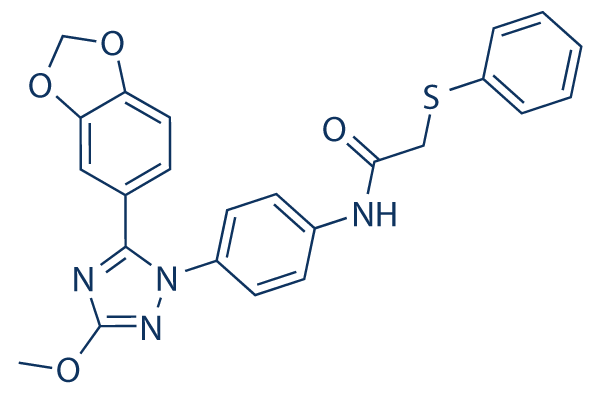
SecinH3 cytohesin inhibitor
Cat.No.S7685
Quality Control
| Related Targets | Bcl-2 Caspase PD-1/PD-L1 Ferroptosis p53 Apoptosis related Synthetic Lethality STAT TNF-alpha Ras |
|---|---|
| Featured Inhibitors | Y-27632 Dihydrochloride SB431542 CHIR-99021 (Laduviglusib) RMC-7977 RMC-6236 (Daraxonrasib) MRTX1133 MG132 Z-VAD-FMK VT3989 IAG933 |
Cell Culture, Treatment & Working Concentration
| Cell Lines | Assay Type | Concentration | Incubation Time | Formulation | Activity Description | PMID |
|---|---|---|---|---|---|---|
| LOX cells | Antiinvasive assay | 30 uM | Antiinvasive activity against human LOX cells assessed as inhibition of 5% FBS-induced cell invasion at 30 uM by Matrigel based cell invasion assay | ChEMBL | ||
| Click to View More Cell Line Experimental Data | ||||||
Solubility
|
In vitro |
DMSO
: 92 mg/mL
(199.78 mM)
Ethanol : 1 mg/mL Water : Insoluble |
Molarity Calculator
|
In vivo |
|||||
In vivo Formulation Calculator (Clear solution)
Step 1: Enter information below (Recommended: An additional animal making an allowance for loss during the experiment)
Step 2: Enter the in vivo formulation (This is only the calculator, not formulation. Please contact us first if there is no in vivo formulation at the solubility Section.)
Calculation results:
Working concentration: mg/ml;
Method for preparing DMSO master liquid: mg drug pre-dissolved in μL DMSO ( Master liquid concentration mg/mL, Please contact us first if the concentration exceeds the DMSO solubility of the batch of drug. )
Method for preparing in vivo formulation: Take μL DMSO master liquid, next addμL PEG300, mix and clarify, next addμL Tween 80, mix and clarify, next add μL ddH2O, mix and clarify.
Method for preparing in vivo formulation: Take μL DMSO master liquid, next add μL Corn oil, mix and clarify.
Note: 1. Please make sure the liquid is clear before adding the next solvent.
2. Be sure to add the solvent(s) in order. You must ensure that the solution obtained, in the previous addition, is a clear solution before proceeding to add the next solvent. Physical methods such
as vortex, ultrasound or hot water bath can be used to aid dissolving.
Chemical Information, Storage & Stability
| Molecular Weight | 460.5 | Formula | C24H20N4O4S |
Storage (From the date of receipt) | |
|---|---|---|---|---|---|
| CAS No. | 853625-60-2 | Download SDF | Storage of Stock Solutions |
|
|
| Synonyms | N/A | SMILES | COC1=NN(C(=N1)C2=CC3=C(C=C2)OCO3)C4=CC=C(C=C4)NC(=O)CSC5=CC=CC=C5 | ||
Read more about storage stability stock solution CAS number SMILES
Mechanism of Action
| Targets/IC50/Ki |
hCyh2
2.4 μM
hCyh1
5.4 μM
mCyh3
5.4 μM
hCyh3
5.6 μM
drosophila steppke
5.6 μM
yGea2-S7
65 μM
|
|---|---|
| In vitro |
In HepG2 cells, SecinH3 inhibits insulin signaling and associated gene expression. This compound also markedly inhibits migration of preadipocyte 3T3-L1 cells. |
| Kinase Assay |
Aptamer displacement screen
|
|
A library of small molecules screened in duplicate from Comgenex (10000 molecules) in 386 well plates by fluorescence polarization at an excitation wavelength of 485 nm using read-out at 520 nm in a reaction volume of 50 μL at 37° C. The screening buffer is PBS, pH 7.5, 3 mM MgCl2, 100 nM fluorecein-labelled M69 aptamer, 1 μM cytohesin-1 Sec7 at 100 μM this compound concentrations.
|
|
| In vivo |
In mice, SecinH3 increases the expression of gluconeogenic genes, reduces the expression of glycolytic, fatty acid and ketone body metabolism genes in the liver, reduces liver glycogen stores, and increases plasma insulin. In mice bearing H460 xenografts, this compound significantly retards tumor growth through its antiproliferative and pro-apoptotic effect. |
References |
|
Tech Support
Tel: +1-832-582-8158 Ext:3
If you have any other enquiries, please leave a message.

Products are for research use only. Not for human use. We do not sell to patients.
©Copyright 2013 Selleck Chemicals. All Rights Reserved.