
-
 Australia
-
 Austria
-
 Belgium
-
 Brazil
-
 Canada
-
 China
China
-
 Czech Republic
-
 Denmark
-
 Finland
-
 France
-
 Germany
-
 Greece
-
 Hong Kong
-
 Hungary
-
 Iceland
-
 India
India
-
 Ireland
-
 Israel
-
 Italy
Italy
-
 Japan
Japan
-
 Korea
Korea
-
 Luxembourg
-
 Malaysia
-
 Netherlands
-
 New Zealand
-
 Norway
-
 Poland
-
 Qatar
Qatar
-
 Romania
-
 Saudi Arabia
-
 Singapore
-
 Spain
Spain
-
 Sweden
-
 Switzerland
-
 Taiwan
-
 Turkey
-
 United Kingdom
-
 United States
research use only
Medroxyprogesterone Acetate (MPA) Progesterone Receptor Agonist
Cat.No.S2567
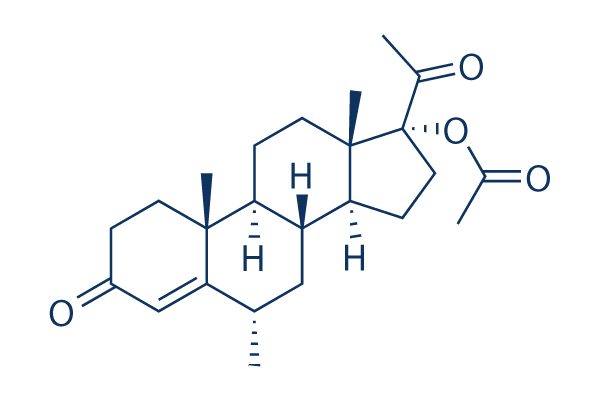
Chemical Structure
Molecular Weight: 386.52
Quality Control
Solubility
|
In vitro |
DMSO
: 12 mg/mL
(31.04 mM)
Ethanol : 12 mg/mL Water : Insoluble |
Molarity Calculator
|
In vivo |
|||||
In vivo Formulation Calculator (Clear solution)
Step 1: Enter information below (Recommended: An additional animal making an allowance for loss during the experiment)
Step 2: Enter the in vivo formulation (This is only the calculator, not formulation. Please contact us first if there is no in vivo formulation at the solubility Section.)
Calculation results:
Working concentration: mg/ml;
Method for preparing DMSO master liquid: mg drug pre-dissolved in μL DMSO ( Master liquid concentration mg/mL, Please contact us first if the concentration exceeds the DMSO solubility of the batch of drug. )
Method for preparing in vivo formulation: Take μL DMSO master liquid, next addμL PEG300, mix and clarify, next addμL Tween 80, mix and clarify, next add μL ddH2O, mix and clarify.
Method for preparing in vivo formulation: Take μL DMSO master liquid, next add μL Corn oil, mix and clarify.
Note: 1. Please make sure the liquid is clear before adding the next solvent.
2. Be sure to add the solvent(s) in order. You must ensure that the solution obtained, in the previous addition, is a clear solution before proceeding to add the next solvent. Physical methods such
as vortex, ultrasound or hot water bath can be used to aid dissolving.
Chemical Information, Storage & Stability
| Molecular Weight | 386.52 | Formula | C24H34O4 |
Storage (From the date of receipt) | |
|---|---|---|---|---|---|
| CAS No. | 71-58-9 | Download SDF | Storage of Stock Solutions |
|
|
| Synonyms | NSC-26386, Medroxyprogesterone 17-acetate, Farlutin | Smiles | CC1CC2C(CCC3(C2CCC3(C(=O)C)OC(=O)C)C)C4(C1=CC(=O)CC4)C | ||
Mechanism of Action
| Targets/IC50/Ki |
progestogen Receptor
|
|---|---|
| In vitro |
Medroxyprogesterone acetate (MPA) inhibits the enzyme 3-hydroxysteroid dehydrogenase, involved in the reversible conversion between 5alpha-dihydroprogesterone (DHP) and 3alpha, 5alpha-tetrahydroprogesterone (THP), and therefore may affect the local actions of DHP and THP in the brain. It reduces secretion of IL-6 and PTHrP from human breast cancer cells. This compound dose-dependently decreases the secretion and mRNA expression of IL-6 and PTHrP in the KTC-2 cells. MPA and dexamethasone dose dependently increase alpha-ENaC promoter-driven luciferase activity in M-1 cells, which is not inhibited by Org31710, indicating that it regulates alpha-ENaC in a PR-independent manner. This compound and dexamethasone, but not progesterone, dose dependently increase alpha-ENaC and sgk1 mRNA in M-1 and in Madin-Darby canine kidney-C7 cells, both collecting duct cell lines. At 0.1 nM, it significantly enhances the in vitro production of specific immunoglobulin G (IgG) antibodies, an effect that appears to involve the interaction of the progestin with PRG receptors |
| In vivo |
Medroxyprogesterone acetate (MPA) impairs delayed memory retention on the water radial-arm maze (WRAM) and exacerbates overnight forgetting on the Morris maze (MM) in aged ovariectomized (OVX) rats. It significantly and progesterone marginally decreases GAD levels in the hippocampus, while both MPA and progesterone significantly increase GAD levels in the entorhinal cortex. |
References |
|
Clinical Trial Information
(data from https://clinicaltrials.gov, updated on 2024-05-22)
| NCT Number | Recruitment | Conditions | Sponsor/Collaborators | Start Date | Phases |
|---|---|---|---|---|---|
| NCT05178563 | Not yet recruiting | Inflammation|Periodontal Diseases |
University College London |
September 1 2024 | Not Applicable |
| NCT06297096 | Not yet recruiting | Systemic Sclerosis|Interstitial Lung Disease |
National Institute of Geriatrics Rheumatology and Rehabilitation Poland|Medical Research Agency Poland |
April 1 2024 | Phase 3 |
| NCT06193135 | Not yet recruiting | Infertility Female|Reproductive Sterility |
Instituto Valenciano de Infertilidad IVI VALENCIA |
March 1 2024 | Not Applicable |
Tech Support
Tel: +1-832-582-8158 Ext:3
If you have any other enquiries, please leave a message.

Products are for research use only. Not for human use. We do not sell to patients.
©Copyright 2013 Selleck Chemicals. All Rights Reserved.