
-
 Argentina
-
 Australia
-
 Austria
-
 Belgium
-
 Brazil
-
 Canada
-
 China
China
-
 Czech Republic
-
 Denmark
-
 Finland
-
 France
-
 Germany
-
 Greece
-
 Hong Kong
-
 Hungary
-
 Iceland
-
 India
India
-
 Ireland
-
 Israel
-
 Italy
Italy
-
 Japan
Japan
-
 Korea
Korea
-
 Luxembourg
-
 Malaysia
-
 Netherlands
-
 New Zealand
-
 Norway
-
 Poland
-
 Portugal
-
 Qatar
Qatar
-
 Romania
-
 Saudi Arabia
-
 Singapore
-
 Spain
Spain
-
 Sweden
-
 Switzerland
-
 Taiwan
-
 Turkey
-
 United Kingdom
-
 United States
research use only
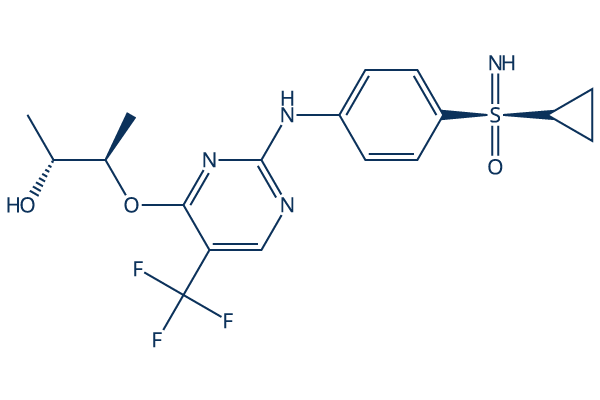
BAY 1000394 CDK inhibitor
Cat.No.S7047
Quality Control
Solubility
|
In vitro |
DMSO
: 86 mg/mL
(199.79 mM)
Ethanol : 86 mg/mL Water : Insoluble |
Molarity Calculator
|
In vivo |
|||||
In vivo Formulation Calculator (Clear solution)
Step 1: Enter information below (Recommended: An additional animal making an allowance for loss during the experiment)
Step 2: Enter the in vivo formulation (This is only the calculator, not formulation. Please contact us first if there is no in vivo formulation at the solubility Section.)
Calculation results:
Working concentration: mg/ml;
Method for preparing DMSO master liquid: mg drug pre-dissolved in μL DMSO ( Master liquid concentration mg/mL, Please contact us first if the concentration exceeds the DMSO solubility of the batch of drug. )
Method for preparing in vivo formulation: Take μL DMSO master liquid, next addμL PEG300, mix and clarify, next addμL Tween 80, mix and clarify, next add μL ddH2O, mix and clarify.
Method for preparing in vivo formulation: Take μL DMSO master liquid, next add μL Corn oil, mix and clarify.
Note: 1. Please make sure the liquid is clear before adding the next solvent.
2. Be sure to add the solvent(s) in order. You must ensure that the solution obtained, in the previous addition, is a clear solution before proceeding to add the next solvent. Physical methods such
as vortex, ultrasound or hot water bath can be used to aid dissolving.
Chemical Information, Storage & Stability
| Molecular Weight | 430.44 | Formula | C18H21F3N4O3S |
Storage (From the date of receipt) | |
|---|---|---|---|---|---|
| CAS No. | 1223498-69-8 | Download SDF | Storage of Stock Solutions |
|
|
Read more about storage stability stock solution CAS number
Mechanism of Action
| Targets/IC50/Ki |
CDK9
5 nM
CDK1
7 nM
CDK2
9 nM
CDK4
11 nM
CDK7
25 nM
|
|---|---|
| In vitro |
BAY 1000394 inhibits the kinase activity of the cell-cycle CDKs CDK1/cyclin B, CDK2/cyclin E, and CDK4/cyclin D with IC50 values of 7, 9, and 11 nM, respectively. The transcriptional CDKs CDK9/cyclin T1 and CDK7/cyclin H/MAT1 are also inhibited by this compound in a similar range (5 and 25 nM), as well as the other CDK family members, classifying it as a pan-CDK inhibitor. This chemical simultaneously inhibits cell-cycle progression and of RNA polymerase II-mediated gene transcription. On a panel of 214 non-CDK Ser/Thr and Tyr kinases, 16 additional kinases are found to be inhibited by this inhibitor with IC50 values below 100 nM. It displays broad and uniform inhibitory activity on cancer cell proliferation with IC50s values between 9 and 79 nM (mean 39 nM) for a panel of 40 human lung tumor cell lines, and IC50s between 6 an d 84 nM (mean 37 nM) for a panel of 24 human breast tumor and immortalized cell lines. Within these panels, which represent a broad range of genetic backgrounds (p53, pRB, K-Ras, PGP, etc.), no cell line could be identified that is poorly sensitive towards treatment with this agent. Antiproliferative activity of the compound is associated with the induction of apoptotic cell death. Exposure of asynchronously growing HeLa cells to it for 24 hours reduces the fraction of cells with 2N content, from 69% to 52% compared with vehicle treated cells and strongly increases the fraction of cells with less than 2N DNA content from 1% to 16%. Only minor shifts are observed for cells in S, G2, or M phase. |
| Kinase Assay |
Kkinase assays
|
|
Recombinant CDK1 and CycB-GST fusion proteins, and CDK2 and CycE-GST fusion proteins, are purified from baculovirus-infected Sf9 insect cells. Histon IIIS is used as kinase substrate. Inhibition of kinase activity is determined by substrate phosphorylation assays using 3P-gamma adenosine triphosphate. This compound is counter screened against a panel of 220 kinases using the Kinase profiler screen at 500 nM.
|
|
| In vivo |
BAY 1000394 shows potent tumor growth inhibition in monotreatment upon oral application in various dosing schedules in a dose-dependent manner, activity in models of treatment-refractory tumors, and efficacy in cell-line–derived as well as in patient tumor–derived models. This compound (2 mg/kg) suppresses growth of HeLa-MaTu xenografts tumor with T/C values of 0.03 and signs of tumor regression. It shows additive efficacy in combination with cisplatin. Addition of this chemical to cisplatin results in a strong tumor growth inhibition of NCI-H82 SCLC xenograft tumors with T/C values of 0.01 (1.0 mg/kg this compound) and -0.02 (1.5 mg/kg this compound). |
References |
Tech Support
Tel: +1-832-582-8158 Ext:3
If you have any other enquiries, please leave a message.
Signaling Pathway Map

Products are for research use only. Not for human use. We do not sell to patients.
©Copyright 2013 Selleck Chemicals. All Rights Reserved.