
-
 Argentina
-
 Australia
-
 Austria
-
 Belgium
-
 Brazil
-
 Canada
-
 China
China
-
 Czech Republic
-
 Denmark
-
 Finland
-
 France
-
 Germany
-
 Greece
-
 Hong Kong
-
 Hungary
-
 Iceland
-
 India
India
-
 Ireland
-
 Israel
-
 Italy
Italy
-
 Japan
Japan
-
 Korea
Korea
-
 Luxembourg
-
 Malaysia
-
 Netherlands
-
 New Zealand
-
 Norway
-
 Poland
-
 Portugal
-
 Qatar
Qatar
-
 Romania
-
 Saudi Arabia
-
 Singapore
-
 Spain
Spain
-
 Sweden
-
 Switzerland
-
 Taiwan
-
 Turkey
-
 United Kingdom
-
 United States
research use only
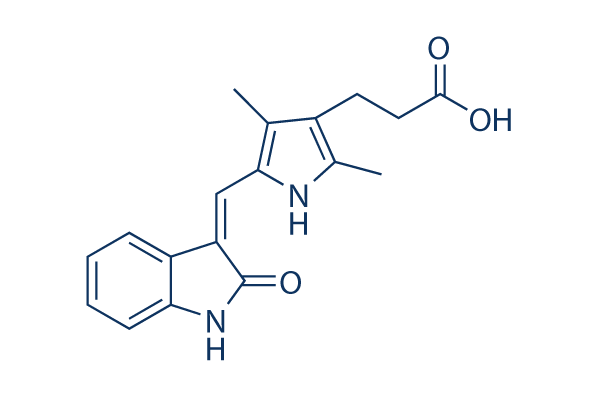
Orantinib (SU6668) PDGFR inhibitor
Cat.No.S1470
Quality Control
| Related Targets | EGFR VEGFR FGFR c-Met Src MEK CSF-1R FLT3 HER2 c-Kit |
|---|---|
| Other PDGFR Inhibitors | CP-673451 Tyrphostin AG 1296 Trapidil PP121 AZD2932 Sennoside B Tyrphostin AG1433 AG 1295 N-(p-Coumaroyl) Serotonin Seralutinib (GB002) |
Solubility
|
In vitro |
DMSO
: 62 mg/mL
(199.77 mM)
Water : Insoluble Ethanol : Insoluble |
Molarity Calculator
|
In vivo |
|||||
In vivo Formulation Calculator (Clear solution)
Step 1: Enter information below (Recommended: An additional animal making an allowance for loss during the experiment)
Step 2: Enter the in vivo formulation (This is only the calculator, not formulation. Please contact us first if there is no in vivo formulation at the solubility Section.)
Calculation results:
Working concentration: mg/ml;
Method for preparing DMSO master liquid: mg drug pre-dissolved in μL DMSO ( Master liquid concentration mg/mL, Please contact us first if the concentration exceeds the DMSO solubility of the batch of drug. )
Method for preparing in vivo formulation: Take μL DMSO master liquid, next addμL PEG300, mix and clarify, next addμL Tween 80, mix and clarify, next add μL ddH2O, mix and clarify.
Method for preparing in vivo formulation: Take μL DMSO master liquid, next add μL Corn oil, mix and clarify.
Note: 1. Please make sure the liquid is clear before adding the next solvent.
2. Be sure to add the solvent(s) in order. You must ensure that the solution obtained, in the previous addition, is a clear solution before proceeding to add the next solvent. Physical methods such
as vortex, ultrasound or hot water bath can be used to aid dissolving.
Chemical Information, Storage & Stability
| Molecular Weight | 310.35 | Formula | C18H18N2O3 |
Storage (From the date of receipt) | |
|---|---|---|---|---|---|
| CAS No. | 252916-29-3 | Download SDF | Storage of Stock Solutions |
|
|
| Synonyms | TSU-68 | SMILES | CC1=C(NC(=C1CCC(=O)O)C)C=C2C3=CC=CC=C3NC2=O | ||
Read more about storage stability stock solution CAS number SMILES
Mechanism of Action
| Targets/IC50/Ki |
PDGFRβ
(Cell-free assay) 8 nM(Ki)
|
|---|---|
| In vitro |
Orantinib (SU6668) is a competitive inhibitor, with regard to ATP, to Flk-1/KDR trans-phosphorylation, FGFR1 trans-phosphorylation, and PDGFRβ kinases autophosphorylation. It (0.03-10 μM) inhibits tyrosine phosphorylation of KDR in VEGF stimulated HUVECs. This compound also inhibits PDGF-stimulated PDGFRβ tyrosine phosphorylation in NIH-3T3 cells overexpressing PDGFRβ at a minimum concentration of 0.03-0.1 μM. It inhibits acidic FGF-induced phosphorylation of the FGFR1 substrate 2 at 10 μM and higher. However, TSU-68 (up to 100 μM) has no effect on EGF-stimulated EGFR tyrosine phosphorylation in NIH-3T3 cells overexpressing EGFR. It inhibits VEGF-driven and FGF-driven mitogenesis of HUVECs with mean IC50 of 0.34 μM and 9.6 μM, respectively. In human myeloid leukemia MO7E cells, this compound inhibits the tyrosine autophosphorylation of stem cell factor (SCF) receptor, c-kit, with IC50 of 0.1-1 μM, as well as ERK1/2 phosphorylation, a signaling event downstream of c-kit activation. It also inhibits SCF-induced proliferation of MO7E cells with IC50 of 0.29 μM, and induces apoptosis.
|
| Kinase Assay |
trans-Phosphorylation Reactions
|
|
Tyrosine kinase assays to quantitate the trans-phosphorylation activity of Flk-1 and FGFR1 are performed in 96-well microtiter plates precoated (20 μg/well in PBS; incubated overnight at 4 °C) with the peptide substrate poly-Glu,Tyr (4:1). Excess protein binding sites are blocked with 1-5% (w/v) BSA in PBS. Purified GST-FGFR1 (kinase domain) or GST-Flk-1 (cytoplasmic domain) fusion proteins are then added to the microtiter wells in 2 × concentration kinase dilution buffer consisting of 100 mM HEPES, 50 mM NaCl, 40 μM NaVO4, and 0.02% (w/v) BSA. The final enzyme concentration for GST-Flk-1 and GST-FGFR1 is 50 ng/mL. Orantinib (SU6668) is dissolved in DMSO at 100× the final required concentration and diluted 1:25 in H2O. Twenty-five μL of diluted this compound are subsequently added to each reaction well. The kinase reaction is initiated by the addition of different concentrations of ATP in a solution of MnCl2 so that the final ATP concentrations spanned the Km for the enzyme, and the final concentration of MnCl2 is 10 mM. The plates are incubated for 5-15 min at room temperature before stopping the reaction with the addition of EDTA. The plates are then washed three times with TBST. Rabbit polyclonal antiphosphotyrosine antisera are added to the wells at a 1: 10000 dilution in TBST containing 0.5% (w/v) BSA, 0.025% (w/v) nonfat dry milk, and 100 μM NaVO4 and incubated for 1 hour at 37 °C. The plates are then washed three times with TBST, followed by the addition of goat anti-rabbit antisera conjugated with HRP. The plates are incubated for 1 hour at 37 °C and then washed three times with TBST. The amount of phosphotyrosine in each well is quantitated after the addition of 2,2
|
|
| In vivo |
Orantinib (SU6668) induces tumor growth inhibition against a broad range of tumor types in xenograft models in athymic mice, including A375, Colo205, H460, Calu-6, C6, SF763T, and SKOV3TP5 cells at doses of 75-200 mg/kg. This compound (75 mg/kg) also suppresses tumor angiogenesis of C6 glioma xenografts. In a tumor model of HT29 human colon carcinoma, it (200 mg/kg) decreases the average vessel permeability and average fractional plasma volume in the tumor rim and core. TSU-68 promotes abnormal stromal development at the periphery of carcinomas. In a rabbit VX2 liver tumor model, it (200 mg/kg) augments the effect of chemotherapeutic infusion.
|
References |
|
Tech Support
Tel: +1-832-582-8158 Ext:3
If you have any other enquiries, please leave a message.
Signaling Pathway Map

Products are for research use only. Not for human use. We do not sell to patients.
©Copyright 2013 Selleck Chemicals. All Rights Reserved.