
-
 Argentina
-
 Australia
-
 Austria
-
 Belgium
-
 Brazil
-
 Canada
-
 China
China
-
 Czech Republic
-
 Denmark
-
 Finland
-
 France
-
 Germany
-
 Greece
-
 Hong Kong
-
 Hungary
-
 Iceland
-
 India
India
-
 Ireland
-
 Israel
-
 Italy
Italy
-
 Japan
Japan
-
 Korea
Korea
-
 Luxembourg
-
 Malaysia
-
 Netherlands
-
 New Zealand
-
 Norway
-
 Poland
-
 Portugal
-
 Qatar
Qatar
-
 Romania
-
 Saudi Arabia
-
 Singapore
-
 Spain
Spain
-
 Sweden
-
 Switzerland
-
 Taiwan
-
 Turkey
-
 United Kingdom
-
 United States
research use only
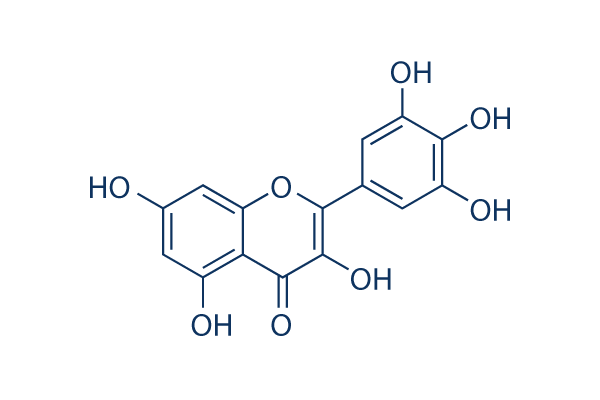
Myricetin MEK inhibitor
Cat.No.S2326
Quality Control
| Related Targets | ERK p38 MAPK Raf JNK Ras KRas S6 Kinase MAP4K TAK1 Mixed Lineage Kinase |
|---|---|
| Other MEK Inhibitors | PD0325901 (Mirdametinib) U0126-EtOH PD 98059 CI-1040 (PD184352) (E/Z)-BIX02189 Pimasertib (AS-703026) Refametinib (RDEA119) TAK-733 AZD8330 GDC-0623 |
Cell Culture, Treatment & Working Concentration
| Cell Lines | Assay Type | Concentration | Incubation Time | Formulation | Activity Description | PMID |
|---|---|---|---|---|---|---|
| HT-29 cells | Function assay | Desensitization of GPR35 receptor in human HT-29 cells assessed as inhibition of zaprinast-induced dynamic mass redistribution after 10 mins, IC50=2.12 μM | ||||
| HeLa cells | Function assay | Inhibition of MRP1 transfected in human HeLa cells assessed as inhibition of [3H]LTC4 transport by rapid filtration assay, Ki=2.4 μM | ||||
| HCT116 cells | Growth inhibition assay | 48 h | Growth inhibition of human HCT116 cells overexpressing PI3Kalpha H1047R mutant after 48 hrs by MTT assay, IC50=4.1 μM | |||
| human 22Rv1 cells | Proliferation assay | 144 h | Antiproliferative activity against human 22Rv1 cells incubated up to 144 hrs by Coulter particle count and size analyzer, IC50=13.1 μM | |||
| human SKBR3 cells | Function assay | 24 h | Displacement of GM-cy3B from Hsp90 in human SKBR3 cells after 24 hrs by fluorescence polarization assay, IC50=13.5 μM | |||
| human U2OS cells | Function assay | 5 h | Agonist activity at GPR35 receptor in human U2OS cells coexpressing Gal4-VP16-TEV assessed as beta arrestin translocation after 5 hrs by beta lactamase reporter gene assay, EC50=14.7 μM | |||
| human H9 cells | Function assay | 3 days | Antiviral activity against HIV1 3B infected in human H9 cells assessed as inhibition of viral replication after 3 days by p24 antigen capture assay, EC50=35 μM | |||
| NCI-60 human tumor cell line | Cytotoxicity assay | In vitro cytotoxic potency against NCI-60 human tumor cell line, GI50=36 μM | ||||
| human HL60 cells | Proliferation assay | 30 μM | 48 h | Antiproliferative activity against human HL60 cells at 30 uM after 48 hrs by MTS assay | ||
| mouse L929 cells | Function assay | 2 h | Inhibition of recombinant human TNF-alpha-induced cytotoxicity of mouse L929 cells assessed as survivality treated with drug after 2 hrs of TNFalpha treatment | |||
| Click to View More Cell Line Experimental Data | ||||||
Solubility
|
In vitro |
DMSO
: 63 mg/mL
(197.96 mM)
Ethanol : 20 mg/mL Water : Insoluble |
Molarity Calculator
|
In vivo |
|||||
In vivo Formulation Calculator (Clear solution)
Step 1: Enter information below (Recommended: An additional animal making an allowance for loss during the experiment)
Step 2: Enter the in vivo formulation (This is only the calculator, not formulation. Please contact us first if there is no in vivo formulation at the solubility Section.)
Calculation results:
Working concentration: mg/ml;
Method for preparing DMSO master liquid: mg drug pre-dissolved in μL DMSO ( Master liquid concentration mg/mL, Please contact us first if the concentration exceeds the DMSO solubility of the batch of drug. )
Method for preparing in vivo formulation: Take μL DMSO master liquid, next addμL PEG300, mix and clarify, next addμL Tween 80, mix and clarify, next add μL ddH2O, mix and clarify.
Method for preparing in vivo formulation: Take μL DMSO master liquid, next add μL Corn oil, mix and clarify.
Note: 1. Please make sure the liquid is clear before adding the next solvent.
2. Be sure to add the solvent(s) in order. You must ensure that the solution obtained, in the previous addition, is a clear solution before proceeding to add the next solvent. Physical methods such
as vortex, ultrasound or hot water bath can be used to aid dissolving.
Chemical Information, Storage & Stability
| Molecular Weight | 318.24 | Formula | C15H10O8 |
Storage (From the date of receipt) | |
|---|---|---|---|---|---|
| CAS No. | 529-44-2 | Download SDF | Storage of Stock Solutions |
|
|
Read more about storage stability stock solution CAS number SMILES
Mechanism of Action
| Targets/IC50/Ki |
MEK1
PI3Kγ
0.17 μM(Kd)
|
|---|---|
| In vitro |
Myricetin(Cannabiscetin) is a flavonoid found in many grapes, berries, fruits, vegetables, herbs, as well as other plants, which has antioxidant and anti tumor properties. This compound has antioxidant properties. In vitro research suggests that this compound in high concentrations can modify LDL cholesterol such that uptake by white blood cells is increased. Studies shows that high consumption of this compound reduces the risk of prostate cancer and pancreatic cancer.
|
References |
|
Clinical Trial Information
(data from https://clinicaltrials.gov, updated on 2024-08-12)
| NCT Number | Recruitment | Conditions | Sponsor/Collaborators | Start Date | Phases |
|---|---|---|---|---|---|
| NCT06548503 | COMPLETED | Oxidative Stress; Alcohol Drinking |
University of Padova |
2023-11-01 |
Read more about Clinical Trials
Tech Support
Tel: +1-832-582-8158 Ext:3
If you have any other enquiries, please leave a message.
Signaling Pathway Map

Products are for research use only. Not for human use. We do not sell to patients.
©Copyright 2013 Selleck Chemicals. All Rights Reserved.