
-
 Argentina
-
 Australia
-
 Austria
-
 Belgium
-
 Brazil
-
 Canada
-
 China
China
-
 Czech Republic
-
 Denmark
-
 Finland
-
 France
-
 Germany
-
 Greece
-
 Hong Kong
-
 Hungary
-
 Iceland
-
 India
India
-
 Ireland
-
 Israel
-
 Italy
Italy
-
 Japan
Japan
-
 Korea
Korea
-
 Luxembourg
-
 Malaysia
-
 Netherlands
-
 New Zealand
-
 Norway
-
 Poland
-
 Portugal
-
 Qatar
Qatar
-
 Romania
-
 Saudi Arabia
-
 Singapore
-
 Spain
Spain
-
 Sweden
-
 Switzerland
-
 Taiwan
-
 Turkey
-
 United Kingdom
-
 United States
research use only
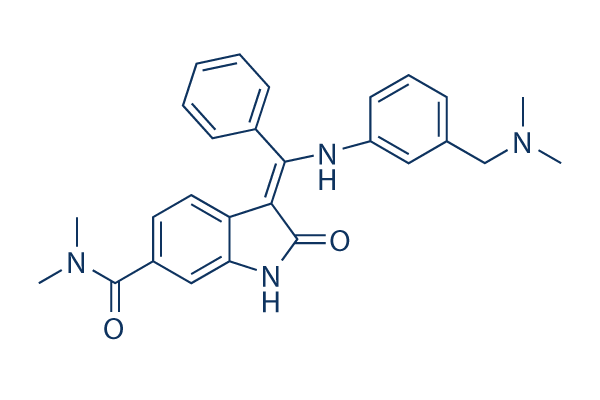
(E/Z)-BIX02189 MEK inhibitor
Cat.No.S1531
Quality Control
| Related Targets | ERK p38 MAPK Raf JNK Ras KRas S6 Kinase MAP4K TAK1 Mixed Lineage Kinase |
|---|---|
| Other MEK Inhibitors | PD0325901 (Mirdametinib) U0126-EtOH PD 98059 CI-1040 (PD184352) Pimasertib (AS-703026) Refametinib (RDEA119) TAK-733 AZD8330 GDC-0623 SL-327 |
Cell Culture, Treatment & Working Concentration
| Cell Lines | Assay Type | Concentration | Incubation Time | Formulation | Activity Description | PMID |
|---|---|---|---|---|---|---|
| HeLa | Function assay | Inhibition of ERK5 phosphorylation in sorbitol-stimulated human HeLa cells, IC50 = 0.059 μM. | 23656407 | |||
| DAOY | qHTS assay | qHTS of pediatric cancer cell lines to identify multiple opportunities for drug repurposing: Primary screen for DAOY cells | 29435139 | |||
| SJ-GBM2 | qHTS assay | qHTS of pediatric cancer cell lines to identify multiple opportunities for drug repurposing: Primary screen for SJ-GBM2 cells | 29435139 | |||
| SK-N-MC | qHTS assay | qHTS of pediatric cancer cell lines to identify multiple opportunities for drug repurposing: Primary screen for SK-N-MC cells | 29435139 | |||
| BT-37 | qHTS assay | qHTS of pediatric cancer cell lines to identify multiple opportunities for drug repurposing: Primary screen for BT-37 cells | 29435139 | |||
| NB-EBc1 | qHTS assay | qHTS of pediatric cancer cell lines to identify multiple opportunities for drug repurposing: Primary screen for NB-EBc1 cells | 29435139 | |||
| Saos-2 | qHTS assay | qHTS of pediatric cancer cell lines to identify multiple opportunities for drug repurposing: Primary screen for Saos-2 cells | 29435139 | |||
| SK-N-SH | qHTS assay | qHTS of pediatric cancer cell lines to identify multiple opportunities for drug repurposing: Primary screen for SK-N-SH cells | 29435139 | |||
| BT-12 | qHTS assay | qHTS of pediatric cancer cell lines to identify multiple opportunities for drug repurposing: Primary screen for BT-12 cells | 29435139 | |||
| OHS-50 | qHTS assay | qHTS of pediatric cancer cell lines to identify multiple opportunities for drug repurposing: Primary screen for OHS-50 cells | 29435139 | |||
| Click to View More Cell Line Experimental Data | ||||||
Solubility
|
In vitro |
DMSO
: 88 mg/mL
(199.75 mM)
Ethanol : 88 mg/mL Water : Insoluble |
Molarity Calculator
|
In vivo |
|||||
In vivo Formulation Calculator (Clear solution)
Step 1: Enter information below (Recommended: An additional animal making an allowance for loss during the experiment)
Step 2: Enter the in vivo formulation (This is only the calculator, not formulation. Please contact us first if there is no in vivo formulation at the solubility Section.)
Calculation results:
Working concentration: mg/ml;
Method for preparing DMSO master liquid: mg drug pre-dissolved in μL DMSO ( Master liquid concentration mg/mL, Please contact us first if the concentration exceeds the DMSO solubility of the batch of drug. )
Method for preparing in vivo formulation: Take μL DMSO master liquid, next addμL PEG300, mix and clarify, next addμL Tween 80, mix and clarify, next add μL ddH2O, mix and clarify.
Method for preparing in vivo formulation: Take μL DMSO master liquid, next add μL Corn oil, mix and clarify.
Note: 1. Please make sure the liquid is clear before adding the next solvent.
2. Be sure to add the solvent(s) in order. You must ensure that the solution obtained, in the previous addition, is a clear solution before proceeding to add the next solvent. Physical methods such
as vortex, ultrasound or hot water bath can be used to aid dissolving.
Chemical Information, Storage & Stability
| Molecular Weight | 440.54 | Formula | C27H28N4O2 |
Storage (From the date of receipt) | |
|---|---|---|---|---|---|
| CAS No. | 1094614-85-3 | Download SDF | Storage of Stock Solutions |
|
|
| Synonyms | N/A | SMILES | CN(C)CC1=CC(=CC=C1)N=C(C2=CC=CC=C2)C3=C(NC4=C3C=CC(=C4)C(=O)N(C)C)O | ||
Read more about storage stability stock solution CAS number SMILES
Mechanism of Action
| Targets/IC50/Ki |
MEK5
(Cell-free assay) 1.5 nM
ERK5
(Cell-free assay) 59 nM
|
|---|---|
| In vitro |
BIX02189 blocks MEK5 and ERK5 catalytic activity with IC50 values of 1.5 nM and 59 nM, respectively. They are more potent than the effect caused by BIX02188 with IC50 values of 4.3 nM and 810 nM, respectively. BIX02189 shows inhibitory activity against CSF1R (FMS) with IC50 of 46 nM but displays no activity against related kinases MEK1, MEK2, ERK1, p38α, JNK2, EGFR, and STK16 with IC50 values of >3.7 μM. Pretreatment with BIX02189 inhibits sorbitol-induced phosphorylation of ERK5 in HeLa cells in a dose dependent manner, and displays no inhibitory activity against the phosphorylation of ERK1/2, p38, and JNK1/2 MAPKs. Treatment with only BIX02189 for 24 hours in HeLa or HEK293 cells does not show any cytotoxic effect. BIX02189 inhibits MEK5/ERK5/MEF2C-driven luciferase expression in HeLa and HEK293 cells with IC50 values of 0.53 μM and 0.26 μM, respectively. This is a more significant than the effect caused by BIX02188.BIX02189 inhibits the activation of ERK5, and suppresses C-terminus of Hsc70-interacting protein (CHIP) mediated p53 ubiquitination, leading to the reverse of the protective effect caused by laminar flow (L-flow) in human umbilical vein endothelial cells (HUVECs) exposed to 15d-PGJ2.BIX02189 (10 uM) inhibits ERK5 phosphorylation, and reduces myocyte enhancer factor 2 (MEF2) transcriptional activity in neonatal rat cardiomyocytes (NRCMs) stimulated by isoproterenol. BIX02189 enhances the sorbitol induced apoptosis in NRCMs, confirming the protective role of ERK5 in cardiomyocytes. |
| Kinase Assay |
Catalytic assay
|
|
MEK5 protein isolated from the baculovirus expression system is used to measure kinase activity utilizing PKLight ATP Detection Reagent. The assay is performed using 15 nM GST-MEK5 and 0.75 μM ATP in assay buffer consisting of 25 mM Hepes, pH 7.5, 10 mM MgCl2, 50 mM KCl, 0.2% BSA, 0.01% CHAPS, 100 μM Na3VO4, 0.5 mM DTT and 1% DMSO in the presence of varying concentrations of BIX02189. The kinase reaction mixture is incubated for 90 minutes at room temperature followed by addition of 10 μL of ATP detection reagent for 15 minutes. The relative light unit (RLU) signal is measured and the RLU signals are converted to percent of control (POC) values for the determination of IC50 value.
|
References |
|
Tech Support
Tel: +1-832-582-8158 Ext:3
If you have any other enquiries, please leave a message.
Frequently Asked Questions
Question 1:
I would like to perform some in vivo experiments in immunodeficient mice. How to perform the experiment in the best way? How to reconstitute it for in vivo experiments?
Answer:
We suggest the following vehicle for this compound: 30% PEG400+0.5% Tween80+5% Propylene glycol, you can make a suspension at up to 30mg/ml that can be used for oral gavage. Or for i.p. injection, it can be dissolved in 2% DMSO+30% PEG 300+5% Tween 80+ddH2O at 10 mg/ml clearly.
Signaling Pathway Map

Products are for research use only. Not for human use. We do not sell to patients.
©Copyright 2013 Selleck Chemicals. All Rights Reserved.