
-
 Argentina
-
 Australia
-
 Austria
-
 Belgium
-
 Brazil
-
 Canada
-
 China
China
-
 Czech Republic
-
 Denmark
-
 Finland
-
 France
-
 Germany
-
 Greece
-
 Hong Kong
-
 Hungary
-
 Iceland
-
 India
India
-
 Ireland
-
 Israel
-
 Italy
Italy
-
 Japan
Japan
-
 Korea
Korea
-
 Luxembourg
-
 Malaysia
-
 Netherlands
-
 New Zealand
-
 Norway
-
 Poland
-
 Portugal
-
 Qatar
Qatar
-
 Romania
-
 Saudi Arabia
-
 Singapore
-
 Spain
Spain
-
 Sweden
-
 Switzerland
-
 Taiwan
-
 Turkey
-
 United Kingdom
-
 United States
TNF-alpha Activators
| Cat.No. | Product Name | Information | Product Use Citations | Product Validations |
|---|---|---|---|---|
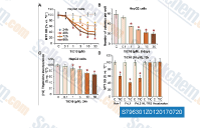
| S5584 | Citronellol | Citronellol (Dihydrogeraniol, (±)-β-Citronellol), a constituent of rose and geranium oils, is used in perfumes and insect repellents. This compound can cause necrotic apoptosis of NCI-H1299 cells by up-regulating TNF-α, RIP1 / RIP3 activities, and down-regulating caspase-3 / caspase-8 activities. It also results in a biphasic increase in ROS production at 1 h and at 12 h in NCI-H1299 cells. | ||
| S7963 | TIC10 (ONC201) | TIC10 (ONC201) inactivates Akt and ERK to induce TNF-related apoptosis-inducing ligand (TRAIL) through Foxo3a, possesses superior drug properties: delivery across the blood-brain barrier, superior stability and improved pharmacokinetics. Phase 1/2. |
|
|
| S2979 | CU-T12-9 | CU-T12-9 is a specific agonist of Toll-like receptor (TLR) 1/2 with EC50 of 52.9 nM in HEK-Blue hTLR2 SEAP assay. This compound activates both the innate and the adaptive immune systems. It signals through NF-κB and invokes an elevation of the downstream effectors TNF-α, IL-10, and iNOS. |
|
|
| S3865 | Taurochenodeoxycholic acid | Taurochenodeoxycholic acid (Taurochenodeoxycholate, TCDCA, Chenodeoxycholyltaurine), a bile acid formed in the liver of most species, is used as a cholagogue and choleretic. |
|
|

Products are for research use only. Not for human use. We do not sell to patients.
©Copyright 2013 Selleck Chemicals. All Rights Reserved.