
-
 Argentina
-
 Australia
-
 Austria
-
 Belgium
-
 Brazil
-
 Canada
-
 China
China
-
 Czech Republic
-
 Denmark
-
 Finland
-
 France
-
 Germany
-
 Greece
-
 Hong Kong
-
 Hungary
-
 Iceland
-
 India
India
-
 Ireland
-
 Israel
-
 Italy
Italy
-
 Japan
Japan
-
 Korea
Korea
-
 Luxembourg
-
 Malaysia
-
 Netherlands
-
 New Zealand
-
 Norway
-
 Poland
-
 Portugal
-
 Qatar
Qatar
-
 Romania
-
 Saudi Arabia
-
 Singapore
-
 Spain
Spain
-
 Sweden
-
 Switzerland
-
 Taiwan
-
 Turkey
-
 United Kingdom
-
 United States
research use only
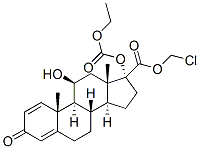
Loteprednol etabonate Glucocorticoid Receptor agonist
Cat.No.S1669
Quality Control
| Related Targets | Adrenergic Receptor Estrogen/progestogen Receptor GPR Androgen Receptor ACE RAAS Progesterone Receptor Opioid Receptor THR PGES |
|---|---|
| Other Glucocorticoid Receptor Inhibitors | Relacorilant (CORT125134) Corticosterone AL082D06 (20S)-Protopanaxatriol Cortodoxone |
Solubility
|
In vitro |
DMSO
: 93 mg/mL
(199.16 mM)
Ethanol : 4 mg/mL Water : Insoluble |
Molarity Calculator
|
In vivo |
|||||
In vivo Formulation Calculator (Clear solution)
Step 1: Enter information below (Recommended: An additional animal making an allowance for loss during the experiment)
Step 2: Enter the in vivo formulation (This is only the calculator, not formulation. Please contact us first if there is no in vivo formulation at the solubility Section.)
Calculation results:
Working concentration: mg/ml;
Method for preparing DMSO master liquid: mg drug pre-dissolved in μL DMSO ( Master liquid concentration mg/mL, Please contact us first if the concentration exceeds the DMSO solubility of the batch of drug. )
Method for preparing in vivo formulation: Take μL DMSO master liquid, next addμL PEG300, mix and clarify, next addμL Tween 80, mix and clarify, next add μL ddH2O, mix and clarify.
Method for preparing in vivo formulation: Take μL DMSO master liquid, next add μL Corn oil, mix and clarify.
Note: 1. Please make sure the liquid is clear before adding the next solvent.
2. Be sure to add the solvent(s) in order. You must ensure that the solution obtained, in the previous addition, is a clear solution before proceeding to add the next solvent. Physical methods such
as vortex, ultrasound or hot water bath can be used to aid dissolving.
Chemical Information, Storage & Stability
| Molecular Weight | 466.95 | Formula | C24H31ClO7 |
Storage (From the date of receipt) | |
|---|---|---|---|---|---|
| CAS No. | 82034-46-6 | Download SDF | Storage of Stock Solutions |
|
|
| Synonyms | N/A | SMILES | CCOC(=O)OC1(CCC2C1(CC(C3C2CCC4=CC(=O)C=CC34C)O)C)C(=O)OCCl | ||
Read more about storage stability stock solution CAS number SMILES
Mechanism of Action
| Targets/IC50/Ki |
Glucocorticoid receptor
|
|---|---|
| In vitro |
Loteprednol etabonate possesses a metabolically labile function, the 17beta-ester, that is designed to be rapidly deactivated in the systemic circulation. This compound exhibits a binding affinity which is 4.3 times that of dexamethasone, both compounds having a Hill factor close to 1 whereas PJ90 and PJ91 does not show any affinity to the receptor.
|
| In vivo |
Loteprednol etabonate administrated directly into the joint effectively blocks the inflammatory response. This compound prevents the adverse inflammatory effects of antigen action in a rabbit acute experimental model for arthritis. It (oral) reaches the upper GI tract effectively, but not the colon, due to absorption and/or decomposition in rats. This chemical shows a rapid, dose-dependent elimination with a total blood clearance (CLtotal) of higher than 60 ml/min/kg in rats. It absorbes systemically, after topical administration, can be rapidly transformed to the inactive metabolites, and eliminates from the body mainly through the bile and urine.
|
References |
|
Clinical Trial Information
(data from https://clinicaltrials.gov, updated on 2026-03-27)
| NCT Number | Recruitment | Conditions | Sponsor/Collaborators | Start Date | Phases |
|---|---|---|---|---|---|
| NCT07496060 | COMPLETED | Anterior Chamber Granulomatous Uveitis |
Fayoum University |
2025-08-10 | PHASE4 |
| NCT05542381 | COMPLETED | Age-Related Macular Degeneration |
Virginia Polytechnic Institute and State University |
2022-12-22 | |
| NCT05136443 | COMPLETED | Corneal Endothelial Dystrophy; Corneal Edema |
Price Vision Group |
2021-11-23 | PHASE4 |
| NCT07090044 | COMPLETED | Vein Occlusion; Macular Degeneration Choroidal Neovascularization; Macular Edema; Diabetic Retinopathy |
Retina Research Institute, LLC |
2021-08-20 | PHASE4 |
| NCT05322148 | COMPLETED | Dry Eye |
Research Insight LLC |
2022-06-03 | PHASE3 |
| NCT04555694 | COMPLETED | Dry Eye |
Thomas Chester, OD |
2020-10-01 | PHASE4 |
Read more about Clinical Trials
Tech Support
Tel: +1-832-582-8158 Ext:3
If you have any other enquiries, please leave a message.

Products are for research use only. Not for human use. We do not sell to patients.
©Copyright 2013 Selleck Chemicals. All Rights Reserved.