Phosphatidylinositol 3-kinase (PI 3-kinase or PI3K) is a famous target which is the upstream of akt because PI3K can activate Akt when PI3K is activated by growth factors including EGF, IGF, TGF-α and so on. The activation Class IA PI3Ks by growth factors is receptor tyrosine kinase (RTK)-dependent activation. Class IB PI3K is primarily regulated by small G-proteins such as Ras. PI3K is a key enzyme involved in cell processes, apoptosis and cancer. PI3K with mTOR, akt and MEK plays a key role in cancer. [show the full text]

-
 Argentina
-
 Australia
-
 Austria
-
 Belgium
-
 Brazil
-
 Canada
-
 China
China
-
 Czech Republic
-
 Denmark
-
 Finland
-
 France
-
 Germany
-
 Greece
-
 Hong Kong
-
 Hungary
-
 Iceland
-
 India
India
-
 Ireland
-
 Israel
-
 Italy
Italy
-
 Japan
Japan
-
 Korea
Korea
-
 Luxembourg
-
 Malaysia
-
 Netherlands
-
 New Zealand
-
 Norway
-
 Poland
-
 Portugal
-
 Qatar
Qatar
-
 Romania
-
 Saudi Arabia
-
 Singapore
-
 Spain
Spain
-
 Sweden
-
 Switzerland
-
 Taiwan
-
 Turkey
-
 United Kingdom
-
 United States
PI3K Inhibitors/Activators
| Cat.No. | Product Name | Information | Product Use Citations | Product Validations |
|---|---|---|---|---|
| S8668 | GDC-0077 (Inavolisib) | Inavolisib (GDC-0077, RG6114, RO-7113755) is a potent selective inhibitor of PI3K alpha (PI3Kα) with an IC50 of 0.038 nM. GDC-0077 is >300-fold more selective for PI3K alpha over the other class I PI3K isoforms (beta, delta, and gamma) and >2000-fold more selective over PIK family members. GDC-0077 binds to the ATP binding site of PI3K and inhibits the phosphorylation of PIP2 to PIP3. |
|
|
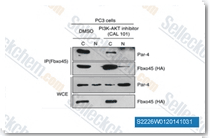
| S2226 | CAL-101 (Idelalisib) | Idelalisib (CAL-101) is a selective p110δ inhibitor with IC50 of 2.5 nM in cell-free assays; shown to have 40- to 300-fold greater selectivity for p110δ than p110α/β/γ, and 400- to 4000-fold more selectivity to p110δ than C2β, hVPS34, DNA-PK and mTOR. Idelalisib also stimulates autophagy. |
|
|
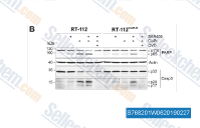
| S7682 | SAR405 | SAR405 is a low-molecular-mass kinase inhibitor of PIK3C3/Vps34 (KD 1.5 nM) showing high selectivity and not be active up to 10 μM on class I and class II PI3Ks as well as on mTOR. SAR405 prevents autophagy and synergizes with MTOR (mechanistic target of rapamycin) inhibition in tumor cells. |
|
|
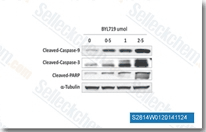
| S2814 | Alpelisib (BYL719) | Alpelisib (BYL719) is a potent and selective PI3Kα inhibitor with IC50 of 5 nM in a cell-free assay, and minimal effect on PI3Kβ/γ/δ. This compound is in Phase 2. |
|
|
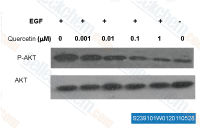
| S2391 | Quercetin (Sophoretin) | Quercetin, a natural flavonoid present in vegetables, fruit and wine, is a stimulator of recombinant SIRT1 and also a PI3K inhibitor with IC50 of 2.4-5.4 μM. Quercetin induces mitophagy, apoptosis and protective autophagy. Phase 4. |
|
|
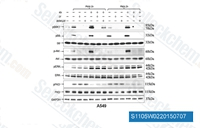
| S1105 | LY294002 | LY294002 (SF 1101, NSC 697286) is the first synthetic molecule known to inhibit PI3Kα/δ/β with IC50 of 0.5 μM/0.57 μM/0.97 μM, respectively; more stable in solution than Wortmannin, and also blocks autophagosome formation. It not only binds to class I PI3Ks and other PI3K-related kinases, but also to novel targets seemingly unrelated to the PI3K family. This compound also inhibits CK2 with IC50 of 98 nM. It is a non-specific DNA-PKcs inhibitor and activates autophagy and apoptosis. |
|
|
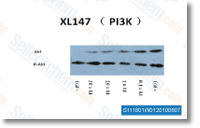
| S1118 | XL147 analogue | XL147 analogue (SAR245408) is a selective and reversible class I PI3K inhibitor for PI3Kα/δ/γ with IC50 of 39 nM/36 nM/23 nM in cell-free assays, less potent to PI3Kβ. This compound induces apoptosis. Phase 1/2. |
|
|
| E1815 | Tersolisib (STX-478) | Tersolisib (STX-478) is a highly potent, mutant-selective, allosteric inhibitor of PI3Kα, that selectively targets prevalent mutant forms of PI3Kα. It demonstrates strong efficacy against common PI3Kα helical- and kinase-domain mutations, including the H1047R variant, with an IC50 value of 9.4 nmol/L. STX-478 exhibits 14-fold greater selectivity for mutant PI3Kα over the wild-type form. It spares metabolic dysfunction and improves therapeutic response in PI3Kα-Mutant Xenografts. | ||
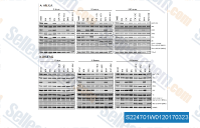
| S2247 | Buparlisib (BKM120) | Buparlisib (BKM120, NVP-BKM120) is a selective PI3K inhibitor of p110α/β/δ/γ with IC50 of 52 nM/166 nM/116 nM/262 nM in cell-free assays, respectively. Reduced potency against VPS34, mTOR, DNAPK, with little activity to PI4Kβ. Buparlisib induces apoptosis. Phase 2. |
|
|
| S7865 | 740 Y-P (PDGFR 740Y-P) | 740 Y-P (PDGFR 740Y-P, 740YPDGFR) is a cell-permeable phosphopeptide activator of PI3K. |
|
|
Signaling Pathway Map
Phosphatidylinositol 3-kinases (PI3Ks) are a family of lipid kinases whose biological function is to phosphorylate the 3-hydroxyl group of phosphoinositide. It is proved that PI3K-dependent signaling pathway contributes to many cellular processes such as cell growth, proliferation, differentiation, motility, survival and intracellular trafficking, which might be involved in oncogenesis under certain situation[1]. When a growth factor or ligand binds to the tyrosine kinase receptors (RTK), the PI3K is activated by G protein-coupled receptors[2]. PI3Ks family is generally divided into Class I, Class II, and Class III according to their primary structure, regulation, and in vitro lipid substrate specificity[2]. Class I PI3Ks are heterodimeric molecules composed of a regulatory subunit (p85) and a catalytic subunit (p110). The regulatory subunit of PI3K could be further divided in to six subtypes: p85-α, p85-β, p55-γ, p150,p101 and p87. P85α is the most highly expressed regulatory subunit than the others. And the catalytic subunit could also further divided into four subtypes: p110-α, p110-β, p110-γ and p110-δ. The α and β isoforms of p110 are expressed in all kinds of cells, whereas δ is only found in leukocytes. The regulatory subunit p101 and catalytic subunit p110γ comprise a complex which is classified as Class IB PI3K. Other collocations of regulatory and catalytic subunits are called Class IA PI3Ks. However, class II is structurally different from Class I. There are three catalytic isoforms of Class II PI3Ks: PI3K-C2α, -C2β, and -C2γ, but no regulatory subunit. Class III is structurally similar to Class I for the reason that it is composed of a catalytic (Vps34) and a regulatory subunit (p150). Functionally, class I PI3Ks catalyze the production of phosphatidylinositol 3-phosphate (PtdIns-3,4-P), phosphatidylinositol (3,4)-bisphosphate (PtdIns-3,4-P2), and phosphatidylinositol (3,4,5)-triphosphate (PtdIns-3,4,5-P3). Class II is related to the production of PtdIns-3-P and PtdIns-3,4-P2, while class III specifically catalyzes the production of PtdIns-3,4-P2 [3-5].

Products are for research use only. Not for human use. We do not sell to patients.
©Copyright 2013 Selleck Chemicals. All Rights Reserved.