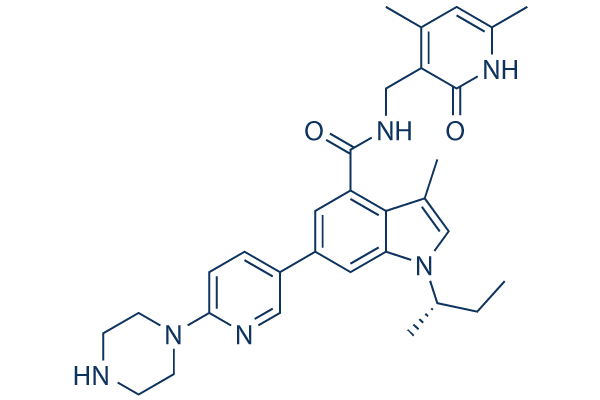
GSK126 EZH2 inhibitor

Cat.No.S7061

GSK126 (GSK2816126A, GSK2816126) is a potent, highly selective EZH2 methyltransferase inhibitor with IC50 of 9.9 nM, >1000-fold selective for EZH2 over 20 other human methyltransferases.
GSK126 Histone Methyltransferase inhibitor Chemical Structure

Chemical Structure

Molecular Weight: 526.67

Quality Control

Cell Culture, Treatment & Working Concentration

Cell Lines Assay Type Concentration Incubation Time Formulation Activity Description PMID
human U87MG cells Cytotoxic assay 72 h Cytotoxicity against human U87MG cells assessed as growth inhibition after 72 hrs by WST-1 assay, GI50=28.5 μM. 24767850
human A549 cells Cytotoxic assay 72 h Cytotoxicity against human A549 cells assessed as growth inhibition after 72 hrs by WST-1 assay, GI50=18.7 μM. 24767850
human T98G cells Cytotoxic assay 72 h Cytotoxicity against human T98G cells assessed as growth inhibition after 72 hrs by WST-1 assay, GI50=12.6 μM. 24767850
human Daudi cells Cytotoxic assay 72 h Cytotoxicity against human Daudi cells assessed as growth inhibition after 72 hrs by WST-1 assay, GI50=11.2 μM. 24767850
human PC3 cells Cytotoxic assay 72 h Cytotoxicity against human PC3 cells assessed as growth inhibition after 72 hrs by WST-1 assay, GI50=9.4 μM. 24767850
human U2932 cells Cytotoxic assay 72 h Cytotoxicity against human U2932 cells assessed as growth inhibition after 72 hrs by WST-1 assay, GI50=6.7 μM. 24767850
human HeLa cells Function assay 72 h Inhibition of EZH2 in human HeLa cells assessed as reduction in H3K27me3 levels incubated for 72 hrs by ELISA method, IC50=0.28 μM. 26189078
human Pfeiffer cells Cytotoxic assay 72 h Cytotoxicity against human Pfeiffer cells expressing EZH2 A667G mutant assessed as growth inhibition after 72 hrs by WST-1 assay, GI50=0.18 μM. 24767850
infected SF9 cells Binding affinity to EZH2 (unknown origin) expressed in baculovirus infected SF9 cells co-expressing SUZ12/EED/RbAp48 complex assessed as binding off-rate at 0.4 uM incubated for 20 mins by Q-TOF mass spectrometry 27512831
A673 cells qHTS of pediatric cancer cell lines to identify multiple opportunities for drug repurposing: Primary screen for A673 cells 29435139
DAOY cells qHTS of pediatric cancer cell lines to identify multiple opportunities for drug repurposing: Primary screen for DAOY cells 29435139
Saos-2 cells qHTS of pediatric cancer cell lines to identify multiple opportunities for drug repurposing: Primary screen for Saos-2 cells 29435139
BT-37 cells qHTS of pediatric cancer cell lines to identify multiple opportunities for drug repurposing: Primary screen for BT-37 cells 29435139
RD cells qHTS of pediatric cancer cell lines to identify multiple opportunities for drug repurposing: Primary screen for RD cells 29435139
SK-N-SH cells qHTS of pediatric cancer cell lines to identify multiple opportunities for drug repurposing: Primary screen for SK-N-SH cells 29435139
BT-12 cells qHTS of pediatric cancer cell lines to identify multiple opportunities for drug repurposing: Primary screen for BT-12 cells 29435139
MG 63 (6-TG R) cells qHTS of pediatric cancer cell lines to identify multiple opportunities for drug repurposing: Primary screen for MG 63 (6-TG R) cells 29435139
NB1643 cells qHTS of pediatric cancer cell lines to identify multiple opportunities for drug repurposing: Primary screen for NB1643 cells 29435139
OHS-50 cells qHTS of pediatric cancer cell lines to identify multiple opportunities for drug repurposing: Primary screen for OHS-50 cells 29435139
Rh41 cells qHTS of pediatric cancer cell lines to identify multiple opportunities for drug repurposing: Primary screen for Rh41 cells 29435139
SK-N-MC cells qHTS of pediatric cancer cell lines to identify multiple opportunities for drug repurposing: Primary screen for SK-N-MC cells 29435139
LAN-5 cells qHTS of pediatric cancer cell lines to identify multiple opportunities for drug repurposing: Primary screen for LAN-5 cells 29435139
Click to View More Cell Line Experimental Data

Chemical Information, Storage & Stability

Molecular Weight 526.67 Formula

C31H38N6O2

Storage (From the date of receipt)
CAS No. 1346574-57-9 Download SDF Storage of Stock Solutions

Synonyms GSK2816126A, GSK2816126 Smiles CCC(C)N1C=C(C2=C(C=C(C=C21)C3=CN=C(C=C3)N4CCNCC4)C(=O)NCC5=C(C=C(NC5=O)C)C)C

Solubility

In vitro
Batch:

DMSO : 5 mg/mL (9.49 mM)
(Moisture-contaminated DMSO may reduce solubility. Use fresh, anhydrous DMSO.)

Ethanol : 4 mg/mL

Water : Insoluble

Molarity Calculator

Mass Concentration Volume Molecular Weight

In vivo
Batch:

In vivo Formulation Calculator (Clear solution)

Step 1: Enter information below (Recommended: An additional animal making an allowance for loss during the experiment)

mg/kg
g
μL

Step 2: Enter the in vivo formulation (This is only the calculator, not formulation. Please contact us first if there is no in vivo formulation at the solubility Section.)

% DMSO
%
% Tween 80
% ddH2O
% DMSO
+
%

Calculation results:

Working concentration: mg/ml;

Method for preparing DMSO master liquid: mg drug pre-dissolved in μL DMSO ( Master liquid concentration mg/mL, Please contact us first if the concentration exceeds the DMSO solubility of the batch of drug. )

Method for preparing in vivo formulation: Take μL DMSO master liquid, next addμL PEG300, mix and clarify, next addμL Tween 80, mix and clarify, next add μL ddH2O, mix and clarify.

Method for preparing in vivo formulation: Take μL DMSO master liquid, next add μL Corn oil, mix and clarify.

Note: 1. Please make sure the liquid is clear before adding the next solvent.
2. Be sure to add the solvent(s) in order. You must ensure that the solution obtained, in the previous addition, is a clear solution before proceeding to add the next solvent. Physical methods such
as vortex, ultrasound or hot water bath can be used to aid dissolving.

Mechanism of Action

Targets/IC50/Ki
EZH2 [1]
(Cell-free assay)
9.9 nM
In vitro
In vitro, GSK126 most potently inhibits H3K27me3, followed by H3K27me2 in both EZH2 wild-type and mutant DLBCL cell lines. This compound also effectively inhibits the proliferation of EZH2 mutant DLBCL cell lines, and induces transcriptional activation of EZH2 target genes in sensitive cell lines. [1] In A687V EZH2-mutant cells, this treatment results in a global decrease in H3K27me3, robust gene activation, caspase activation, and decreased proliferation. [2] In parental H2087 cells, it inhibits the expression of VEGF-A and phosphorylated Ser(473)-AKT, and thus causes the inhibition of cell proliferation, migration and metastasis. [3]
Kinase Assay
EZH2 assay
The five-member PRC2 complex (Flag–EZH2, EED, SUZ12, AEBP2, RbAp48) containing either wild-type or mutant EZH2 is prepared. GSK126 is dissolved in DMSO and tested at concentrations of 0.6 nM to 300 nM with a final DMSO concentration of 2.5%. In contrast to wild-type EZH2 which prefers H3K27me0 as a substrate in vitro, EZH2 Y641 mutants prefer H3K27me2 and have little activity with H3K27me0 or H3K27me1. The A677G mutant is distinct from both the wild-type and Y641 mutant forms of EZH2 in that it efficiently methylates H3K27me0, H3K27me1, and H3K27me2; therefore, histone H3 peptides (residues 21–44; 10 μM final) with either K27me0 (wild type, A677G EZH2), K27me1 (A677G EZH2), or K27me2 (A677G, Y641N, Y641C, Y641H, Y641S and Y641F EZH2) are used as methyltransferase substrates. This compound is added to plates followed by addition of 6 nM EZH2 complex and peptide. As the potency of this chemical is at or near the tight binding limit of an assay run at [SAM] = Km, IC50 values are measured at a high concentration of the competitive substrate SAM relative to its Km (7.5 μM SAM where the SAM Km is 0.3 μM). Under these conditions, the contribution from the enzyme concentration becomes relatively small and accurate estimates of Ki can be calculated. Reactions are initiated with [3H]-SAM, incubated for 30 min, quenched with the addition of 500-fold excess unlabelled SAM, and the methylated product peptide is captured on phosphocellulose filters according to the vendor supplied protocol for MSPH Multiscreen plates. Plates are read on a TopCount after adding 20 μL of Microscint-20 cocktail. Apparent Ki values are calculated using the Cheng–Prusoff relationship for a competitive inhibitor. IC50=Ki (1+[S]/Km)+[E]/2, where E is the enzyme and S is the substrate.
In vivo
In mice bearing KARPAS-422 and Pfeiffer xenografts, GSK126 (150 mg/kg/d, i.p.) decreases global H3K27me3, increases gene expression, and thus causes marked tumour regression. [1]
References

Applications

Methods Biomarkers Images PMID
Western blot β-catenin / c-Myc / LEF1 / DVL2 / DVL3 / p-GSK3β XIAP / Survivin / MCL-1 / BID / BIM / BAX / BCL-xl/ Bcl-2 H3K27Me3 / EZH2 S7061-WB3 27926488
Immunofluorescence H3K27me3 S7061-IF1 25053977
Growth inhibition assay Cell proliferation Cell viability S7061-proliferation 29685965

Clinical Trial Information

(data from https://clinicaltrials.gov, updated on 2024-05-22)

NCT Number Recruitment Conditions Sponsor/Collaborators Start Date Phases
NCT02082977 Terminated
Cancer|Neoplasms
GlaxoSmithKline
April 24 2014 Phase 1

Tech Support

Handling Instructions

Tel: +1-832-582-8158 Ext:3

If you have any other enquiries, please leave a message.

Frequently Asked Questions

Question 1:
Could you please suggest a vehicle for in vivo uses of this compound without oil?

Answer:
It could be dissolved in 4% DMSO+30% PEG 300+ddH2O (0.5mg/ml).

Question 2:
Does this compound require an activation step to be functional? For example, an acidic or basic environment.

Answer:
It does not require an activation step to be functional.

Signaling Pathway Map