
-
 Argentina
-
 Australia
-
 Austria
-
 Belgium
-
 Brazil
-
 Canada
-
 China
China
-
 Czech Republic
-
 Denmark
-
 Finland
-
 France
-
 Germany
-
 Greece
-
 Hong Kong
-
 Hungary
-
 Iceland
-
 India
India
-
 Ireland
-
 Israel
-
 Italy
Italy
-
 Japan
Japan
-
 Korea
Korea
-
 Luxembourg
-
 Malaysia
-
 Netherlands
-
 New Zealand
-
 Norway
-
 Poland
-
 Portugal
-
 Qatar
Qatar
-
 Romania
-
 Saudi Arabia
-
 Singapore
-
 Spain
Spain
-
 Sweden
-
 Switzerland
-
 Taiwan
-
 Turkey
-
 United Kingdom
-
 United States
research use only
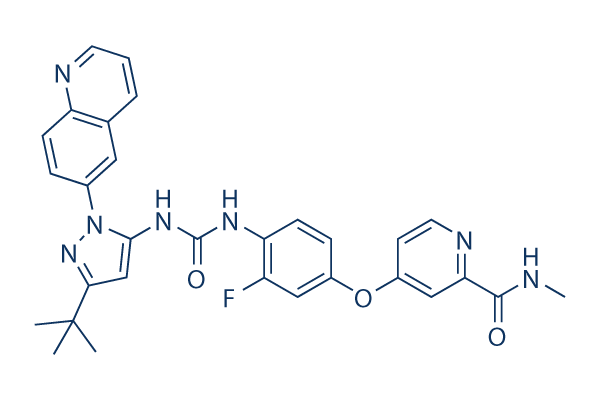
Rebastinib (DCC-2036) Bcr-Abl inhibitor
Cat.No.S2634
Quality Control
| Related Targets | EGFR VEGFR JAK FGFR PDGFR Src HIF FLT3 HER2 FLT |
|---|---|
| Other Bcr-Abl Inhibitors | Degrasyn (WP1130) Bafetinib (INNO-406) GNF-5 Berbamine GNF-2 Olverembatinib dimesylate (GZD824) PD173955 GNF-7 Berbamine dihydrochloride Radotinib |
Solubility
|
In vitro |
DMSO
: 111 mg/mL
(200.5 mM)
Ethanol : 18 mg/mL Water : Insoluble |
Molarity Calculator
|
In vivo |
|||||
In vivo Formulation Calculator (Clear solution)
Step 1: Enter information below (Recommended: An additional animal making an allowance for loss during the experiment)
Step 2: Enter the in vivo formulation (This is only the calculator, not formulation. Please contact us first if there is no in vivo formulation at the solubility Section.)
Calculation results:
Working concentration: mg/ml;
Method for preparing DMSO master liquid: mg drug pre-dissolved in μL DMSO ( Master liquid concentration mg/mL, Please contact us first if the concentration exceeds the DMSO solubility of the batch of drug. )
Method for preparing in vivo formulation: Take μL DMSO master liquid, next addμL PEG300, mix and clarify, next addμL Tween 80, mix and clarify, next add μL ddH2O, mix and clarify.
Method for preparing in vivo formulation: Take μL DMSO master liquid, next add μL Corn oil, mix and clarify.
Note: 1. Please make sure the liquid is clear before adding the next solvent.
2. Be sure to add the solvent(s) in order. You must ensure that the solution obtained, in the previous addition, is a clear solution before proceeding to add the next solvent. Physical methods such
as vortex, ultrasound or hot water bath can be used to aid dissolving.
Chemical Information, Storage & Stability
| Molecular Weight | 553.59 | Formula | C30H28FN7O3 |
Storage (From the date of receipt) | |
|---|---|---|---|---|---|
| CAS No. | 1020172-07-9 | Download SDF | Storage of Stock Solutions |
|
|
| Synonyms | N/A | SMILES | CC(C)(C)C1=NN(C(=C1)NC(=O)NC2=C(C=C(C=C2)OC3=CC(=NC=C3)C(=O)NC)F)C4=CC5=C(C=C4)N=CC=C5 | ||
Read more about storage stability stock solution CAS number SMILES
Mechanism of Action
| Features |
A conformational control inhibitor of Abl1 and T315I Abl1.
|
|---|---|
| Targets/IC50/Ki |
u-Abl1 (native)
(Cell-free assay) 0.75 nM
Abl1 (H396P)
(Cell-free assay) 1.4 nM
p-Abl1 (native)
(Cell-free assay) 2 nM
FLT3
(Cell-free assay) 2 nM
p-Abl1 (T315I)
(Cell-free assay) 4 nM
KDR
(Cell-free assay) 4 nM
u-Abl1 (T315I)
(Cell-free assay) 5 nM
Tie-2
(Cell-free assay) 6 nM
Lyn
(Cell-free assay) 29 nM
Src
(Cell-free assay) 34 nM
FGR
(Cell-free assay) 38 nM
Hck
(Cell-free assay) 40 nM
PDGFRα
(Cell-free assay) 70 nM
|
| In vitro |
Rebastinib (DCC-2036) shows potent inhibitory activities against purified native Abl1 in unphosphorylated (u-Abl1native) and phosphorylated (p-Abl1native) forms, unphosphorylated and phosphorylated gatekeeper mutant Abl1T315I, and the activation loop mutant Abl1H396P in a non-ATP-competitive manner with IC50 values of 0.8 nM, 2 nM, 1.4 nM, 5 nM, and 4 nM, respectively. Moreover, it also inhibits the Src family kinases Src, LYN, FGR, and HCK, and the receptor TKs KDR, FLT3, and TIE2 with IC50 values of 34 nM, 29 nM, 38 nM, 40 nM, 4 nM, 2 nM and 6 nM, respectively. This compound shows anti-proliferative activities against Ba/F3 cells expressing native or mutant Bcr-Abl1 with IC50 ranging from 2 nM to 150 nM. In addition, it also inhibits proliferation of the Ph+ cell line K562 (IC50 5.5 nM), and induces apoptosis in both Bcr-Abl1-expressing Ba/F3 and K562 cells potently. A recent study shows that it exhibits selectivity for growth inhibition of Bcr-Abl-positive cells by its marked inhibition of CML cell lines compared to non-CML leukemia lines.
|
| Kinase Assay |
Assay of Abl1 kinase isoforms and determination of inhibitor potency
|
|
Activity of u-Abl1native is determined by following the production of ADP from the kinase reaction through coupling with the pyruvate kinase/lactate dehydrogenase system. In this assay, the oxidation of NADH (measured as a decreased A340nm) is continuously monitored spectrophotometrically. The final reaction mixture (100 μL, in a 384-well Corning plate) is prepared as follows: An Abl1 kinase/coupled assay components mixture is prepared containing u-Abl1 kinase (1 nM), Abltide (EAIYAAPFAKKK, 0.2 mM), MgCl2 (9 mM), pyruvate kinase (~ 4 units), lactate dehydrogenase (~ 0.7 units), phosphoenol pyruvate (1 mM), and NADH (0.28 mM) in 90 mM Tris containing 0.1 % octyl-glucoside and 1 % DMSO, pH 7.5. Separately, an inhibitor mixture is prepared containing Rebastinib (DCC-2036) serially diluted 3-fold in DMSO followed by dilution into buffer composed of 180 mM Tris, pH 7.5, containing MgCl2 (18 mM) and 0.2 % octyl-glucoside. Fifty μL of the inhibitor mixture is mixed with 50 μL of the above Abl1 kinase/coupled assay components mixture, which is then incubated at 30 °C for 2 hours before 2 μL of 25 mM ATP (500 μM, final) is added to start the reaction. The reaction is recorded every 2 minutes for 2.5 hours at 30 °C on a Polarstar Optima or Synergy2 plate reader. Reaction rate (slope) is calculated using the 1 to 2 hour time frame with reader's software. Percent inhibition is obtained by comparison of reaction rate with that of a DMSO control. IC50 values are calculated from a series of percent inhibition values determined at a range of inhibitor concentrations using GraphPad Prism. The kinase assay for Abl1T315I, p-Abl1native or Abl1H396P is assayed the same as above except that 2.2 nM Abl1T315I, 1 nM p-Abl1 native or 1.3 nM Abl1H396P is used. The above assay format is also used for kinases other than Abl1 with the exception of TIE2, for which a fluorescence polarization/Transcreener format is used. The assay conditions are the same as described above except that PolyE4Y (final 1 mg/mL) is used as the substrate and one hour preincubation is used.
|
|
| In vivo |
In a mouse allograft model bearing Ba/F3-Bcr-Abl1T315I leukemia cells, treatment with Rebastinib (DCC-2036) by oral gavage at 100 mg/kg once daily effectively inhibits Bcr-Abl1 signaling and significantly prolongs mouse survival.
|
References |
|
Clinical Trial Information
(data from https://clinicaltrials.gov, updated on 2024-12-27)
| NCT Number | Recruitment | Conditions | Sponsor/Collaborators | Start Date | Phases |
|---|---|---|---|---|---|
| NCT03601897 | TERMINATED | Locally Advanced or Metastatic Solid Tumor |
Deciphera Pharmaceuticals, LLC |
2018-10-25 | PHASE1; PHASE2 |
| NCT03717415 | TERMINATED | Locally Advanced or Metastatic Solid Tumor |
Deciphera Pharmaceuticals, LLC |
2019-01-02 | PHASE1; PHASE2 |
| NCT02824575 | TERMINATED | Breast Cancer; Breast Adenocarcinoma; Human Epidermal Growth Factor 2 Negative Carcinoma of Breast; Recurrent Breast Carcinoma; Stage IV Breast Cancer |
Montefiore Medical Center |
2016-07 | PHASE1 |
| NCT03717415 | Completed | Locally Advanced or Metastatic Solid Tumor |
Deciphera Pharmaceuticals LLC |
2019-01-02 | Phase 1|Phase 2 |
| NCT03601897 | Completed | Locally Advanced or Metastatic Solid Tumor |
Deciphera Pharmaceuticals LLC |
2018-10-25 | Phase 1|Phase 2 |
| NCT00827138 | COMPLETED | Chronic Myeloid Leukemia |
Deciphera Pharmaceuticals, LLC |
2009-03 | PHASE1 |
Read more about Clinical Trials
Tech Support
Tel: +1-832-582-8158 Ext:3
If you have any other enquiries, please leave a message.
Signaling Pathway Map

Products are for research use only. Not for human use. We do not sell to patients.
©Copyright 2013 Selleck Chemicals. All Rights Reserved.