
-
 Australia
-
 Austria
-
 Belgium
-
 Brazil
-
 Canada
-
 China
China
-
 Czech Republic
-
 Denmark
-
 Finland
-
 France
-
 Germany
-
 Greece
-
 Hong Kong
-
 Hungary
-
 Iceland
-
 India
India
-
 Ireland
-
 Israel
-
 Italy
Italy
-
 Japan
Japan
-
 Korea
Korea
-
 Luxembourg
-
 Malaysia
-
 Netherlands
-
 New Zealand
-
 Norway
-
 Poland
-
 Qatar
Qatar
-
 Romania
-
 Saudi Arabia
-
 Singapore
-
 Spain
Spain
-
 Sweden
-
 Switzerland
-
 Taiwan
-
 Turkey
-
 United Kingdom
-
 United States
p53 Inhibitors
| Cat.No. | Product Name | Information | Product Use Citations | Product Validations |
|---|---|---|---|---|
| S8149 | NSC348884 | NSC348884, as a nucleophosmin inhibitor, inhibit cell proliferation and induce apoptosis in various cancer cell lines with IC50 values ranging from 1.4-4 µM. |
|
|
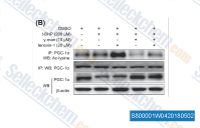
| S8000 | Tenovin-1 | Tenovin-1 protects against MDM2-mediated p53 degradation, which involves ubiquitination, and acts through inhibition of protein-deacetylating activities of SirT1 and SirT2. This compound is also an inhibitor of dihydroorotate dehydrogenase (DHODH). |
|
|
| S4900 | Tenovin-6 | Tenovin-6 is a small molecule activator of p53 transcriptional activity and inhibits dihydroorotate dehydrogenase (DHODH). This compound is also an inhibitor of SirT1 and SirT2. |
|
|
| S8106 | NSC59984 | NSC59984 is a p53 pathway activator via induction of mutant p53 protein degradation and p73 activation. |
|
|
| S8580 | COTI-2 | COTI-2 is an orally available third generation thiosemicarbazone and activator of mutant forms of the p53 protein, with potential antineoplastic activity. |
|
|
| S5791 | Cyclic Pifithrin-α hydrobromide | Cyclic Pifithrin-α hydrobromide is the hydrobromide salt form of Cyclic Pifithrin-α, which is a transcriptional inhibitor of p53. |
|
|
| S8187 | ReACp53 | ReACp53 is a cell-penetrating peptide, designed to inhibit p53 amyloid formation, resues p53 function in cancer cell lines and in organoids derived from high-grade serous ovarian carcinomas (HGSOC). |
|
|
| S5811 | Kevetrin hydrochloride | Kevetrin hydrochloride (Thioureidobutyronitrile) is a water-soluble, small molecule and activator of the tumor suppressor protein p53, with potential antineoplastic activity. |
|
|
| E2943 | Pifithrin-β | Pifithrin-β (PFT β hydrobromide; Cyclic Pifithrin-α hydrobromide) is a potent inhibitor of p53 with an IC50 of 23 μM and is regarded as a lead compound for cancer and neurodegenerative disease therapy. |
|
|
| S9235 | Didymin | Didymin (Neoponcirin, Isosakuranetin-7-O-rutinoside) is a citrus-derived natural compound that kills p53 wild-type as well as drug-resistant p53-mutant neuroblastoma cells in culture. It possesses antioxidant, anti-inflammation and anti-cancer properties. | ||
| E1971 | Rezatapopt | Rezatapopt(PC14586) is a first-in-class p53 reactivator. It selectively binds to the mutated p53 Y220C protein and restores its wild-type activity. It can also be used to inhibit solid tumor with p53 mutation. | ||
| E0935 | MS7972 | MS7972 is a small molecule that blocks human p53 and CREB binding protein association. | ||
| E0035 | CP-31398 Dihydrochloride |
CP-31398 Dihydrochloride stabilizes the active conformation of p53 and promotes p53 activity in cancer cell lines with mutant or wild-type p53. |
||
| E7154 | C16-Ceramide | C16-Ceramide (N-Palmitoylsphingosine)is a sphingolipid ligand and an activator of p53 tumor suppressor. It tightly binds within the p53 DNA-binding domain with a Kd of ~ 60 nM, in close vicinity to the Box V motif. It regulates the protein ubiquitination and proteasomal degradation and also induces apoptosis in cancer cells making it a research tool for targeting human cancers. | ||
| E1735 | PK11007 | PK11007 is a thiol-reactive anticancer agent that stabilizes p53 via selective alkylation of two surface cysteines without compromising its DNA binding. It induces mutant p53 cancer cell death by increasing reactive oxygen species (ROS) levels. | ||
| S9488 | Lobetyolin | Lobetyolin is one of the important active ingredients extracted from the root of Codonopsis pilosula, which has a good protective effect on gastric mucosal damage. This compound can downregulate glutamine metabolism, contribute to drug-induced apoptosis and tumor growth inhibition, and it significantly reduces the mRNA and protein expression of the amino acid transporter alanine-serine-cysteine transporter 2 (ASCT2). | ||
| S8728 | PK11000 | PK11000 stabilizes the DBD of both WT and mutant p53 proteins by covalent cysteine modification without compromising DNA binding and effective in inducing cell death. | ||
| S2427 | Triglycidyl Isocyanurate (Teroxirone) | Triglycidyl Isocyanurate (Teroxirone, Tris(2,3-epoxypropyl) Isocyanurate, TGI, TGIC) is a triazene triepoxide with antineoplastic activity. It inhibits growth of human non-small cell lung cancer cells by activating p53. This compound alkylates and cross-links DNA, thereby inhibiting DNA replication. It is also used in various polyester powder coatings in the metal finishing industry. | ||
| S2341 | (-)-Parthenolide | (-)-Parthenolide, an inhibitor of the Nuclear Factor-κB Pathway, specifically depletes HDAC1 protein without affecting other class I/II HDACs; Also promotes the ubiquitination of MDM2 and activates p53 cellular functions. |
|
-Parthenolide-S234101W0220161110.gif)
|
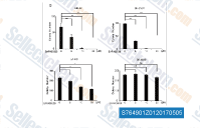
| S7649 | SAR405838 | SAR405838 is an orally available MDM2 antagonist with Ki of 0.88 nM. This compound is a diastereomer of MI-773 (CAS: 1303607-07-9). Phase 1. |
|
|
| S0507 | CBL0137 | CBL0137 (Curaxin-137) is an inhibitor of the histone chaperone FACT (facilitates chromatin transcription) that simultaneously suppresses NF-κB and activates p53 with EC50 of 0.47 μM and 0.37 μM, respectively. |
|
|
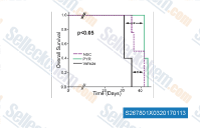
| S2678 | NSC 207895 | NSC 207895 (XI-006) suppresses MDMX with IC50 of 2.5 μM, leading to enhanced p53 stabilization/activation and DNA damage, and also regulates MDM2, an E3 ligase. |
|
|
| E3037 | Solanum lyratum Extract | Solanum lyratum Extract (300 μg/ml) increases Bax levels and decreases Bcl-2 levels, which cause the loss of mitochondrial membrane potential (Δæm) followed by cytochrome C release and caspase-9 and -3 activation, finally leading to apoptosis. This compound also promotes p53 and p27, but decreases the levels of cyclin B1 thus causing S-phase arrest. | ||
| S2176 | Tenovin-3 | Tenovin-3 is an inhibitor of SIRT2. This compound is able to increase p53 levels in MCF-7 cells. | ||
| S6882 | HI-TOPK-032 | HI-TOPK-032 is a potent and specific inhibitor of TOPK. This compound also reduces ERK-RSK phosphorylation, regulates of the abundance of p53, cleaved caspase-7, and cleaved PARP, and induces apoptosis in cancer cells. | ||
| E0068 | NiCur | NiCur is a small molecule which blocks CREB-binding protein (CBP) histone acetyltransferase (HAT) activity and downregulates p53 activation upon genotoxic stress and diminishs the recruitment of p53 as well as RNA Polymerase II and levels of acetylation on histone H3 on CDKN1A promoter. | ||
| E0394 | YK 3-237 | YK-3-237, a SIRT1 activator, reduces acetylation of mutant p53 and inhibits the proliferation of triple-negative breast cancer cells. | ||
| S6851 | RA-190 | RA190, a bis-benzylidine piperidon, is a potent, selective and oral effective inhibitor of proteasome ubiquitin receptor RPN13/ADRM1 with anticancer activity. RA190 triggers ER stress response, p53/p21 signaling axis and autophagy in multiple myeloma cells. |

Products are for research use only. Not for human use. We do not sell to patients.
©Copyright 2013 Selleck Chemicals. All Rights Reserved.