
-
 Argentina
-
 Australia
-
 Austria
-
 Belgium
-
 Brazil
-
 Canada
-
 China
China
-
 Czech Republic
-
 Denmark
-
 Finland
-
 France
-
 Germany
-
 Greece
-
 Hong Kong
-
 Hungary
-
 Iceland
-
 India
India
-
 Ireland
-
 Israel
-
 Italy
Italy
-
 Japan
Japan
-
 Korea
Korea
-
 Luxembourg
-
 Malaysia
-
 Netherlands
-
 New Zealand
-
 Norway
-
 Poland
-
 Portugal
-
 Qatar
Qatar
-
 Romania
-
 Saudi Arabia
-
 Singapore
-
 Spain
Spain
-
 Sweden
-
 Switzerland
-
 Taiwan
-
 Turkey
-
 United Kingdom
-
 United States
p53 Inhibitors
| Cat.No. | Product Name | Information | Product Use Citations | Product Validations |
|---|---|---|---|---|
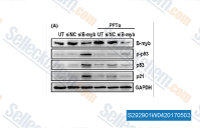
| S2929 | Pifithrin-α (PFTα) Hhydrobromide | Pifithrin-α is an inhibitor of p53, inhibiting p53-dependent transactivation of p53-responsive genes. Pifithrin-α is also a potent agonist of the aryl hydrocarbon receptor (AhR). |
|
|
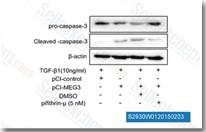
| S2930 | Pifithrin-μ | Pifithrin-μ (NSC 303580, PFTμ, 2-Phenylethynesulfonamide) is a specific p53 inhibitor by reducing its affinity to Bcl-xL and Bcl-2, and this compound also inhibits HSP70 function and autophagy. |
|
|
| S5791 | Cyclic Pifithrin-α hydrobromide | Cyclic Pifithrin-α hydrobromide is the hydrobromide salt form of Cyclic Pifithrin-α, which is a transcriptional inhibitor of p53. |
|
|
| S8187 | ReACp53 | ReACp53 is a cell-penetrating peptide, designed to inhibit p53 amyloid formation, resues p53 function in cancer cell lines and in organoids derived from high-grade serous ovarian carcinomas (HGSOC). |
|
|
| E2943 | Pifithrin-β | Pifithrin-β (PFT β hydrobromide; Cyclic Pifithrin-α hydrobromide) is a potent inhibitor of p53 with an IC50 of 23 μM and is regarded as a lead compound for cancer and neurodegenerative disease therapy. |
|
|
| S9235 | Didymin | Didymin (Neoponcirin, Isosakuranetin-7-O-rutinoside) is a citrus-derived natural compound that kills p53 wild-type as well as drug-resistant p53-mutant neuroblastoma cells in culture. It possesses antioxidant, anti-inflammation and anti-cancer properties. | ||
| E0935 | MS7972 | MS7972 is a small molecule that blocks human p53 and CREB binding protein association. | ||
| E1735 | PK11007 | PK11007 is a thiol-reactive anticancer agent that stabilizes p53 via selective alkylation of two surface cysteines without compromising its DNA binding. It induces mutant p53 cancer cell death by increasing reactive oxygen species (ROS) levels. | ||
| S9488 | Lobetyolin | Lobetyolin is one of the important active ingredients extracted from the root of Codonopsis pilosula, which has a good protective effect on gastric mucosal damage. This compound can downregulate glutamine metabolism, contribute to drug-induced apoptosis and tumor growth inhibition, and it significantly reduces the mRNA and protein expression of the amino acid transporter alanine-serine-cysteine transporter 2 (ASCT2). | ||
| S7030 | RG-7112 | RG7112 (RO5045337) is an orally bioavailable and selective p53-MDM2 inhibitor with HTRF IC50 of 18 nM. |
|
|
| E0068 | NiCur | NiCur is a small molecule which blocks CREB-binding protein (CBP) histone acetyltransferase (HAT) activity and downregulates p53 activation upon genotoxic stress and diminishs the recruitment of p53 as well as RNA Polymerase II and levels of acetylation on histone H3 on CDKN1A promoter. | ||
| E0394 | YK 3-237 | YK-3-237, a SIRT1 activator, reduces acetylation of mutant p53 and inhibits the proliferation of triple-negative breast cancer cells. | ||

Products are for research use only. Not for human use. We do not sell to patients.
©Copyright 2013 Selleck Chemicals. All Rights Reserved.