
-
 Australia
-
 Austria
-
 Belgium
-
 Brazil
-
 Canada
-
 China
China
-
 Czech Republic
-
 Denmark
-
 Finland
-
 France
-
 Germany
-
 Greece
-
 Hong Kong
-
 Hungary
-
 Iceland
-
 India
India
-
 Ireland
-
 Israel
-
 Italy
Italy
-
 Japan
Japan
-
 Korea
Korea
-
 Luxembourg
-
 Malaysia
-
 Netherlands
-
 New Zealand
-
 Norway
-
 Poland
-
 Qatar
Qatar
-
 Romania
-
 Saudi Arabia
-
 Singapore
-
 Spain
Spain
-
 Sweden
-
 Switzerland
-
 Taiwan
-
 Turkey
-
 United Kingdom
-
 United States
p38 MAPK Activators
| Cat.No. | Product Name | Information | Product Use Citations | Product Validations |
|---|---|---|---|---|
| S2266 | Asiatic Acid | Asiatic acid (Dammarolic acid, Asiantic acid) is the aglycone of asiaticoside isolated from the plant Centella asiatica, commonly used in wound healing. |
|
|
| E0526 | sappanone A | Sappanone A, a homoisoflavanone isolated from the heartwood of Caesalpinia sappan (Leguminosae), induces HO-1 expression by activating Nrf2 through the p38 MAPK pathway, suppresses LPS-induced NF-κB activation by suppressing the phosphorylation of RelA/p65 at Ser536, exerting its anti-inflammatory effect. |
|
|
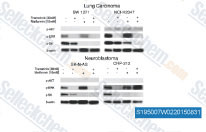
| S1950 | Metformin Hydrochloride | Metformin Hydrochloride (1,1-Dimethylbiguanide Hydrochloride) is a highly effective Antihyperglycemic Agent, which primarily decreases hyperglycemia in hepatocytes by suppressing hepatic gluconeogenesis (glucose production by the liver). It also promotes mitophagy in mononuclear cells and induces apoptosis of lung cancer cells through activating the JNK/p38 MAPK pathway and GADD153. |
|
|
| S5958 | Metformin (1,1-Dimethylbiguanide) | Metformin (1,1-Dimethylbiguanide), a widely used drug for treatment of type 2 diabetes, activates AMP-activated protein kinase (AMPK) in hepatocytes. Metformin promotes mitophagy in mononuclear cells. Metformin induces apoptosis of lung cancer cells through activating JNK/p38 MAPK pathway and GADD153. |
|
|
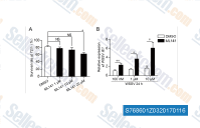
| S7686 | ML141 (CID-2950007) | ML141 (CID-2950007) is demonstrated to be a potent, selective and reversible non-competitive inhibitor of Cdc42 GTPase suitable for in vitro assays, with IC50 of 200 nM and selectivity against other members of the Rho family of GTPases (Rac1, Rab2, Rab7). ML141 is associated with an increase in p38 activation and may induce p38-dependent apoptosis/senescence. ML141 also protects neuroblastoma cells from metformin-induced apoptosis. |
|
|
| S2271 | Berberine chloride | Berberine chloride is a quaternary ammonium salt from the group of isoquinoline alkaloids. This compound activates caspase 3 and caspase 8, cleavage of poly ADP-ribose polymerase (PARP) and the release of cytochrome c. It decreases the expression of c-IAP1, Bcl-2 and Bcl-XL. This chemical induces apoptosis with sustained phosphorylation of JNK and p38 MAPK, as well as generation of the ROS. It is a dual topoisomerase I and II inhibitor. It is also a potential autophagy modulator. |
|
|
| S5967 | Berberine chloride hydrate | Berberine (Natural Yellow 18) chloride hydrate is a quaternary ammonium salt from the group of isoquinoline alkaloids. Berberine activates caspase 3 and caspase 8, cleavage of poly ADP-ribose polymerase (PARP) and the release of cytochrome c. Berberine chloride decreases the expression of c-IAP1, Bcl-2 and Bcl-XL. Berberine chloride induces apoptosis with sustained phosphorylation of JNK and p38 MAPK, as well as generation of the ROS. Berberine chloride is a dual topoisomerase I and II inhibitor. Berberine chloride is also a potential autophagy modulator. |
|
|

Products are for research use only. Not for human use. We do not sell to patients.
©Copyright 2013 Selleck Chemicals. All Rights Reserved.