
-
 Argentina
-
 Australia
-
 Austria
-
 Belgium
-
 Brazil
-
 Canada
-
 China
China
-
 Czech Republic
-
 Denmark
-
 Finland
-
 France
-
 Germany
-
 Greece
-
 Hong Kong
-
 Hungary
-
 Iceland
-
 India
India
-
 Ireland
-
 Israel
-
 Italy
Italy
-
 Japan
Japan
-
 Korea
Korea
-
 Luxembourg
-
 Malaysia
-
 Netherlands
-
 New Zealand
-
 Norway
-
 Poland
-
 Qatar
Qatar
-
 Romania
-
 Saudi Arabia
-
 Singapore
-
 Spain
Spain
-
 Sweden
-
 Switzerland
-
 Taiwan
-
 Turkey
-
 United Kingdom
-
 United States
p300/CBP Inhibitors
| Cat.No. | Product Name | Information | Product Use Citations | Product Validations |
|---|---|---|---|---|
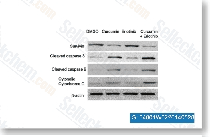
| S1848 | Curcumin (Diferuloylmethane) | Curcumin (Diferuloylmethane, Natural Yellow 3, Turmeric yellow) is the principal curcuminoid of the popular Indian spice turmeric, which is a member of the ginger family (Zingiberaceae). It is an inhibitor of p300 histone acetylatransferase(IC50~25 μM)and Histone deacetylase (HDAC); activates Nrf2 pathway and supresses the activation of NF-κB. Curcumin induces mitophagy, autophagy, apoptosis, and cell cycle arrest with antitumor activity. Curcumin reduces renal damage associated with rhabdomyolysis by decreasing ferroptosis-mediated cell death. Curcumin exhibits anti-infective properties against various human pathogens like the influenza virus, hepatitis C virus, HIV and so on. |
|
|
| S8740 | A-485 | A-485 is a potent, selective and drug-like p300/CBP catalytic inhibitor with an IC50 of 0.06 μM for p300 HAT. It is selective over BET bromodomain proteins and >150 non-epigenetic targets. |
|
|
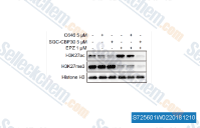
| S7256 | SGC-CBP30 | SGC-CBP30 is a potent CREBBP/EP300 inhibitor with IC50 of 21 nM and 38 nM in cell-free assays, respectively. Exhibits 40-fold and 250-fold selectivity for CBP over the first BRD of BRD4 (BRD4(1)) and BRD4(2) respectively. |
|
|
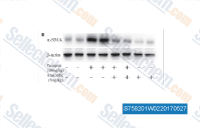
| S7582 | Anacardic Acid | Anacardic Acid (6-pentadecylsalicylic Acid) is a potent inhibitor of p300 and p300/CBP-associated factor histone acetyltranferases, which also has antibacterial activity, antimicrobial activity, prostaglandin synthase inhibition, and tyrosinase and lipoxygenase inhibition. |
|
|
| S9667 | Inobrodib (CCS-1477) | Inobrodib (CCS1477; CBP-IN-1; CBP/p300-IN-4)is a potent and selective inhibitor of p300/CBP bromodomain. CCS1477 works by inhibiting the expression and function of the androgen receptor (AR), as well as inhibiting c-Myc. |
|
|
| S8190 | CPI-637 | CPI-637 is a selective and cell-active benzodiazepinone CBP/EP300 bromodomain inhibitor with IC50 values of 0.03 μM and 0.051μM for CBP and EP300 respectively in TR-FRET assay. It is highly selective against other bromodomains, displaying substantial biochemical activity only against BRD9. |
|
|
| E1348 | E7386 | E-7386 is a selective inhibitor which inhibits interaction between CBP/beta-catenin with IC50 value of 0.0484 μM in HEK293 cells. |
|
|
| S6758 | I-CBP112 | I-CBP112 is a potent and selective CBP/p300 inhibitor with dissociation constant (KD) of 151 ± 6 nM and 167 ± 8 nM for CBP and p300, respectively. |
|
|
| S8625 | GNE-049 | GNE-049 is a highly potent and selective inhibitor of CBP. It exhibits an IC50 of 1.1 nM in TR-FRET assay. GNE-049 also effectively inhibits BRET and BRD4 with IC50 values of 12 nM and 4200 nM, respectively. |
|
|
| S1161 | Histone Acetyltransferase Inhibitor II |
Histone Acetyltransferase Inhibitor II (HAT Inhibitor II, compound 2c) is a potent, selective and cell-permeable p300 histone acetyltransferase (HAT) inhibitor with IC50 of 5 μM. Histone Acetyltransferase Inhibitor II shows anti-acetylase activity in mammalian cells. |
|
|
| S6876 | CPI-1612 | CPI-1612 is a highly potent, orally active inhibitor of EP300/CBP histone acetyltransferase (HAT). It displays an IC50 of 8.0 nM for EP300 HAT. CPI-1612 suppresses H3K27 acetylation in vivo and exhibits efficacy in JEKO-1 mantle cell lymphoma xenograft at a low dose. CPI-1612 displays anticancer activity. | ||
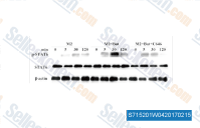
| S7152 | C646 | C646 is an inhibitor for histone acetyltransferase, and inhibits p300 with a Ki of 400 nM in a cell-free assay. Preferentially selective for p300 versus other acetyltransferases. C646 induces cell cycle arrest, apoptosis and autophagy. |
|
|
| S9648 | NEO2734 (EP31670) | NEO2734 (EP31670) is a novel, orally active and selective dual inhibitor of p300/CBP and BET bromodomain with IC50 of both <30 nM. |
|
|
| S3984 | Nordihydroguaiaretic acid (NDGA) | Nordihydroguaiaretic acid (NDGA) is a phenolic antioxidant found in the leaves and twigs of the evergreen desert shrub, Larrea tridentata (Sesse and Moc. ex DC) Coville (creosote bush). It is a recognized inhibitor of lipoxygenase (LOX) and has antioxidant and free radical scavenging properties. Nordihydroguaiaretic acid (NDGA) is a cytotoxic insulin-like growth factor-I receptor (IGF-1R)/HER2 inhibitor and induces apoptosis. |
|
|

Products are for research use only. Not for human use. We do not sell to patients.
©Copyright 2013 Selleck Chemicals. All Rights Reserved.