
-
 Argentina
-
 Australia
-
 Austria
-
 Belgium
-
 Brazil
-
 Canada
-
 China
China
-
 Czech Republic
-
 Denmark
-
 Finland
-
 France
-
 Germany
-
 Greece
-
 Hong Kong
-
 Hungary
-
 Iceland
-
 India
India
-
 Ireland
-
 Israel
-
 Italy
Italy
-
 Japan
Japan
-
 Korea
Korea
-
 Luxembourg
-
 Malaysia
-
 Netherlands
-
 New Zealand
-
 Norway
-
 Poland
-
 Portugal
-
 Qatar
Qatar
-
 Romania
-
 Saudi Arabia
-
 Singapore
-
 Spain
Spain
-
 Sweden
-
 Switzerland
-
 Taiwan
-
 Turkey
-
 United Kingdom
-
 United States
Syk Inhibitors
| Cat.No. | Product Name | Information | Product Use Citations | Product Validations |
|---|---|---|---|---|
| S9715 | Lanraplenib (GS-SYK) | Lanraplenib (GS-SYK) is a potent, highly selective and orally active inhibitor of Spleen Tyrosine Kinase (SYK) with IC50 of 9.5 nM. It inhibits SYK activity in platelets via the glycoprotein VI (GPVI) receptor without prolonging bleeding time (BT) in monkeys or humans. |
|
|
| S7286 | RO9021 | RO9021 potently inhibits SYK kinase activity with an average IC50 of 5.6 nM and suppresses B-cell receptor signaling. |
|
|
| S4944 | Fostamatinib disodium hexahydrate | Fostamatinib (R788) disodium (Tamatinib Fosdium) hexahydrate, a prodrug of the active metabolite R406, is a Syk inhibitor with IC50 of 41 nM in a cell-free assay. |
|
|
| S6519 | R112 | R112 is an ATP-competitive spleen tyrosine kinase (Syk) inhibitor with Ki value of 96 nM. | ||
| E1836 | Cevidoplenib dimesylate | Cevidoplenib dimesylate(SKI-O-703 dimesylate) is an orally available inhibitor of spleen tyrosine kinase (Syk) with potential anti-inflammatory and immunomodulating activities. It attenuates the progression of autoantibody-mediated autoimmune diseases by inhibiting both autoantibody-producing and autoantibody-sensing cells. | ||
| S0871 | Gusacitinib (ASN-002) | Gusacitinib (ASN-002) is a novel and potent dual inhibitor of spleen tyrosine kinase (SYK) and Janus kinases (JAK) with IC50 values of 5-46 nM in biochemical assays. | ||
| S8948 | SRX3207 | SRX3207 is an orally active dual inhibitor of Syk-PI3K with IC50 of 39.9 nM, 31200 nM, 3070 nM, 3070 nM, 244 nM, 388 nM, 9790 nM for Syk, Zap70, BRD41, BRD42, PI3K alpha, PI3K delta, PI3K gamma, respectively. This compound blocks tumor immunosuppression and increases anti-tumor immunity. | ||
| E0437 | ZAP-180013 | ZAP-180013 is a inhibitor of zeta-chain-associated protein kinase 70 (ZAP-70) with an IC50 of 1.8 μM. | ||
| E7793 | PRT062607 | PRT062607 is a highly specific, potent and orally bioavailable inhibitor of purified Spleen tyrosine kinase (SYK) with an IC50 of 1-2 nM. It exhibits significant anti-inflammatory activity and can be used in non-Hodgkin lymphoma (NHL), chronic lymphocytic leukemia (CLL) and rheumatoid arthritis research. | ||
| E4580 | Sovleplenib | Sovleplenib(HMPL-523) is a highly potent and selective SYK inhibitor with IC50 of 0.025 μM, that exhibits anti-tumor activities in vitro and in vivo. Sovleplenib exhibits synergistic activities in combination with BTK, PI3Kδ, and Bcl2 family inhibitors in killing human-diffused large B cell lymphoma (DLBCL). | ||
| S7634 | Cerdulatinib (PRT062070) hydrochloride | Cerdulatinib (PRT-062070, PRT2070) hydrochloride is an oral active, multi-targeted tyrosine kinase inhibitor with IC50 of 12 nM/6 nM/8 nM/0.5 nM and 32 nM for JAK1/JAK2/JAK3/TYK2 and Syk, respectively. Also inhibits 19 other tested kinases with IC50 less than 200 nM. |
|
|
| S3566 | Cerdulatinib (PRT062070) | Cerdulatinib (PRT062070, PRT2070) is an oral active, multi-targeted tyrosine kinase inhibitor with IC50 of 12 nM/6 nM/8 nM/0.5 nM and 32 nM for JAK1/JAK2/JAK3/TYK2 and Syk, respectively, also inhibits19 other tested kinases with IC50 less than 200 nM. |
|
|
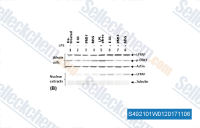
| S4921 | MNS (3,4-Methylenedioxy-β-nitrostyrene) | MNS (3,4-Methylenedioxy-β-nitrostyrene) is a tyrosine kinase inhibitor that inhibits Syk, Src, and p97 with IC50 values of 2.5 μM, 29.3 μM, and 1.7 μM, respectively. |
|
|
| S3226 | Dehydroabietic acid | Dehydroabietic acid (DAA, DHAA), a naturally occurring diterpene resin acid derived from coniferous plants such as Pinus and Picea, displays anti-inflammatory activity via suppression of Src-, Syk-, and TAK1-mediated pathways. | ||

Products are for research use only. Not for human use. We do not sell to patients.
©Copyright 2013 Selleck Chemicals. All Rights Reserved.