
-
 Australia
-
 Austria
-
 Belgium
-
 Brazil
-
 Canada
-
 China
China
-
 Czech Republic
-
 Denmark
-
 Finland
-
 France
-
 Germany
-
 Greece
-
 Hong Kong
-
 Hungary
-
 Iceland
-
 India
India
-
 Ireland
-
 Israel
-
 Italy
Italy
-
 Japan
Japan
-
 Korea
Korea
-
 Luxembourg
-
 Malaysia
-
 Netherlands
-
 New Zealand
-
 Norway
-
 Poland
-
 Qatar
Qatar
-
 Romania
-
 Saudi Arabia
-
 Singapore
-
 Spain
Spain
-
 Sweden
-
 Switzerland
-
 Taiwan
-
 Turkey
-
 United Kingdom
-
 United States
research use only
Liquiritigenin Estrogen/progestogen Receptor agonist
Cat.No.S3929
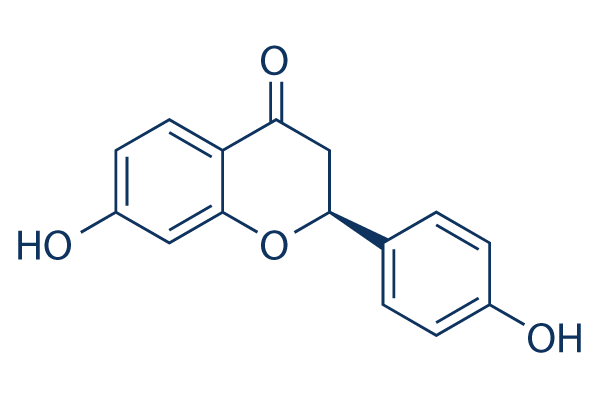
Chemical Structure
Molecular Weight: 256.25
Quality Control
| Related Targets | Adrenergic Receptor GPR Androgen Receptor Glucocorticoid Receptor ACE RAAS Progesterone Receptor Opioid Receptor PGES THR |
|---|---|
| Other Estrogen/progestogen Receptor Inhibitors | Elacestrant (RAD1901) Dihydrochloride MPP dihydrochloride Cholesterol Endoxifen HCl G15 Chrysin Licochalcone A AZD9496 PHTPP Brilanestrant (GDC-0810) |
Solubility
|
In vitro |
DMSO
: 51 mg/mL
(199.02 mM)
Ethanol : 51 mg/mL Water : Insoluble |
Molarity Calculator
|
In vivo |
|||||
In vivo Formulation Calculator (Clear solution)
Step 1: Enter information below (Recommended: An additional animal making an allowance for loss during the experiment)
Step 2: Enter the in vivo formulation (This is only the calculator, not formulation. Please contact us first if there is no in vivo formulation at the solubility Section.)
Calculation results:
Working concentration: mg/ml;
Method for preparing DMSO master liquid: mg drug pre-dissolved in μL DMSO ( Master liquid concentration mg/mL, Please contact us first if the concentration exceeds the DMSO solubility of the batch of drug. )
Method for preparing in vivo formulation: Take μL DMSO master liquid, next addμL PEG300, mix and clarify, next addμL Tween 80, mix and clarify, next add μL ddH2O, mix and clarify.
Method for preparing in vivo formulation: Take μL DMSO master liquid, next add μL Corn oil, mix and clarify.
Note: 1. Please make sure the liquid is clear before adding the next solvent.
2. Be sure to add the solvent(s) in order. You must ensure that the solution obtained, in the previous addition, is a clear solution before proceeding to add the next solvent. Physical methods such
as vortex, ultrasound or hot water bath can be used to aid dissolving.
Chemical Information, Storage & Stability
| Molecular Weight | 256.25 | Formula | C15H12O4 |
Storage (From the date of receipt) | |
|---|---|---|---|---|---|
| CAS No. | 578-86-9 | Download SDF | Storage of Stock Solutions |
|
|
| Synonyms | 4',7-Dihydroxyflavanone | Smiles | C1C(OC2=C(C1=O)C=CC(=C2)O)C3=CC=C(C=C3)O | ||
Mechanism of Action
| Targets/IC50/Ki |
ERβ
VEGF
|
|---|---|
| In vitro |
Liquiritigenin-treated murine osteoblastic MC3T3-E1 cells shows an increased alkaline phosphatase activity and enhances phosphorylation of Smad1/5 compared with untreated cells. Moreover, this compound inhibits osteoclast differentiation, its bone-resorption activity through slightly decreases the phosphorylation of extracellular signal-regulated kinase, c-Jun N-terminal kinase, and inhibitor of nuclear factor kappa B-α ; however, the phosphorylation of Akt and p38 slightly increase in bone marrow-derived osteoclasts. The expression levels of the osteoclast marker proteins nuclear factor of activated T-cell cytoplasmic-1, Src, and cathepsin K diminish. This chemical is shown to exert the following pharmacological effects: increased cell growth, increased alkaline phosphatase activity, promotion of collagen synthesis, and the mineralization of osteoblastic MC3T3-E1 cells. It inhibits serum-induced HIF-1α and VEGF expression via the AKT/mTOR-p70S6K signaling pathway in HeLa cells.
|
| In vivo |
Liquiritigenin inhibits the growth of tumors in nude mice originating from human cervical cancer cell line HeLa cells, and reduces angiogenesis in a dose dependent manner. This compound effectively reduces the levels of pro-inflammatory cytokines and the expressions of p-p65NF-κB and p-IκBα. Furthermore, its preconditioning could down-regulate the immobility time in tail suspension test (TST), forced swimming test (FST) and up-regulate BDNF and TrkB contents in hippocampus. Thus, this chemical has antidepressant activity that might be attributed to its anti-inflammatory property and BDNF/TrkB signaling pathway.
|
References |
|
Clinical Trial Information
(data from https://clinicaltrials.gov, updated on 2024-05-22)
| NCT Number | Recruitment | Conditions | Sponsor/Collaborators | Start Date | Phases |
|---|---|---|---|---|---|
| NCT01199250 | Not yet recruiting | Lynch Syndrome|Recurrent Uterine Corpus Carcinoma|Stage I Uterine Corpus Cancer|Stage II Uterine Corpus Cancer|Stage III Uterine Corpus Cancer|Stage IV Uterine Corpus Cancer |
Gynecologic Oncology Group|National Cancer Institute (NCI)|GOG Foundation |
January 2100 | -- |
| NCT04662164 | Withdrawn | Type 2 Diabetes Patients |
Shanghai HEP Pharmaceutical Co. Ltd. |
December 2025 | Phase 1|Phase 2 |
| NCT06177132 | Not yet recruiting | Vestibular Disorder |
University Hospital Ghent|University Ghent |
November 2025 | Not Applicable |
| NCT03277170 | Not yet recruiting | Asthma; Status|Asthma in Children|Asthma Acute|Asthma Attack|Acute Asthma Exacerbation |
Vanderbilt University Medical Center |
September 1 2025 | Phase 2 |
Tech Support
Tel: +1-832-582-8158 Ext:3
If you have any other enquiries, please leave a message.
Signaling Pathway Map

Products are for research use only. Not for human use. We do not sell to patients.
©Copyright 2013 Selleck Chemicals. All Rights Reserved.