
-
 Australia
-
 Austria
-
 Belgium
-
 Brazil
-
 Canada
-
 China
China
-
 Czech Republic
-
 Denmark
-
 Finland
-
 France
-
 Germany
-
 Greece
-
 Hong Kong
-
 Hungary
-
 Iceland
-
 India
India
-
 Ireland
-
 Israel
-
 Italy
Italy
-
 Japan
Japan
-
 Korea
Korea
-
 Luxembourg
-
 Malaysia
-
 Netherlands
-
 New Zealand
-
 Norway
-
 Poland
-
 Qatar
Qatar
-
 Romania
-
 Saudi Arabia
-
 Singapore
-
 Spain
Spain
-
 Sweden
-
 Switzerland
-
 Taiwan
-
 Turkey
-
 United Kingdom
-
 United States
research use only
GSK1324726A (I-BET726) BET inhibitor
Cat.No.S7620
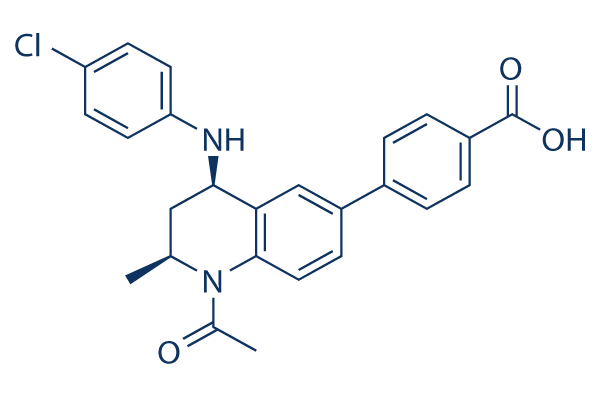
Chemical Structure
Molecular Weight: 434.91
Quality Control
Solubility
|
In vitro |
DMSO
: 86 mg/mL
(197.74 mM)
Ethanol : 86 mg/mL Water : Insoluble |
Molarity Calculator
|
In vivo |
|||||
In vivo Formulation Calculator (Clear solution)
Step 1: Enter information below (Recommended: An additional animal making an allowance for loss during the experiment)
Step 2: Enter the in vivo formulation (This is only the calculator, not formulation. Please contact us first if there is no in vivo formulation at the solubility Section.)
Calculation results:
Working concentration: mg/ml;
Method for preparing DMSO master liquid: mg drug pre-dissolved in μL DMSO ( Master liquid concentration mg/mL, Please contact us first if the concentration exceeds the DMSO solubility of the batch of drug. )
Method for preparing in vivo formulation: Take μL DMSO master liquid, next addμL PEG300, mix and clarify, next addμL Tween 80, mix and clarify, next add μL ddH2O, mix and clarify.
Method for preparing in vivo formulation: Take μL DMSO master liquid, next add μL Corn oil, mix and clarify.
Note: 1. Please make sure the liquid is clear before adding the next solvent.
2. Be sure to add the solvent(s) in order. You must ensure that the solution obtained, in the previous addition, is a clear solution before proceeding to add the next solvent. Physical methods such
as vortex, ultrasound or hot water bath can be used to aid dissolving.
Chemical Information, Storage & Stability
| Molecular Weight | 434.91 | Formula | C25H23ClN2O3 |
Storage (From the date of receipt) | |
|---|---|---|---|---|---|
| CAS No. | 1300031-52-0 | Download SDF | Storage of Stock Solutions |
|
|
| Synonyms | N/A | Smiles | CC1CC(C2=C(N1C(=O)C)C=CC(=C2)C3=CC=C(C=C3)C(=O)O)NC4=CC=C(C=C4)Cl | ||
Mechanism of Action
| Targets/IC50/Ki |
BRD4
(Cell-free assay) 22 nM
BRD3
(Cell-free assay) 31 nM
BRD2
(Cell-free assay) 41 nM
|
|---|---|
| In vitro |
In neuroblastoma cell lines, GSK1324726A (I-BET726) inhibits cell growth and induces cytotoxicity. It also modulates expression of genes involved in apoptosis, signaling, and MYC-family pathways, including the direct suppression of BCL2 and MYCN.
|
| Kinase Assay |
Determination of BET Protein Binding Affinities to I-BET726
|
|
For determination of binding affinities to BET protein bromodomains, GSK1324726A (I-BET726) is titrated against truncates containing both BD1 and BD2 of BRD2 (10 nM), BRD3 (10 nM), and BRD4 (10 nM) in 50 mM HEPES pH7.5, 150 mM NaCl, 5% Glycerol, 1 mM DTT and 1 mM CHAPS in the presence of an Alexa 647 derivative (50 nM) of fluorescent ligand. After equilibrating for 1 h, the bromodomain protein: ligand interaction is detected using Time Resolved Fluorescence Resonance Energy Transfer (TR-FRET) following the addition of 1.5 nM europium chelate labeled anti-6His antibody. Plates are read using an Envision Plate reader (λEX = 337 nm, λEM = 615 nm, λEM = 665 nm; dual dichroic = 400 nm & 630 nm). These data are fitted to a four parameter IC50 model using Graphit data analysis software.
|
|
| In vivo |
In the mouse SK–N-AS and CHP-212 models, GSK1324726A (I-BET726) (15 mg/kg p.o.) results in tumor growth inhibition and down-regulation of MYCN and BCL2 expression. In a mouse septic shock model, this compound (10 mg/kg i.v.) shows potent anti-inflammatory effects and prevents death of diseased animals.
|
References |
|
Tech Support
Tel: +1-832-582-8158 Ext:3
If you have any other enquiries, please leave a message.
Signaling Pathway Map

Products are for research use only. Not for human use. We do not sell to patients.
©Copyright 2013 Selleck Chemicals. All Rights Reserved.