
-
 Argentina
-
 Australia
-
 Austria
-
 Belgium
-
 Brazil
-
 Canada
-
 China
China
-
 Czech Republic
-
 Denmark
-
 Finland
-
 France
-
 Germany
-
 Greece
-
 Hong Kong
-
 Hungary
-
 Iceland
-
 India
India
-
 Ireland
-
 Israel
-
 Italy
Italy
-
 Japan
Japan
-
 Korea
Korea
-
 Luxembourg
-
 Malaysia
-
 Netherlands
-
 New Zealand
-
 Norway
-
 Poland
-
 Portugal
-
 Qatar
Qatar
-
 Romania
-
 Saudi Arabia
-
 Singapore
-
 Spain
Spain
-
 Sweden
-
 Switzerland
-
 Taiwan
-
 Turkey
-
 United Kingdom
-
 United States
research use only
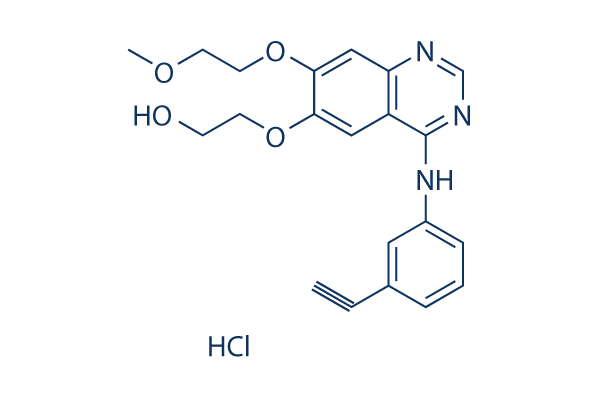
DesMethyl Erlotinib (OSI-420) HCl EGFR inhibitor
Cat.No.S2205
Quality Control
| Related Targets | VEGFR FGFR PDGFR c-Met Src MEK CSF-1R FLT3 HER2 c-Kit |
|---|---|
| Other EGFR Inhibitors | Lazertinib (YH25448) Icotinib Hydrochloride Sunvozertinib AG-490 AG-1478 Canertinib (CI-1033) Genistein Poziotinib (NOV120101, HM781-36B) Rociletinib (CO-1686) WZ4002 |
Solubility
|
In vitro |
DMSO
: 83 mg/mL
(199.58 mM)
Water : Insoluble Ethanol : Insoluble |
Molarity Calculator
|
In vivo |
|||||
In vivo Formulation Calculator (Clear solution)
Step 1: Enter information below (Recommended: An additional animal making an allowance for loss during the experiment)
Step 2: Enter the in vivo formulation (This is only the calculator, not formulation. Please contact us first if there is no in vivo formulation at the solubility Section.)
Calculation results:
Working concentration: mg/ml;
Method for preparing DMSO master liquid: mg drug pre-dissolved in μL DMSO ( Master liquid concentration mg/mL, Please contact us first if the concentration exceeds the DMSO solubility of the batch of drug. )
Method for preparing in vivo formulation: Take μL DMSO master liquid, next addμL PEG300, mix and clarify, next addμL Tween 80, mix and clarify, next add μL ddH2O, mix and clarify.
Method for preparing in vivo formulation: Take μL DMSO master liquid, next add μL Corn oil, mix and clarify.
Note: 1. Please make sure the liquid is clear before adding the next solvent.
2. Be sure to add the solvent(s) in order. You must ensure that the solution obtained, in the previous addition, is a clear solution before proceeding to add the next solvent. Physical methods such
as vortex, ultrasound or hot water bath can be used to aid dissolving.
Chemical Information, Storage & Stability
| Molecular Weight | 415.87 | Formula | C21H21N3O4.HCl |
Storage (From the date of receipt) | |
|---|---|---|---|---|---|
| CAS No. | 183320-51-6 | Download SDF | Storage of Stock Solutions |
|
|
| Synonyms | CP-473420 | SMILES | COCCOC1=C(C=C2C(=C1)N=CN=C2NC3=CC=CC(=C3)C#C)OCCO.Cl | ||
Read more about storage stability stock solution CAS number SMILES
Mechanism of Action
| Features |
OSI 420 is a major active metabolite of Erlotinib.
|
|---|---|
| Targets/IC50/Ki |
EGFR
2 nM
|
| In vitro |
OSI-420 is the major metabolite of Erlotinib in human plasma. Erlotinib disappearance from plasma after a short IV infusion is biexponential with a mean terminal half-life of 5.2 h and a mean clearance of 128 ml/min per m(2). OSI-420 exposure (AUC) in plasma is 30% (range 12-59%) of erlotinib, and OSI-420 clearance is more than 5-fold higher than erlotinib. Erlotinib and OSI-420 are equipotent, and the combined concentrations of erlotinib + OSI-420 achieved in the CSF exceeded the IC50 (7.9 ng/ml or 20 nM) for the EGFR tyrosine kinase inhibition in intact tumor cells. Erlotinib potently inhibits EGFR activation in intact cells including HNS human head and neck tumor cells (IC50 20nM), DiFi human colon cancer cells andMDA MB-468 human breast cancer cells. Erlotinib (1 μM) induces apoptosis in DiFi human colon cancer cells. Erlotinib inhibits growth of a panel of NSCLC cell lines including A549, H322, H3255, H358 H661, H1650, H1975, H1299, H596 with IC50 ranging from 29 nM to >20 μM. Erlotinib(2 μM) significantly inhibits growth of AsPC-1 and BxPC-3 pancreatic cells. The effects of Erlotinib HCl in combination with gemcitabine are considered additive in KRAS-mutated pancreatic cancer cells. Ten micromolar of Erlotinib inhibits EGFR phospho-rylation at the Y845 (Src-dependent phosphorylation) and Y1068 (auto-phosphorylation) sites. Combination with Erlotinib could down-modulate rapamycin-stimulated Akt activity and produces a synergistic effect on cell growth inhibition.
|
| Kinase Assay |
Kinase Assays
|
|
96-well plates are coated by incubation overnight at 37 °C with 100 μL per well of 0.25 mg/mL PGT in PBS. Excess PGT is removed by aspiration, and the plate is washed 3 times with washing buffer (0.1% Tween 20 in PBS). The kinase reaction is performed in 50 μL of 50 mM HEPES (pH 7.3), containing 125 mM sodium chloride, 24 mM magnesium chloride, 0.1 mM sodium orthovanadate, 20 μM ATP, 1.6 μg/mL EGF, and 15 ng of EGFR, affinity purified from A431 cell membranes. Erlotinib HCl in DMSO is added to give a final DMSO concentration of 2.5%. Phosphorylation is initiated by addition of ATP and proceeded for 8 minutes at room temperature, with constant shaking. The kinase reaction is terminated by aspiration of the reaction mixture and is washed 4 times with washing buffer. Phosphorylated PGT is measured by 25 minutes of incubation with 50 μL per well HRP-conjugated PY54 antiphosphotyrosine antibody, diluted to 0.2 μg/mL in blocking buffer (3% BSA and 0.05% Tween 20 in PBS). Antibody is removed by aspiration, and the plate is washed 4 times with washing buffer. The colonmetric signal is developed by addition of TMB Microwell Peroxidase Substrate, 50μL per well, and stopped by the addition of 0.09 M sulfuric acid, 50 μL per well. Phosphotyrosine is estimated by measurement of absorbance at 450 nm. The signal for controls is typically 0.6-1.2 absorbance units, with essentially no back ground in wells without AlP, EGFR, or PGT and is proportional to the time of incubation for 10 minutes.
|
|
| In vivo |
At doses of 100 mg/kg, Erlotinib completely prevents EGF-induced autophosphorylation of EGFR in human HN5 tumors growing as xenografts in athymic mice and of the hepatic EGFR of the treated mice. Erlotinib reduces the growth of xenografted human AML cells.
|
References |
|
Clinical Trial Information
(data from https://clinicaltrials.gov, updated on 2024-05-22)
| NCT Number | Recruitment | Conditions | Sponsor/Collaborators | Start Date | Phases |
|---|---|---|---|---|---|
| NCT00124657 | Completed | Brain and Central Nervous System Tumors |
St. Jude Children''s Research Hospital|Rady Children''s Hospital San Diego|Duke University |
2005-03 | Phase 1|Phase 2 |
Read more about Clinical Trials
Tech Support
Tel: +1-832-582-8158 Ext:3
If you have any other enquiries, please leave a message.
Signaling Pathway Map

Products are for research use only. Not for human use. We do not sell to patients.
©Copyright 2013 Selleck Chemicals. All Rights Reserved.