
-
 Australia
-
 Austria
-
 Belgium
-
 Brazil
-
 Canada
-
 China
China
-
 Czech Republic
-
 Denmark
-
 Finland
-
 France
-
 Germany
-
 Greece
-
 Hong Kong
-
 Hungary
-
 Iceland
-
 India
India
-
 Ireland
-
 Israel
-
 Italy
Italy
-
 Japan
Japan
-
 Korea
Korea
-
 Luxembourg
-
 Malaysia
-
 Netherlands
-
 New Zealand
-
 Norway
-
 Poland
-
 Qatar
Qatar
-
 Romania
-
 Saudi Arabia
-
 Singapore
-
 Spain
Spain
-
 Sweden
-
 Switzerland
-
 Taiwan
-
 Turkey
-
 United Kingdom
-
 United States
research use only
Erlotinib (CP-358774) Hydrochloride EGFR inhibitor
Cat.No.S1023
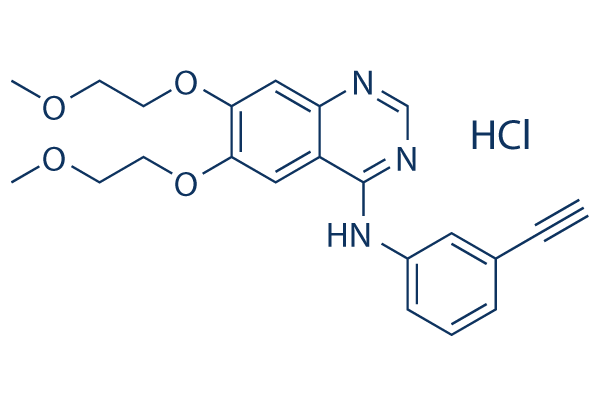
Chemical Structure
Molecular Weight: 429.90
Quality Control
| Related Targets | VEGFR PDGFR FGFR c-Met Src MEK CSF-1R FLT3 HER2 c-Kit |
|---|---|
| Other EGFR Inhibitors | Lazertinib (YH25448) Icotinib Hydrochloride Sunvozertinib AG-490 AG-1478 Canertinib (CI-1033) Rociletinib (CO-1686) Genistein Poziotinib (NOV120101, HM781-36B) WZ4002 |
Cell Culture, Treatment & Working Concentration
| Cell Lines | Assay Type | Concentration | Incubation Time | Formulation | Activity Description | PMID |
|---|---|---|---|---|---|---|
| human SKBR3 cells | Function assay | Inhibition of HER2 in human SKBR3 cells by HTRF assay, IC50=1.89 μM. | 19815412 | |||
| human A431 cells | Function assay | Inhibition of EGFR in human A431 cells by HTRF assay, IC50=0.42 μM. | 19815412 | |||
| A431 | Function assay | Inhibition of EGFR in human A431 cells by phosphotyrosine ELISA assay, IC50 = 0.0012 μM. | 24890652 | |||
| MCF7 | Cytotoxicity assay | Cytotoxicity against human ER-positive MCF7 cells, IC50 = 0.0012 μM. | 24890652 | |||
| A431 | Function assay | 60 mins | Inhibition of EGF-induced EGFR activation in human A431 cells pretreated for 60 mins followed by EGF addition and measured after 10 mins by ELISA, IC50 = 0.0012 μM. | 30098869 | ||
| A431 | Function assay | 60 mins | Inhibition of EGFR in human A431 cells assessed as reduction in EGF induced phosphorylation preincubated for 60 mins followed by EGF addition measured after 10 mins by ELISA method, IC50 = 0.0012 μM. | 27894589 | ||
| A431 | Function assay | 60 mins | Inhibition of EGFR in human A431 cells compound pretreated for 60 min before EGF stimulation for 10 mins by phosphotyrosine ELISA cytoblot method, IC50 = 0.0012 μM. | 25882519 | ||
| HCC827 | Cytotoxicity assay | 48 hrs | Cytotoxicity against human HCC827 cells after 48 hrs by MTT assay, IC50 = 0.002 μM. | 24900830 | ||
| PC9 | Function assay | 2 hrs | Inhibition of EGFR exon 19 deletion activating mutant phosphorylation in human PC9 cells after 2 hrs by fluorescence assay, IC50 = 0.0059 μM. | 23930994 | ||
| NCI-H292 | Function assay | 1 hr | Inhibition of EGFR phosphorylation in human NCI-H292 cells preincubated for 1 hr followed by stimulation with EGF for 8 mins by electrochemiluminescent immunoassay, IC50 = 0.0063 μM. | 26455919 | ||
| HCC827 | Function assay | 2 hrs | Inhibition of EGFR deletion mutant autophosphorylation in human HCC827 cells after 2 hrs by sandwich ELISA, IC50 = 0.008 μM. | 26756222 | ||
| MCF7 | Antiproliferative assay | 48 hrs | Antiproliferative activity against human MCF7 cells after 48 hrs by MTT assay, IC50 = 0.01 μM. | 19914837 | ||
| H3255 | Function assay | 2 hrs | Inhibition of EGFR L858R mutant autophosphorylation in human H3255 cells after 2 hrs by sandwich ELISA, IC50 = 0.01 μM. | 26756222 | ||
| H3255 | Function assay | 2 hrs | Inhibition of EGFR L858R mutant phosphorylation in human H3255 cells preincubated for 2 hrs followed by EGF stimulation for 10 mins by sandwich ELISA, IC50 = 0.01 μM. | 28287730 | ||
| PC9 | Function assay | 2 hrs | Inhibition of EGFR deletion mutant autophosphorylation in human PC9 cells after 2 hrs by sandwich ELISA, IC50 = 0.011 μM. | 26756222 | ||
| A549 | Function assay | 2 hrs | Inhibition of EGF-stimulated wild-type EGFR phosphorylation in human A549 cells preincubated for 2 hrs followed by EGF stimulation for 10 mins by sandwich ELISA, IC50 = 0.011 μM. | 28287730 | ||
| PC9 | Function assay | 2 hrs | Inhibition of EGFR exon 19 deletion mutant phosphorylation in human PC9 cells preincubated for 2 hrs followed by EGF stimulation for 10 mins by sandwich ELISA, IC50 = 0.011 μM. | 28287730 | ||
| A549 | Function assay | Inhibition of EGF-stimulated wild type EGFR autophosphorylation expressed in human A549 cells by sandwich ELISA, IC50 = 0.011 μM. | 26756222 | |||
| BA/F3 | Cytotoxicity assay | Cytotoxicity against mouse BA/F3 cells expressing EGFR L858R mutant, IC50 = 0.0125 μM. | 19239229 | |||
| KB | Function assay | 1 hr | Inhibition of EGF-stimulated autophosphorylation of EGFR in human KB cells incubated for 1 hr prior to EGF challenge measured after 6 mins by ELISA, IC50 = 0.019 μM. | 24411123 | ||
| NIH3T3 | Function assay | Inhibition of EGF stimulated human erbB1 autophosphorylation in NIH3T3 cells, IC50 = 0.0193 μM. | 16480284 | |||
| MCF7 | Antiproliferative assay | 48 hrs | Antiproliferative activity against human MCF7 cells after 48 hrs by MTT assay, IC50 = 0.02 μM. | 19914835 | ||
| Sf9 | Function assay | Inhibition of cloned EGFR autophosphorylation expressed in baculovirus-infected Sf9 cells by solid-phase ELISA, IC50 = 0.02 μM. | 19914837 | |||
| MCF7 | Antiproliferative assay | 48 hrs | Antiproliferative activity against human MCF7 cells after 48 hrs by MTT assay, IC50 = 0.02 μM. | 20005116 | ||
| MCF7 | Antiproliferative assay | 48 hrs | Antiproliferative activity against human MCF7 cells after 48 hrs by MTT assay, IC50 = 0.02 μM. | 20594859 | ||
| MCF7 | Antiproliferative assay | 48 hrs | Antiproliferative activity against human MCF7 cells after 48 hrs by MTT assay, IC50 = 0.02 μM. | 22277588 | ||
| A16-F10 | Antiproliferative assay | 48 hrs | Antiproliferative activity against human A16-F10 cells after 48 hrs by MTT assay, IC50 = 0.02 μM. | 22112541 | ||
| MCF7 | Cytotoxicity assay | 48 hrs | Cytotoxicity against human MCF7 cells after 48 hrs by MTT assay, IC50 = 0.02 μM. | 21802290 | ||
| MCF7 | Cytotoxicity assay | 48 hrs | Cytotoxicity against human MCF7 cells after 48 hrs by MTT assay, IC50 = 0.02 μM. | 20627597 | ||
| HT-29 | Antiproliferative assay | 48 hrs | Antiproliferative activity human HT-29 cells after 48 hrs by propidium iodide staining-based fluorescence assay, IC50 = 0.02 μM. | 29407956 | ||
| MCF7 | Antiproliferative assay | 48 hrs | Antiproliferative activity against human MCF7 cells after 48 hrs by MTT assay, IC50 = 0.02 μM. | 23245802 | ||
| HCC827 | Antiproliferative assay | 72 hrs | Antiproliferative activity against human HCC827 cells after 72 hrs by CCK-8 assay, IC50 = 0.029 μM. | 26487917 | ||
| Sf9 | Function assay | Inhibition of cloned EGFR autophosphorylation expressed in baculovirus-infected Sf9 cells by solid-phase ELISA, IC50 = 0.03 μM. | 19914835 | |||
| Sf9 | Function assay | 1 hr | Inhibition of human recombinant His6x-tagged EGFR autophosphorylation expressed in Sf9 cells after 1 hr by ELISA, IC50 = 0.03 μM. | 20594859 | ||
| Sf9 | Function assay | 1 hr | Inhibition of autophosphorylation of recombinant His-tagged EGFR expressed in baculovirus infected Sf9 cells after 1 hr by DELFIA/time-resolved fluorimetry assay, IC50 = 0.03 μM. | 22277588 | ||
| Sf9 | Function assay | 10 mins | Inhibition of EGFR expressed in baculovirus infected Sf9 cells assessed as inhibition of autophosphorylation preincubated for 10 mins measured after 1 hr by DELFIA/Time-Resolved Fluorometry, IC50 = 0.03 μM. | 22112541 | ||
| Sf9 | Function assay | 1 hr | Inhibition of histidine-tagged human recombinant cytoplasmic domain of EGFR expressed in baculovirus infected insect Sf9 cells after 1 hr by DELFIA/time-resolved fluorometric analysis, IC50 = 0.03 μM. | 22361272 | ||
| Sf9 | Function assay | 1 hr | Inhibition of recombinant EGFR expressed in baculovirus infected Sf9 cells after 1 hr by DELFIA/time-resolved fluorimetry assay, IC50 = 0.03 μM. | 21763148 | ||
| Sf9 | Function assay | 1 hr | Inhibition of His-tagged EGFR expressed in insect Sf9 cells after 1 hr by time-resolved fluorimetric analysis, IC50 = 0.03 μM. | 21816517 | ||
| Sf9 | Function assay | Inhibition of histidine-tagged recombinant EGFR autophosphorylation expressed in Sf9 cells by solid-phase ELISA, IC50 = 0.03 μM. | 20627597 | |||
| MIAPaCa2 | Antiproliferative assay | 48 hrs | Antiproliferative activity human MIAPaCa2 cells after 48 hrs by propidium iodide staining-based fluorescence assay, IC50 = 0.03 μM. | 29407956 | ||
| MCF7 | Antiproliferative assay | 48 hrs | Antiproliferative activity human MCF7 cells after 48 hrs by propidium iodide staining-based fluorescence assay, IC50 = 0.03 μM. | 29407956 | ||
| PC3 | Antiproliferative assay | 48 hrs | Antiproliferative activity human PC3 cells after 48 hrs by propidium iodide staining-based fluorescence assay, IC50 = 0.03 μM. | 29407956 | ||
| Sf9 | Function assay | Inhibition of histidine-tagged recombinant EGFR cytoplasmic domain (amino acids 645-1186) (unknown origin) expressed in Sf9 cells assessed as reduction in enzyme autophosphorylation by DELFIA/time-resolved fluorometry, IC50 = 0.03 μM. | 25172421 | |||
| Sf9 | Function assay | Inhibition of EGFR cytoplasmic domain (amino acids 645 to 1186) (unknown origin) expressed in Sf9 cells assessed as reduction in enzyme autophosphorylation by DELFIA time resolved fluorometry, IC50 = 0.03 μM. | 23245570 | |||
| A549 | Antiproliferative assay | 24 hrs | Antiproliferative activity against human A549 cells after 24 hrs by MTT assay, GI50 = 0.03 μM. | 23391364 | ||
| Sf9 | Function assay | 10 mins | Inhibition of recombinant EGFR kinase cytoplasmic domain (unknown origin) expressed in baculovirus expression vector-infected insect sf9 cells assessed as level of autophosphorylation after 10 mins by DELFIA/time-resolved fluorometry, IC50 = 0.03 μM. | 23962660 | ||
| NCI-H292 | Antiproliferative assay | 72 hrs | Antiproliferative activity against human NCI-H292 cells expressing wild type EGFR after 72 hrs by luminescence assay, EC50 = 0.031 μM. | 26455919 | ||
| Sf9 | Function assay | 1 hr | Inhibition of autophosphorylation of recombinant EGFR cytoplasmic domain (645 to 1186) (unknown origin) expressed in Sf9 cells after 1 hr by DELFIA/time-resolved fluorometric analysis, IC50 = 0.032 μM. | 24607998 | ||
| Sf9 | Function assay | 1 hr | Inhibition of autophosphorylation of EGFR cytoplasmic domain (amino acids 645 to 1186) (unknown origin) expressed in Sf9 cells after 1 hr by time-resolved fluorometry, IC50 = 0.032 μM. | 24630412 | ||
| Sf9 | Function assay | 10 mins | Inhibition of recombinant EGFR cytoplasmic domain (645 to 1186) (unknown origin) autophosphorylation expressed in baculovirus infected insect Sf9 cells preincubated for 10 mins followed by ATP-MgCl2 addition measured after 1 hr by fluorometric analysis, IC50 = 0.032 μM. | 24144854 | ||
| A431 | Function assay | Inhibition of EGFR intracellular phosphorylation in human A431 cells by ELISA, IC50 = 0.034 μM. | 20346655 | |||
| A549 | Antiproliferative assay | 48 hrs | Antiproliferative activity human A549 cells after 48 hrs by propidium iodide staining-based fluorescence assay, IC50 = 0.04 μM. | 29407956 | ||
| B16/F10 | Antiproliferative assay | 48 hrs | Antiproliferative activity against mouse B16/F10 cells after 48 hrs by MTT assay, IC50 = 0.05 μM. | 23245802 | ||
| MIAPaCa | Function assay | Inhibition of EGFR phosphorylation in human MIAPaCa cells by ELISA, IC50 = 0.051 μM. | 20817523 | |||
| A431 | Cytotoxicity assay | 48 hrs | Cytotoxicity against human A431 cells over expressing EGFR after 48 hrs by MTT assay, IC50 = 0.055 μM. | 22414612 | ||
| Sf9 | Function assay | Inhibition of recombinant full-length GST-tagged human B-RAF V600E mutant (417 to 766 residues) expressed in Baculovirus infected Sf9 cells using N-terminal His-tagged human MEK1 as substrate by Nu-page gel-based phosphor screen analysis, IC50 = 0.06 μM. | 29549841 | |||
| Sf9 | Function assay | 10 mins | Inhibition of His6-tagged recombinant EGFR cytoplasmic domain (unknown origin) (645 to 1186 residues) expressed in baculovirus infected Sf-9 cells preincubated for 10 mins followed by ATP addition measured after 1 hr by DELFIA/Time-Resolved fluorometry, IC50 = 0.06 μM. | 28431353 | ||
| MCF7 | Antiproliferative assay | 48 hrs | Antiproliferative activity against human MCF7 cells after 48 hrs by MTT assay, IC50 = 0.07 μM. | 22361272 | ||
| PC9 | Antiproliferative assay | 96 hrs | Antiproliferative activity against human PC9 cells after 96 hrs by Sytox green marker based fluorescence analysis, IC50 = 0.07 μM. | 26599532 | ||
| LoVo | Function assay | 2 hrs | Inhibition of wild type EGFR phosphorylation in human LoVo cells after 2 hrs by fluorescence assay, IC50 = 0.077 μM. | 23930994 | ||
| HepG2 | Antiproliferative assay | 48 hrs | Antiproliferative activity against human HepG2 cells after 48 hrs by MTT assay, IC50 = 0.08 μM. | 21816517 | ||
| MCF7 | Antiproliferative assay | 48 hrs | Antiproliferative activity against human MCF7 cells after 48 hrs by MTT assay, IC50 = 0.08 μM. | 28988624 | ||
| Sf9 | Function assay | 10 mins | Inhibition of His6-tagged EGFR (unknown origin) cytoplasmic domain expressed in baculovirus infected Sf9 insect cells after 10 mins followed by addition of ATP-MgCl2 and measured after 1 hr by time-resolved fluorometric analysis, IC50 = 0.08 μM. | 29407956 | ||
| Sf9 | Function assay | Inhibition of His-6 tagged recombinant EGFR cytoplasmic domain (645 to 1186 residues) (unknown origin) expressed in Baculovirus infected Sf9 cells by dissociation-enhanced lanthanide fluorescence immunoassay/time-resolved fluorometric analysis, IC50 = 0.08 μM. | 29549841 | |||
| MCF7 | Antiproliferative assay | 24 hrs | Antiproliferative activity against human MCF7 cells after 24 hrs by MTT assay, GI50 = 0.08 μM. | 23391364 | ||
| BA/F3 | Function assay | 48 hrs | Inhibition of EGFR L858R mutant (unknown origin) expressed in mouse BA/F3 cells assessed as reduction in cell viability after 48 hrs by XTT assay, IC50 = 0.087 μM. | 27235841 | ||
| Sf9 | Function assay | 5 mins | Inhibition of recombinant human GST-tagged HER2 (676-end) expressed in baculovirus infected Sf9 insect cells preincubated for 5 mins followed by ATP addition and measured after 30 mins by HTRF assay, IC50 = 0.091 μM. | 30096580 | ||
| A431 | Cytotoxicity assay | 72 hrs | Cytotoxicity against human A431 cells after 72 hrs by SRB assay, IC50 = 0.096 μM. | 19888761 | ||
| B16F10 | Antiproliferative assay | 48 hrs | Antiproliferative activity against mouse B16F10 cells after 48 hrs by MTT assay, IC50 = 0.1 μM. | 22361272 | ||
| MCF7 | Antiproliferative assay | 12 hrs | Antiproliferative activity against human MCF7 cells after 12 hrs by MTT assay, IC50 = 0.1 μM. | 26652482 | ||
| A549 | Antiproliferative assay | 48 hrs | Antiproliferative activity against human A549 cells after 48 hrs by MTT assay, IC50 = 0.1 μM. | 25172421 | ||
| HepG2 | Antiproliferative assay | 48 hrs | Antiproliferative activity against human HepG2 cells after 48 hrs by MTT assay, IC50 = 0.1 μM. | 25172421 | ||
| Sf9 | Function assay | Inhibition of human cloned HER2 autophosphorylation expressed in baculovirus-infected Sf9 cells by solid-phase ELISA, IC50 = 0.12 μM. | 19914837 | |||
| HepG2 | Antiproliferative assay | 48 hrs | Antiproliferative activity against human HepG2 cells after 48 hrs by MTT assay, IC50 = 0.12 μM. | 22112541 | ||
| B16F10 | Antiproliferative assay | 48 hrs | Antiproliferative activity against mouse B16F10 cells after 48 hrs by MTT assay, IC50 = 0.12 μM. | 28988624 | ||
| HepG2 | Antiproliferative assay | 48 hrs | Antiproliferative activity against human HepG2 cells after 48 hrs by MTT assay, IC50 = 0.12 μM. | 24607998 | ||
| HepG2 | Antiproliferative assay | 48 hrs | Antiproliferative activity against human HepG2 cells after 48 hrs by MTT assay, IC50 = 0.12 μM. | 24630412 | ||
| HepG2 | Cytotoxicity assay | 48 hrs | Cytotoxicity against human HepG2 cells assessed as growth inhibition after 48 hrs by MTT assay, IC50 = 0.12 μM. | 24144854 | ||
| HepG2 | Antiproliferative assay | 12 hrs | Antiproliferative activity against human HepG2 cells after 12 hrs by MTT assay, IC50 = 0.12 μM. | 26652482 | ||
| HepG2 | Antiproliferative assay | 48 hrs | Antiproliferative activity against human HepG2 cells after 48 hrs by MTT assay, IC50 = 0.12 μM. | 23245570 | ||
| HepG2 | Antiproliferative assay | 48 hrs | Antiproliferative activity against human HepG2 cells after 48 hrs by MTT assay, IC50 = 0.12 μM. | 23962660 | ||
| U251 | Function assay | Inhibition of VEGFR2 in human U251 cells by phosphotyrosine ELISA assay, IC50 = 0.1247 μM. | 24890652 | |||
| U251 | Function assay | 60 mins | Inhibition of VEGF-induced VEGFR2 activation in human U251 cells pretreated for 60 mins followed by VEGF addition and measured after 10 mins by ELISA, IC50 = 0.1247 μM. | 30098869 | ||
| U251 | Function assay | 60 mins | Inhibition of VEGFR2 in human U251 cells compound pretreated for 60 min before VEGF stimulation for 10 mins by phosphotyrosine ELISA cytoblot method, IC50 = 0.1247 μM. | 25882519 | ||
| A549 | Antiproliferative assay | 48 hrs | Antiproliferative activity against human A549 cells after 48 hrs by MTT assay, IC50 = 0.13 μM. | 24607998 | ||
| A549 | Antiproliferative assay | 48 hrs | Antiproliferative activity against human A549 cells after 48 hrs by MTT assay, IC50 = 0.13 μM. | 24630412 | ||
| A549 | Cytotoxicity assay | 48 hrs | Cytotoxicity against human A549 cells assessed as growth inhibition after 48 hrs by MTT assay, IC50 = 0.13 μM. | 24144854 | ||
| A549 | Antiproliferative assay | 48 hrs | Antiproliferative activity against human A549 cells after 48 hrs by MTT assay, IC50 = 0.13 μM. | 23962660 | ||
| HCT116 | Antiproliferative assay | 48 hrs | Antiproliferative activity against human HCT116 cells after 48 hrs by MTT assay, IC50 = 0.14 μM. | 22361272 | ||
| DIFI | Cytotoxicity assay | 4 days | Cytotoxicity against human DIFI cells after 4 days by propidium iodide staining-based fluorometric analysis, IC50 = 0.14 μM. | 22169601 | ||
| Sf9 | Function assay | 1 hr | Inhibition of histidine-tagged human recombinant cytoplasmic domain of HER2 expressed in baculovirus infected insect Sf9 cells after 1 hr by DELFIA/time-resolved fluorometric analysis, IC50 = 0.14 μM. | 22361272 | ||
| Sf9 | Function assay | Inhibition of human cloned HER2 autophosphorylation expressed in baculovirus-infected Sf9 cells by solid-phase ELISA, IC50 = 0.16 μM. | 19914835 | |||
| Sf9 | Function assay | 1 hr | Inhibition of human recombinant His6x-tagged HER2 autophosphorylation expressed in Sf9 cells after 1 hr by ELISA, IC50 = 0.16 μM. | 20594859 | ||
| Sf9 | Function assay | 1 hr | Inhibition of autophosphorylation of human HER2 cytoplasmic domain (amino acids 676 to 1245) (unknown origin) expressed in Sf9 cells after 1 hr by time-resolved fluorometry, IC50 = 0.16 μM. | 24630412 | ||
| Sf9 | Function assay | Inhibition of human HER2 cytoplasmic domain (amino acids 676 to 1245) expressed in Sf9 cells by DELFIA time resolved fluorometry, IC50 = 0.16 μM. | 23245802 | |||
| B16F10 | Antiproliferative assay | 12 hrs | Antiproliferative activity against mouse B16F10 cells after 12 hrs by MTT assay, IC50 = 0.17 μM. | 26652482 | ||
| HeLa | Antiproliferative assay | 12 hrs | Antiproliferative activity against human HeLa cells after 12 hrs by MTT assay, IC50 = 0.2 μM. | 26652482 | ||
| Sf9 | Function assay | Inhibition of histidine-tagged recombinant HER2 (unknown origin) expressed in Sf9 cells assessed as reduction in enzyme autophosphorylation by DELFIA/time-resolved fluorometry, IC50 = 0.2 μM. | 25172421 | |||
| A16-F10 | Antiproliferative assay | 48 hrs | Antiproliferative activity against human A16-F10 cells after 48 hrs by MTT assay, IC50 = 0.2 μM. | 23245570 | ||
| MDA-MB-468 | Cytotoxicity assay | Cytotoxicity against human triple negative MDA-MB-468 cells, IC50 = 0.2352 μM. | 24890652 | |||
| CAL27 | Cytotoxicity assay | 4 days | Cytotoxicity against human CAL27 cells after 4 days by propidium iodide staining-based fluorometric analysis, IC50 = 0.239 μM. | 22169601 | ||
| Sf9 | Function assay | 5 mins | Inhibition of GST-tagged recombinant human VEGFR (789-end) expressed in baculovirus infected Sf9 insect cells preincubated for 5 mins followed by ATP addition and measured after 30 mins by HTRF assay, IC50 = 0.25 μM. | 30096580 | ||
| A549 | Antiproliferative assay | 48 hrs | Antiproliferative activity against human A549 cells expressing EGFR assessed as inhibition of basal cell growth after 48 hrs by MTT assay, IC50 = 0.27 μM. | 21763148 | ||
| T24 NIH | Function assay | Inhibition of ligand stimulated erbB2 autophosphorylation in T24 NIH cells, IC50 = 0.299 μM. | 16480284 | |||
| GXF251L | Cytotoxicity assay | 4 days | Cytotoxicity against human GXF251L cells after 4 days by propidium iodide staining-based fluorometric analysis, IC50 = 0.369 μM. | 22169601 | ||
| A431 | Antiproliferative assay | 72 hrs | Antiproliferative activity against human A431 cells after 72 hrs by SRB assay, IC50 = 0.409 μM. | 24183742 | ||
| MDA-MB-231 | Cytotoxicity assay | Cytotoxicity against human triple negative MDA-MB-231 cells, IC50 = 0.4385 μM. | 24890652 | |||
| A431 | Growth inhibition assay | 72 hrs | Growth inhibition of human A431 cells overexpressing EGFR after 72 hrs by MTT assay, GI50 = 0.47 μM. | 17983745 | ||
| BA/F3 | Growth inhibition assay | 96 hrs | Growth inhibition of mouse BA/F3 cells expressing EGFR Del1 mutant after 96 hrs by cell titer-glo assay, GI50 = 0.5 μM. | 20222733 | ||
| BA/F3 | Growth inhibition assay | 96 hrs | Growth inhibition of mouse BA/F3 cells expressing EGFR Del3 mutant after 96 hrs by cell titer-glo assay, GI50 = 0.5 μM. | 20222733 | ||
| BA/F3 | Growth inhibition assay | 96 hrs | Growth inhibition of mouse BA/F3 cells expressing EGFR Del5 mutant after 96 hrs by cell titer-glo assay, GI50 = 0.5 μM. | 20222733 | ||
| BA/F3 | Growth inhibition assay | 96 hrs | Growth inhibition of mouse BA/F3 cells expressing EGFR L858R mutant after 96 hrs by cell titer-glo assay, GI50 = 0.5 μM. | 20222733 | ||
| Huh7.5 | Antiviral assay | 72 hrs | Antiviral activity against Hepatitis C virus J6/JFH infected in human Huh7.5 cells assessed as inhibition of viral replication measured after 72 hrs by luciferase reporter gene assay, EC50 = 0.5 μM. | 25822739 | ||
| Huh7.5 | Antiviral assay | 72 hrs | Antiviral activity against Hepatitis C virus J6/JFH electroporated in human Huh7.5 cells assessed as inhibition of intracellular infectivity drug treated every 24 hrs for 72 hrs measured 72 hrs post electroporation by luciferase reporter gene assay, EC50 = 0.5 μM. | 25822739 | ||
| Huh7.5 | Antiviral assay | 72 hrs | Antiviral activity against Hepatitis C virus J6/JFH infected in human Huh7.5 cells assessed as inhibition of extracellular infectivity drug treated every 24 hrs for 72 hrs measured after 72 hrs by luciferase reporter gene assay, EC50 = 0.5 μM. | 25822739 | ||
| HEK293 | Function assay | 5 mins | Inhibition of human liver OATP2B1 expressed in HEK293 Flp-In cells assessed as reduction in [3H]E3S uptake incubated for 5 mins by scintillation counting, Ki = 0.53 μM. | 22541068 | ||
| HEK293 | Function assay | 5 mins | Inhibition of human liver OATP2B1 expressed in HEK293 Flp-In cells assessed as reduction in [3H]E3S uptake incubated for 5 mins by scintillation counting, IC50 = 0.55 μM. | 22541068 | ||
| A431 | Antiproliferative assay | 72 hrs | Antiproliferative activity against human A431 cells assessed as growth inhibition after 72 hrs by SRB assay, IC50 = 0.56 μM. | 24565969 | ||
| MDA-MB-435 | Cytotoxicity assay | Cytotoxicity against human MDA-MB-435 cells, IC50 = 0.6221 μM. | 24890652 | |||
| LXFA 629L | Cytotoxicity assay | 4 days | Cytotoxicity against human LXFA 629L cells after 4 days by propidium iodide staining-based fluorometric analysis, IC50 = 0.66 μM. | 22169601 | ||
| A549 | Cytotoxicity assay | 24 hrs | Cytotoxicity against human A549 cells after 24 hrs by MTT assay, IC50 = 0.73 μM. | 29028534 | ||
| A431 | Cytotoxicity assay | 72 hrs | Cytotoxicity against human A431 cells expressing EGFR after 72 hrs by MTT assay, IC50 = 0.75 μM. | 24411123 | ||
| A431 | Antiproliferative assay | 72 hrs | Antiproliferative activity against human A431 cells after 72 hrs by CCK-8 assay, IC50 = 0.844 μM. | 26487917 | ||
| A431 | Growth inhibition assay | 72 hrs | Growth inhibition of human A431 cells after 72 hrs by MTT assay, GI50 = 0.915 μM. | 19969465 | ||
| Calu3 | Cytotoxicity assay | 72 hrs | Cytotoxicity against human Calu3 cells expressing HER2 after 72 hrs by MTT assay, IC50 = 0.93 μM. | 24411123 | ||
| DU145 | Cytotoxicity assay | 4 days | Cytotoxicity against human DU145 cells after 4 days by propidium iodide staining-based fluorometric analysis, IC50 = 0.966 μM. | 22169601 | ||
| NCI-H2122 | Antiproliferative assay | Antiproliferative activity against human NCI-H2122 cells, IC50 = 1 μM. | 20143778 | |||
| NCI-H292 | Cytotoxicity assay | 72 hrs | Cytotoxicity against human NCI-H292 cells after 72 hrs by SRB assay, IC50 = 1 μM. | 25215856 | ||
| A431 | Function assay | 10 mins | Inhibition of EGFR phosphorylation in human A431 cells after 10 mins by FLISA, IC50 = 1.2 μM. | 20403700 | ||
| A431 | Function assay | Inhibition of EGFR expressed in human A431 cells, IC50 = 1.2 μM. | 20558072 | |||
| A431 | Function assay | 60 mins | Inhibition of EGFR tyrosine kinase activity in EGF-stimulated human A431 cells after 60 mins by ELISA, IC50 = 1.2 μM. | 22204741 | ||
| A431 | Function assay | 60 mins | Inhibition of EGF-induced EGFR phosphorylation in human A431 cells overexpressing EGFR pretreated for 60 mins prior to EGF addition measured after 10 mins by phosphotyrosine ELISA cytoblot analysis, IC50 = 1.2 μM. | 23375090 | ||
| A431 | Function assay | 60 mins | Inhibition of EGFR in human A431 cells assessed as inhibition of EGF-induced tyrosine phosphorylation incubated for 60 mins prior to EGF-activation measured 10 mins by ELISA, IC50 = 1.2 μM. | 23434139 | ||
| A431 | Function assay | 60 mins | Inhibition of EGFR in human A431 cells pretreated for 60 mins measured after 1 hr by ELISA, IC50 = 1.2 μM. | 22739090 | ||
| H9 | Antiproliferative assay | 72 hrs | Antiproliferative activity against human H9 cells after 72 hrs by CellTiter-Glo assay, IC50 = 1.3 μM. | 26599532 | ||
| PC9 | Function assay | 24 hrs | Inhibition of EGFR phosphorylation in human PC9 cells after 24 hrs by by Western blot analysis, IC50 = 1.36 μM. | 22980218 | ||
| SK-BR-3 | Antiproliferative assay | Antiproliferative activity against human SK-BR-3 cells after hrs by ATP content assay, IC50 = 1.56 μM. | 20143778 | |||
| LXFA 289L | Cytotoxicity assay | 4 days | Cytotoxicity against human LXFA 289L cells after 4 days by propidium iodide staining-based fluorometric analysis, IC50 = 1.78 μM. | 22169601 | ||
| SCC15 | Antiproliferative assay | Antiproliferative activity against human SCC15 cells, IC50 = 1.94 μM. | 20143778 | |||
| Jurkat | Growth inhibition assay | 24 hrs | Growth inhibition of human Jurkat cells after 24 hrs, IC50 = 2 μM. | 17178722 | ||
| erythroleukemia cell | Growth inhibition assay | 24 hrs | Growth inhibition of JAK2 V617F mutant expressing human erythroleukemia cells after 24 hrs, IC50 = 2 μM. | 17178722 | ||
| erythroleukemia cell | Growth inhibition assay | 24 hrs | Growth inhibition of mouse erythroleukemia cells after 24 hrs, IC50 = 2 μM. | 17178722 | ||
| NCI-H1993 | Cytotoxicity assay | 48 hrs | Cytotoxicity against human NCI-H1993 cells after 48 hrs by MTT assay, IC50 = 2.043 μM. | 24900830 | ||
| HT-29 | Antiproliferative assay | 72 hrs | Antiproliferative activity against human HT-29 cells assessed as inhibition of cell proliferation under normoxia conditions after 72 hrs by SRB assay, IC50 = 2.98 μM. | 25468044 | ||
| PANC1 | Growth inhibition assay | 72 hrs | Growth inhibition of human PANC1 cells after 72 hrs by CCK-8 assay, IC50 = 3.1 μM. | 26547690 | ||
| SCC25 | Antiproliferative assay | Antiproliferative activity against human SCC25 cells, IC50 = 3.34 μM. | 20143778 | |||
| NCI-H358 | Antiproliferative assay | 48 hrs | Antiproliferative activity against human NCI-H358 cells assessed as reduction in cell viability after 48 hrs by cck8 assay, IC50 = 3.91 μM. | 27234887 | ||
| COS7 | Function assay | Inhibition of human JAK2 V617F mutant expressed in COS7 cells, IC50 = 4 μM. | 17178722 | |||
| L3.6PL | Growth inhibition assay | 72 hrs | Growth inhibition of human L3.6PL cells after 72 hrs by CCK-8 assay, IC50 = 4 μM. | 26547690 | ||
| HT-29 | Antiproliferative assay | 72 hrs | Antiproliferative activity against human HT-29 cells assessed as inhibition of cell proliferation under hypoxia conditions after 72 hrs by SRB assay, IC50 = 4.37 μM. | 25468044 | ||
| OVCAR3 | Antiproliferative assay | 72 hrs | Antiproliferative activity against human OVCAR3 cells after 72 hrs by CellTiter-Glo assay, IC50 = 4.6 μM. | 26599532 | ||
| Calu3 | Antiproliferative assay | 72 hrs | Antiproliferative activity against human Calu3 cells after 72 hrs by CellTiter blue assay, IC50 = 4.7 μM. | 26599532 | ||
| hematopoietic progenitor cell | Growth inhibition assay | Growth inhibition of JAK2 V617F mutant expressing hematopoietic progenitor cells isolated from polycythemia vera patient by colony forming assay, IC50 = 5 μM. | 17178722 | |||
| KB | Antiproliferative assay | 48 hrs | Antiproliferative activity against human KB cells expressing EGFR and Src after 48 hrs by SRB assay, IC50 = 5 μM. | 26188620 | ||
| N87 | Function assay | Inhibition of ErbB2 intracellular phosphorylation in human N87 cells by ELISA, IC50 = 5.2 μM. | 20346655 | |||
| NCI-H1975 | Cytotoxicity assay | 72 hrs | Cytotoxicity against human NCI-H1975 cells expressing EGFR L858R/T790M mutant after 72 hrs by MTT assay, IC50 = 5.51 μM. | 24411123 | ||
| MRC5 | Antiproliferative assay | 72 hrs | Antiproliferative activity against human MRC5 cells after 72 hrs by CellTiter-Glo assay, IC50 = 5.8 μM. | 26599532 | ||
| HepG2 | Antiproliferative assay | 48 hrs | Antiproliferative activity against human HepG2 cells after 48 hrs by MTT assay, IC50 = 5.8 μM. | 26896708 | ||
| NCI-H358 | Antiproliferative assay | Antiproliferative activity against human NCI-H358 cells after hrs by ATP content assay, IC50 = 6 μM. | 20143778 | |||
| A549 | Antiproliferative assay | Antiproliferative activity against human A549 cells assessed as viable cells after 48 hrs by CCK8 assay, IC50 = 6.26 μM. | 26879314 | |||
| LNCAP | Cytotoxicity assay | 4 days | Cytotoxicity against human LNCAP cells after 4 days by propidium iodide staining-based fluorometric analysis, IC50 = 6.63 μM. | 22169601 | ||
| MIAPaCa | Function assay | Inhibition of ERBb2 phosphorylation in human MIAPaCa cells by ELISA, IC50 = 6.73 μM. | 20817523 | |||
| NCI-H358 | Antiproliferative assay | Antiproliferative activity against human NCI-H358 cells assessed as viable cells after 48 hrs by CCK8 assay, IC50 = 6.85 μM. | 26879314 | |||
| NCI-H1975 | Antiproliferative assay | 72 hrs | Antiproliferative activity against human NCI-H1975 cells expressing EGFR T790M mutant after 72 hrs by SRB assay, IC50 = 6.9 μM. | 24183742 | ||
| NCI-H1975 | Antiproliferative assay | 72 hrs | Antiproliferative activity against gefitinib-resistant human NCI-H1975 cells assessed as growth inhibition after 72 hrs by SRB assay, IC50 = 7.06 μM. | 24565969 | ||
| A549 | Cytotoxicity assay | 48 hrs | Cytotoxicity against human A549 cells after 48 hrs by MTT assay, IC50 = 7.099 μM. | 24900830 | ||
| A549 | Antiproliferative assay | 48 hrs | Antiproliferative activity against human A549 cells assessed as reduction in cell viability after 48 hrs by cck8 assay, IC50 = 7.35 μM. | 27234887 | ||
| NCI-H1975 | Cytotoxicity assay | 48 hrs | Cytotoxicity against human NCI-H1975 cells after 48 hrs by MTT assay, IC50 = 7.498 μM. | 24900830 | ||
| HCC827 | Antiproliferative assay | Antiproliferative activity against human HCC827 cells after hrs by ATP content assay, IC50 = 7.5 μM. | 20143778 | |||
| A549 | Antiproliferative assay | 72 hrs | Antiproliferative activity against human A549 cells assessed as inhibition of cell proliferation under normoxia conditions after 72 hrs by SRB assay, IC50 = 7.59 μM. | 25468044 | ||
| BxPC3 | Antiproliferative assay | Antiproliferative activity against human BxPC3 cells after hrs by ATP content assay, IC50 = 7.6 μM. | 20143778 | |||
| NCI-H1975 | Function assay | 2 hrs | Inhibition of EGFR L858R/T970M double mutant phosphorylation in human NCI-H1975 cells after 2 hrs by fluorescence assay, IC50 = 7.6 μM. | 23930994 | ||
| PCI35 | Growth inhibition assay | 72 hrs | Growth inhibition of human PCI35 cells after 72 hrs by CCK-8 assay, IC50 = 7.7 μM. | 26547690 | ||
| WM266.4 | Antiproliferative assay | 24 hrs | Antiproliferative activity against human WM266.4 cells after 24 hrs by MTT assay, IC50 = 8.09 μM. | 22985957 | ||
| WM266.4 | Growth inhibition assay | 24 hrs | Growth inhibition in human WM266.4 cells after 24 hrs by MTT reduction assay, GI50 = 8.12 μM. | 22985962 | ||
| WM266.4 | Antiproliferative assay | 24 hrs | Antiproliferative activity against human WM266.4 cells assessed as cell viability after 24 hrs by MTT assay, GI50 = 8.14 μM. | 27238841 | ||
| H460 | Antiproliferative assay | Antiproliferative activity against human H460 cells after hrs by ATP content assay, IC50 = 8.2 μM. | 20143778 | |||
| OVXF 899L | Cytotoxicity assay | 4 days | Cytotoxicity against human OVXF 899L cells after 4 days by propidium iodide staining-based fluorometric analysis, IC50 = 8.77 μM. | 22169601 | ||
| MCF7 | Antiproliferative assay | 24 hrs | Antiproliferative activity against human MCF7 cells after 24 hrs by MTT assay, IC50 = 8.97 μM. | 22985957 | ||
| NCI-H1975 | Function assay | 2 hrs | Inhibition of EGFR L858R/T790M double mutant autophosphorylation in human NCI-H1975 cells after 2 hrs by sandwich ELISA, IC50 = 9 μM. | 26756222 | ||
| H1975 | Function assay | 2 hrs | Inhibition of EGFR T790M/L858R double mutant phosphorylation in human H1975 cells preincubated for 2 hrs followed by EGF stimulation for 10 mins by sandwich ELISA, IC50 = 9.003 μM. | 28287730 | ||
| A549 | Antiproliferative assay | 72 hrs | Antiproliferative activity against human A549 cells assessed as inhibition of cell proliferation under hypoxia conditions after 72 hrs by SRB assay, IC50 = 9.1 μM. | 25468044 | ||
| H460 | Cytotoxicity assay | 72 hrs | Cytotoxicity against human H460 cells after 72 hrs by SRB assay, IC50 = 9.5 μM. | 25215856 | ||
| PC9-DRH | Function assay | 2 hrs | Inhibition of EGFR deletion/T790M mutant autophosphorylation in human PC9-DRH cells after 2 hrs by sandwich ELISA, IC50 = 9.7 μM. | 26756222 | ||
| PC9-DRH | Function assay | 2 hrs | Inhibition of EGFR T790M/exon 19 deletion mutant phosphorylation in human PC9-DRH cells preincubated for 2 hrs followed by EGF stimulation for 10 mins by sandwich ELISA, IC50 = 9.736 μM. | 28287730 | ||
| U937 | Antiproliferative assay | 72 hrs | Antiproliferative activity against human U937 cells after 72 hrs by CellTiter blue assay, IC50 = 9.9 μM. | 26599532 | ||
| PAXF 546L | Cytotoxicity assay | 4 days | Cytotoxicity against human PAXF 546L cells after 4 days by propidium iodide staining-based fluorometric analysis, IC50 = 10 μM. | 22169601 | ||
| RXF 486L | Cytotoxicity assay | 4 days | Cytotoxicity against human RXF 486L cells after 4 days by propidium iodide staining-based fluorometric analysis, IC50 = 10 μM. | 22169601 | ||
| CAL27 | Antiproliferative assay | Antiproliferative activity against human CAL27 cells, IC50 = 10.15 μM. | 20143778 | |||
| SKHEP1 | Antiproliferative assay | Antiproliferative activity against human SKHEP1 cells after hrs by ATP content assay, IC50 = 10.37 μM. | 20143778 | |||
| MDA-MB-468 | Antiproliferative assay | Antiproliferative activity against human MDA-MB-468 cells, IC50 = 11.4 μM. | 20143778 | |||
| SF539 | Function assay | 60 mins | Inhibition of PDGF-BB-induced PDGFR beta phosphorylation in human SF539 cells overexpressing PDGFR beta pretreated for 60 mins prior to PDGF-BB addition measured after 10 mins by phosphotyrosine ELISA cytoblot analysis, IC50 = 12.2 μM. | 23375090 | ||
| SF539 | Function assay | 60 mins | Inhibition of PDGFRbeta in human SF539 cells assessed as inhibition of PDGFR-BB-induced tyrosine phosphorylation incubated for 60 mins prior to EGF-activation measured 10 mins by ELISA, IC50 = 12.2 μM. | 23434139 | ||
| SF539 | Function assay | 60 mins | Inhibition of PDGFRbeta in human SF539 cells pretreated for 60 mins measured after 1 hr by ELISA, IC50 = 12.2 μM. | 22739090 | ||
| A498 | Antiproliferative assay | 48 hrs | Antiproliferative activity against human A498 cells after 48 hrs by MTT assay, IC50 = 12.5 μM. | 29057042 | ||
| NCI-H661 | Cytotoxicity assay | 4 to 5 days | Cytotoxicity against human NCI-H661 cells after 4 to 5 days by MTT assay, IC50 = 12.71 μM. | 20466555 | ||
| BT474 | Antiproliferative assay | 72 hrs | Antiproliferative activity against human BT474 cells after 72 hrs by CellTiter blue assay, IC50 = 13 μM. | 26599532 | ||
| BXF T24 | Cytotoxicity assay | 4 days | Cytotoxicity against human BXF T24 cells after 4 days by propidium iodide staining-based fluorometric analysis, IC50 = 13.9 μM. | 22169601 | ||
| CXF 269L | Cytotoxicity assay | 4 days | Cytotoxicity against human CXF 269L cells after 4 days by propidium iodide staining-based fluorometric analysis, IC50 = 16 μM. | 22169601 | ||
| HEK293 | Function assay | 2 mins | Inhibition of human OCT1 expressed in HEK293 cells assessed as decrease in uptake of ASP+ after 2 mins by fluorescence assay, IC50 = 16.2 μM. | 28230985 | ||
| PC3M | Cytotoxicity assay | 4 days | Cytotoxicity against human PC3M cells after 4 days by propidium iodide staining-based fluorometric analysis, IC50 = 17.2 μM. | 22169601 | ||
| A549 | Anticancer assay | 96 hrs | Anticancer activity against human A549 cells assessed as reduction in cell viability after 96 hrs by MTT assay, IC50 = 17.32 μM. | 29549841 | ||
| LXFL 529L | Cytotoxicity assay | 4 days | Cytotoxicity against human LXFL 529L cells after 4 days by propidium iodide staining-based fluorometric analysis, IC50 = 17.4 μM. | 22169601 | ||
| FADU | Antiproliferative assay | Antiproliferative activity against human FADU cells, IC50 = 18 μM. | 26599532 | |||
| LNCAP | Antiproliferative assay | Antiproliferative activity against human LNCAP cells, IC50 = 18.35 μM. | 20143778 | |||
| LO2 | Cytotoxicity assay | 48 hrs | Cytotoxicity against human LO2 cells after 48 hrs by MTT assay, IC50 = 18.5 μM. | 26896708 | ||
| MEXF 276L | Cytotoxicity assay | 4 days | Cytotoxicity against human MEXF 276L cells after 4 days by propidium iodide staining-based fluorometric analysis, IC50 = 18.6 μM. | 22169601 | ||
| DU145 | Cytotoxicity assay | 4 to 5 days | Cytotoxicity against human DU145 cells after 4 to 5 days by MTT assay, IC50 = 19.4 μM. | 20466555 | ||
| MCF7 | Antiproliferative assay | 48 hrs | Antiproliferative activity against human MCF7 cells after 48 hrs by MTT assay, IC50 = 20 μM. | 30047410 | ||
| Saos2 | Cytotoxicity assay | 4 days | Cytotoxicity against human Saos2 cells after 4 days by propidium iodide staining-based fluorometric analysis, IC50 = 21 μM. | 22169601 | ||
| HEK293 | Function assay | Inhibition of human liver OATP1B1 expressed in HEK293 Flp-In cells assessed as reduction in E17-betaG uptake by scintillation counting, IC50 = 21 μM. | 22541068 | |||
| HEK293 | Function assay | Inhibition of human liver OATP1B1 expressed in HEK293 Flp-In cells assessed as reduction in E17-betaG uptake by scintillation counting, Ki = 21 μM. | 22541068 | |||
| A549 | Antiproliferative assay | 72 hrs | Antiproliferative activity against human A549 cells after 72 hrs by MTT assay, IC50 = 21.3 μM. | 28886509 | ||
| H460/Vbl | Cytotoxicity assay | 72 hrs | Cytotoxicity against human H460/Vbl cells after 72 hrs by SRB assay, IC50 = 21.5 μM. | 25215856 | ||
| UXF 1138L | Cytotoxicity assay | 4 days | Cytotoxicity against human UXF 1138L cells after 4 days by propidium iodide staining-based fluorometric analysis, IC50 = 24.5 μM. | 22169601 | ||
| MAXF 401NL | Cytotoxicity assay | 4 days | Cytotoxicity against human MAXF 401NL cells after 4 days by propidium iodide staining-based fluorometric analysis, IC50 = 25 μM. | 22169601 | ||
| HepG2 | Antiproliferative assay | 48 hrs | Antiproliferative activity against human HepG2 cells after 48 hrs by MTT assay, IC50 = 25 μM. | 30047410 | ||
| HepG2 | Cytotoxicity assay | 24 hrs | Cytotoxicity against human HepG2 cells assessed as decrease in cell viability after 24 hrs by spectrophotometry, IC50 = 25 μM. | 28487127 | ||
| HuH7 | Antiproliferative assay | 48 hrs | Antiproliferative activity against human HuH7 cells after 48 hrs by MTT assay, IC50 = 25 μM. | 29057042 | ||
| A498 | Antiproliferative assay | 48 hrs | Antiproliferative activity against human A498 cells expressing EGFR and Src after 48 hrs by SRB assay, IC50 = 25.6 μM. | 26188620 | ||
| MEXF 1341L | Cytotoxicity assay | 4 days | Cytotoxicity against human MEXF 1341L cells after 4 days by propidium iodide staining-based fluorometric analysis, IC50 = 30.1 μM. | 22169601 | ||
| MDA-MB-231 | Antiproliferative assay | 72 hrs | Antiproliferative activity against human MDA-MB-231 cells incubated for 72 hrs by MTT assay, IC50 = 30.12 μM. | 28923383 | ||
| PXF 1752L | Cytotoxicity assay | 4 days | Cytotoxicity against human PXF 1752L cells after 4 days by propidium iodide staining-based fluorometric analysis, IC50 = 31.6 μM. | 22169601 | ||
| A549 | Cytotoxicity assay | 4 to 5 days | Cytotoxicity against human A549 cells after 4 to 5 days by MTT assay, IC50 = 33.03 μM. | 20466555 | ||
| MDA-MB-231 | Antiproliferative assay | 48 hrs | Antiproliferative activity against human MDA-MB-231 cells incubated for 48 hrs by MTT assay, IC50 = 33.46 μM. | 28923383 | ||
| MDA231 | Cytotoxicity assay | 4 days | Cytotoxicity against human MDA231 cells after 4 days by propidium iodide staining-based fluorometric analysis, IC50 = 34.5 μM. | 22169601 | ||
| LXFL 1121L | Cytotoxicity assay | 4 days | Cytotoxicity against human LXFL 1121L cells after 4 days by propidium iodide staining-based fluorometric analysis, IC50 = 34.6 μM. | 22169601 | ||
| PXF 698L | Cytotoxicity assay | 4 days | Cytotoxicity against human PXF 698L cells after 4 days by propidium iodide staining-based fluorometric analysis, IC50 = 36.4 μM. | 22169601 | ||
| PC3 | Cytotoxicity assay | 4 to 5 days | Cytotoxicity against human PC3 cells after 4 to 5 days by MTT assay, IC50 = 36.76 μM. | 20466555 | ||
| HEK293 | Function assay | 5 mins | Inhibition of human liver OATP1B3 expressed in HEK293 Flp-In cells assessed as reduction in [3H]E17-betaG uptake incubated for 5 mins by scintillation counting, Ki = 41 μM, IC50 = 44 μM. | 22541068 | ||
| RXF 393NL | Cytotoxicity assay | 4 days | Cytotoxicity against human RXF 393NL cells after 4 days by propidium iodide staining-based fluorometric analysis, IC50 = 45.6 μM. | 22169601 | ||
| LIXF 575L | Cytotoxicity assay | 4 days | Cytotoxicity against human LIXF 575L cells after 4 days by propidium iodide staining-based fluorometric analysis, IC50 = 47.2 μM. | 22169601 | ||
| NCI-H23 | Cytotoxicity assay | 46 hrs | Cytotoxicity against human NCI-H23 cells assessed as reduction in cell viability after 46 hrs by MTT assay, IC50 = 49.3 μM. | 29138027 | ||
| polycythemia vera hematopoietic progenitor cell | Growth inhibition assay | 5 uM | Growth inhibition of JAK2 V617F mutant expressing human polycythemia vera hematopoietic progenitor cells at 5 uM by erythroid burst-forming unit assay, NULL = NULL μM. | 17178722 | ||
| A431 | Function assay | 1 hrs | Inhibition of EGF-induced EGFR phosphorylation in human A431 cells pretreated for 1 hrs followed by EGF-stimulation by immunoblot analysis, NULL = NULL μM. | 19969465 | ||
| PC9 | Cytotoxicity assay | 0.001 to 10 uM | 96 hrs | Cytotoxicity against human PC9 cells expressing 746-750 sequence deleted EGFR assessed as cell viability at 0.001 to 10 uM after 96 hrs by cell titer-glo assay, NULL = NULL μM. | 20222733 | |
| NCI-H1975 | Cytotoxicity assay | 0.001 to 10 uM | 96 hrs | Cytotoxicity against human NCI-H1975 cells expressing EGFR T790M and L858R mutant at 0.001 to 10 uM after 96 hrs by cell titer-glo assay, NULL = NULL μM. | 20222733 | |
| Huh7.5 | Antiviral assay | 30 mins | Antiviral activity against Hepatitis C virus J6/JFH infected in human Huh7.5 cells assessed as inhibition of HCV replication pretreated for 30 mins followed by infection measured after 72 hrs by alamar blue dye based fluorescence assay, Activity = NULL μM. | 26925208 | ||
| A673 | qHTS assay | qHTS of pediatric cancer cell lines to identify multiple opportunities for drug repurposing: Primary screen for A673 cells, NULL = NULL μM. | 29435139 | |||
| Saos-2 | qHTS assay | qHTS of pediatric cancer cell lines to identify multiple opportunities for drug repurposing: Primary screen for Saos-2 cells, NULL = NULL μM. | 29435139 | |||
| BT-37 | qHTS assay | qHTS of pediatric cancer cell lines to identify multiple opportunities for drug repurposing: Primary screen for BT-37 cells, NULL = NULL μM. | 29435139 | |||
| BT-12 | qHTS assay | qHTS of pediatric cancer cell lines to identify multiple opportunities for drug repurposing: Primary screen for BT-12 cells, NULL = NULL μM. | 29435139 | |||
| NB1643 | qHTS assay | qHTS of pediatric cancer cell lines to identify multiple opportunities for drug repurposing: Primary screen for NB1643 cells, NULL = NULL μM. | 29435139 | |||
| OHS-50 | qHTS assay | qHTS of pediatric cancer cell lines to identify multiple opportunities for drug repurposing: Primary screen for OHS-50 cells, NULL = NULL μM. | 29435139 | |||
| Rh41 | qHTS assay | qHTS of pediatric cancer cell lines to identify multiple opportunities for drug repurposing: Primary screen for Rh41 cells, NULL = NULL μM. | 29435139 | |||
| BT-37 | qHTS assay | qHTS of pediatric cancer cell lines to identify multiple opportunities for drug repurposing: Confirmatory screen for BT-37 cells, NULL = NULL μM. | 29435139 | |||
| MG 63 (6-TG R) | qHTS assay | qHTS of pediatric cancer cell lines to identify multiple opportunities for drug repurposing: Confirmatory screen for MG 63 (6-TG R) cells, NULL = NULL μM. | 29435139 | |||
| Rh41 | qHTS assay | qHTS of pediatric cancer cell lines to identify multiple opportunities for drug repurposing: Confirmatory screen for Rh41 cells, NULL = NULL μM. | 29435139 | |||
| SJ-GBM2 | qHTS assay | qHTS of pediatric cancer cell lines to identify multiple opportunities for drug repurposing: Primary screen for SJ-GBM2 cells, NULL = NULL μM. | 29435139 | |||
| SK-N-MC | qHTS assay | qHTS of pediatric cancer cell lines to identify multiple opportunities for drug repurposing: Primary screen for SK-N-MC cells, NULL = NULL μM. | 29435139 | |||
| NB-EBc1 | qHTS assay | qHTS of pediatric cancer cell lines to identify multiple opportunities for drug repurposing: Primary screen for NB-EBc1 cells, NULL = NULL μM. | 29435139 | |||
| LAN-5 | qHTS assay | qHTS of pediatric cancer cell lines to identify multiple opportunities for drug repurposing: Primary screen for LAN-5 cells, NULL = NULL μM. | 29435139 | |||
| Rh18 | qHTS assay | qHTS of pediatric cancer cell lines to identify multiple opportunities for drug repurposing: Primary screen for Rh18 cells, NULL = NULL μM. | 29435139 | |||
| SK-N-MC | qHTS assay | qHTS of pediatric cancer cell lines to identify multiple opportunities for drug repurposing: Confirmatory screen for SK-N-MC cells, NULL = NULL μM. | 29435139 | |||
| TC32 | qHTS assay | qHTS of pediatric cancer cell lines to identify multiple opportunities for drug repurposing: Confirmatory screen for TC32 cells, NULL = NULL μM. | 29435139 | |||
| HCC827 | Apoptosis assay | 1 uM | 24 hrs | Induction of apoptosis in human HCC827 cells at 1 uM after 24 hrs using propidium iodide by flow cytometry, NULL = NULL μM. | 24900830 | |
| NCI-H1648 | Growth inhibition assay | IC50 = 0.04002 μM | SANGER | |||
| TE-12 | Growth inhibition assay | IC50 = 0.05441 μM | SANGER | |||
| ECC12 | Growth inhibition assay | IC50 = 0.08052 μM | SANGER | |||
| BB30-HNC | Growth inhibition assay | IC50 = 0.14765 μM | SANGER | |||
| LB996-RCC | Growth inhibition assay | IC50 = 0.40161 μM | SANGER | |||
| EW-24 | Growth inhibition assay | IC50 = 0.59443 μM | SANGER | |||
| LC-1F | Growth inhibition assay | IC50 = 0.60632 μM | SANGER | |||
| TK10 | Growth inhibition assay | IC50 = 0.85878 μM | SANGER | |||
| A388 | Growth inhibition assay | IC50 = 1.0938 μM | SANGER | |||
| EKVX | Growth inhibition assay | IC50 = 1.12354 μM | SANGER | |||
| TE-9 | Growth inhibition assay | IC50 = 1.22511 μM | SANGER | |||
| TE-1 | Growth inhibition assay | IC50 = 1.4048 μM | SANGER | |||
| MOLT-16 | Growth inhibition assay | IC50 = 1.92925 μM | SANGER | |||
| TE-6 | Growth inhibition assay | IC50 = 2.5678 μM | SANGER | |||
| 697 | Growth inhibition assay | IC50 = 2.65305 μM | SANGER | |||
| A253 | Growth inhibition assay | IC50 = 2.7516 μM | SANGER | |||
| OS-RC-2 | Growth inhibition assay | IC50 = 2.94023 μM | SANGER | |||
| KS-1 | Growth inhibition assay | IC50 = 2.94542 μM | SANGER | |||
| MC116 | Growth inhibition assay | IC50 = 3.62049 μM | SANGER | |||
| LB2241-RCC | Growth inhibition assay | IC50 = 3.81729 μM | SANGER | |||
| RL95-2 | Growth inhibition assay | IC50 = 4.0332 μM | SANGER | |||
| HCE-T | Growth inhibition assay | IC50 = 4.10188 μM | SANGER | |||
| NCCIT | Growth inhibition assay | IC50 = 4.38497 μM | SANGER | |||
| GCIY | Growth inhibition assay | IC50 = 4.63532 μM | SANGER | |||
| LB1047-RCC | Growth inhibition assay | IC50 = 4.98379 μM | SANGER | |||
| A3-KAW | Growth inhibition assay | IC50 = 5.43946 μM | SANGER | |||
| TE-15 | Growth inhibition assay | IC50 = 5.4727 μM | SANGER | |||
| NOS-1 | Growth inhibition assay | IC50 = 5.49386 μM | SANGER | |||
| EW-16 | Growth inhibition assay | IC50 = 6.25387 μM | SANGER | |||
| LAMA-84 | Growth inhibition assay | IC50 = 7.00772 μM | SANGER | |||
| TE-5 | Growth inhibition assay | IC50 = 7.04247 μM | SANGER | |||
| HEL | Growth inhibition assay | IC50 = 7.33564 μM | SANGER | |||
| NCI-H209 | Growth inhibition assay | IC50 = 8.04412 μM | SANGER | |||
| DJM-1 | Growth inhibition assay | IC50 = 8.52964 μM | SANGER | |||
| OVCAR-4 | Growth inhibition assay | IC50 = 8.84219 μM | SANGER | |||
| NB17 | Growth inhibition assay | IC50 = 9.25991 μM | SANGER | |||
| SK-NEP-1 | Growth inhibition assay | IC50 = 9.35776 μM | SANGER | |||
| NB5 | Growth inhibition assay | IC50 = 10.29 μM | SANGER | |||
| BV-173 | Growth inhibition assay | IC50 = 10.3272 μM | SANGER | |||
| MPP-89 | Growth inhibition assay | IC50 = 10.442 μM | SANGER | |||
| RPMI-6666 | Growth inhibition assay | IC50 = 10.4969 μM | SANGER | |||
| MS-1 | Growth inhibition assay | IC50 = 11.4658 μM | SANGER | |||
| ALL-PO | Growth inhibition assay | IC50 = 11.5179 μM | SANGER | |||
| NB10 | Growth inhibition assay | IC50 = 11.7587 μM | SANGER | |||
| NB13 | Growth inhibition assay | IC50 = 11.9914 μM | SANGER | |||
| SCH | Growth inhibition assay | IC50 = 12.1891 μM | SANGER | |||
| ES6 | Growth inhibition assay | IC50 = 12.475 μM | SANGER | |||
| ETK-1 | Growth inhibition assay | IC50 = 14.0885 μM | SANGER | |||
| ES4 | Growth inhibition assay | IC50 = 14.8445 μM | SANGER | |||
| K-562 | Growth inhibition assay | IC50 = 15.814 μM | SANGER | |||
| D-502MG | Growth inhibition assay | IC50 = 17.3468 μM | SANGER | |||
| LB647-SCLC | Growth inhibition assay | IC50 = 17.7726 μM | SANGER | |||
| TE-10 | Growth inhibition assay | IC50 = 18.1138 μM | SANGER | |||
| MZ1-PC | Growth inhibition assay | IC50 = 18.3774 μM | SANGER | |||
| CTB-1 | Growth inhibition assay | IC50 = 18.5075 μM | SANGER | |||
| NMC-G1 | Growth inhibition assay | IC50 = 18.8029 μM | SANGER | |||
| C2BBe1 | Growth inhibition assay | IC50 = 18.8664 μM | SANGER | |||
| SK-PN-DW | Growth inhibition assay | IC50 = 19.5482 μM | SANGER | |||
| HCC2157 | Growth inhibition assay | IC50 = 20.3361 μM | SANGER | |||
| Becker | Growth inhibition assay | IC50 = 20.3541 μM | SANGER | |||
| ST486 | Growth inhibition assay | IC50 = 20.4093 μM | SANGER | |||
| LC-2-ad | Growth inhibition assay | IC50 = 20.9637 μM | SANGER | |||
| NCI-H747 | Growth inhibition assay | IC50 = 21.5139 μM | SANGER | |||
| BE-13 | Growth inhibition assay | IC50 = 21.8158 μM | SANGER | |||
| no-11 | Growth inhibition assay | IC50 = 21.9106 μM | SANGER | |||
| TE-8 | Growth inhibition assay | IC50 = 22.6318 μM | SANGER | |||
| NB6 | Growth inhibition assay | IC50 = 22.8303 μM | SANGER | |||
| BB65-RCC | Growth inhibition assay | IC50 = 22.9623 μM | SANGER | |||
| SK-UT-1 | Growth inhibition assay | IC50 = 23.1497 μM | SANGER | |||
| D-392MG | Growth inhibition assay | IC50 = 24.2934 μM | SANGER | |||
| JVM-2 | Growth inhibition assay | IC50 = 24.5333 μM | SANGER | |||
| SW954 | Growth inhibition assay | IC50 = 24.5916 μM | SANGER | |||
| QIMR-WIL | Growth inhibition assay | IC50 = 25.1973 μM | SANGER | |||
| MEG-01 | Growth inhibition assay | IC50 = 25.9016 μM | SANGER | |||
| A101D | Growth inhibition assay | IC50 = 28.7139 μM | SANGER | |||
| LB831-BLC | Growth inhibition assay | IC50 = 30.4004 μM | SANGER | |||
| KGN | Growth inhibition assay | IC50 = 30.8661 μM | SANGER | |||
| HC-1 | Growth inhibition assay | IC50 = 31.3508 μM | SANGER | |||
| CP66-MEL | Growth inhibition assay | IC50 = 31.8366 μM | SANGER | |||
| D-542MG | Growth inhibition assay | IC50 = 32.4337 μM | SANGER | |||
| LS-513 | Growth inhibition assay | IC50 = 33.4844 μM | SANGER | |||
| DOHH-2 | Growth inhibition assay | IC50 = 33.6589 μM | SANGER | |||
| NB69 | Growth inhibition assay | IC50 = 33.9206 μM | SANGER | |||
| SW962 | Growth inhibition assay | IC50 = 35.7217 μM | SANGER | |||
| J-RT3-T3-5 | Growth inhibition assay | IC50 = 36.0724 μM | SANGER | |||
| MONO-MAC-6 | Growth inhibition assay | IC50 = 36.5359 μM | SANGER | |||
| MLMA | Growth inhibition assay | IC50 = 38.652 μM | SANGER | |||
| HOP-62 | Growth inhibition assay | IC50 = 39.1765 μM | SANGER | |||
| LP-1 | Growth inhibition assay | IC50 = 39.4415 μM | SANGER | |||
| ONS-76 | Growth inhibition assay | IC50 = 39.9152 μM | SANGER | |||
| KNS-42 | Growth inhibition assay | IC50 = 40.0531 μM | SANGER | |||
| NCI-H1581 | Growth inhibition assay | IC50 = 41.1842 μM | SANGER | |||
| DSH1 | Growth inhibition assay | IC50 = 42.407 μM | SANGER | |||
| NCI-H1355 | Growth inhibition assay | IC50 = 42.839 μM | SANGER | |||
| D-247MG | Growth inhibition assay | IC50 = 45.719 μM | SANGER | |||
| MC-CAR | Growth inhibition assay | IC50 = 45.9691 μM | SANGER | |||
| EW-1 | Growth inhibition assay | IC50 = 47.5624 μM | SANGER | |||
| GI-ME-N | Growth inhibition assay | IC50 = 48.1384 μM | SANGER | |||
| BT-474 | Growth inhibition assay | IC50 = 48.1738 μM | SANGER | |||
| LB373-MEL-D | Growth inhibition assay | IC50 = 48.7563 μM | SANGER | |||
| Click to View More Cell Line Experimental Data | ||||||
Solubility
|
In vitro |
DMSO
: 6 mg/mL
(13.95 mM)
Water : Insoluble Ethanol : Insoluble |
Molarity Calculator
|
In vivo |
|||||
In vivo Formulation Calculator (Clear solution)
Step 1: Enter information below (Recommended: An additional animal making an allowance for loss during the experiment)
Step 2: Enter the in vivo formulation (This is only the calculator, not formulation. Please contact us first if there is no in vivo formulation at the solubility Section.)
Calculation results:
Working concentration: mg/ml;
Method for preparing DMSO master liquid: mg drug pre-dissolved in μL DMSO ( Master liquid concentration mg/mL, Please contact us first if the concentration exceeds the DMSO solubility of the batch of drug. )
Method for preparing in vivo formulation: Take μL DMSO master liquid, next addμL PEG300, mix and clarify, next addμL Tween 80, mix and clarify, next add μL ddH2O, mix and clarify.
Method for preparing in vivo formulation: Take μL DMSO master liquid, next add μL Corn oil, mix and clarify.
Note: 1. Please make sure the liquid is clear before adding the next solvent.
2. Be sure to add the solvent(s) in order. You must ensure that the solution obtained, in the previous addition, is a clear solution before proceeding to add the next solvent. Physical methods such
as vortex, ultrasound or hot water bath can be used to aid dissolving.
Chemical Information, Storage & Stability
| Molecular Weight | 429.90 | Formula | C22H23N3O4.HCl |
Storage (From the date of receipt) | |
|---|---|---|---|---|---|
| CAS No. | 183319-69-9 | Download SDF | Storage of Stock Solutions |
|
|
| Synonyms | CP358774, NSC 718781,OSI-774 HCl | Smiles | COCCOC1=C(C=C2C(=C1)C(=NC=N2)NC3=CC=CC(=C3)C#C)OCCOC.Cl | ||
Mechanism of Action
| Targets/IC50/Ki |
HER1/EGFR
(Cell-free assay) 2 nM
|
|---|---|
| In vitro |
Erlotinib HCl potently inhibits EGFR activation in intact cells including HNS human head and neck tumor cells (IC50 20nM), DiFi humancolon cancer cells andMDA MB-468 human breast cancer cells. This compound (1 μM) induces apoptosis in DiFi humancolon cancer cells. It inhibits growth of a panel of NSCLC cell lines including A549, H322, H3255, H358 H661, H1650, H1975, H1299, H596 with IC50 ranging from 29 nM to >20 μM. This chemical (2 μM) significantly inhibits growth of AsPC-1 and BxPC-3 pancreatic cells. The effects of this compound in combination with gemcitabine are considered additive in KRAS-mutated pancreatic cancer cells. Ten micromolar of this chemical inhibits EGFR phospho-rylation at the Y845 (Src-dependent phosphorylation) and Y1068 (auto-phosphorylation) sites. Combination with it could down-modulate rapamycin-stimulated Akt activity and produces a synergistic effect on cell growth inhibition.
|
| Kinase Assay |
Kinase assays
|
|
96-well plates are coated by incubation overnight at 37 °C with 100 μL per well of 0.25 mg/mL PGT in PBS. Excess PGT is removed by aspiration, and the plate is washed 3 times with washing buffer (0.1% Tween 20 in PBS). The kinase reaction is performed in 50 μL of 50 mM HEPES (pH 7.3), containing 125 mM sodium chloride, 24 mM magnesium chloride, 0.1 mM sodium orthovanadate, 20 μM ATP, 1.6 μg/mL EGF, and 15 ng of EGFR, affinity purified from A431 cell membranes. Erlotinib HCl in DMSO is added to give a final DMSO concentration of 2.5%. Phosphorylation is initiated by addition of ATP and proceeded for 8 minutes at room temperature, with constant shaking. The kinase reaction is terminated by aspiration of the reaction mixture and is washed 4 times with washing buffer. Phosphorylated PGT is measured by 25 minutes of incubation with 50 μL per well HRP-conjugated PY54 antiphosphotyrosine antibody, diluted to 0.2 μg/mL in blocking buffer (3% BSA and 0.05% Tween 20 in PBS). Antibody is removed by aspiration, and the plate is washed 4 times with washing buffer. The colonmetric signal is developed by addition of TMB Microwell Peroxidase Substrate, 50μL per well, and stopped by the addition of 0.09 M sulfuric acid, 50 μL per well. Phosphotyrosine is estimated by measurement of absorbance at 450 nm. The signal for controls is typically 0.6-1.2 absorbance units, with essentially no back ground in wells without AlP, EGFR, or PGT and is proportional to the time of incubation for 10 minutes.
|
|
| In vivo |
At doses of 100 mg/kg, Erlotinib HCl completely prevents EGF-induced autophosphorylation of EGFR in human HN5 tumors growing as xenografts in athymic mice and of the hepatic EGFR of the treated mice. This compound (100 mg/Kg) inhibits H460a and A549 tumor models with 71 and 93% inhibition rate.
|
References |
|
Applications
| Methods | Biomarkers | Images | PMID |
|---|---|---|---|
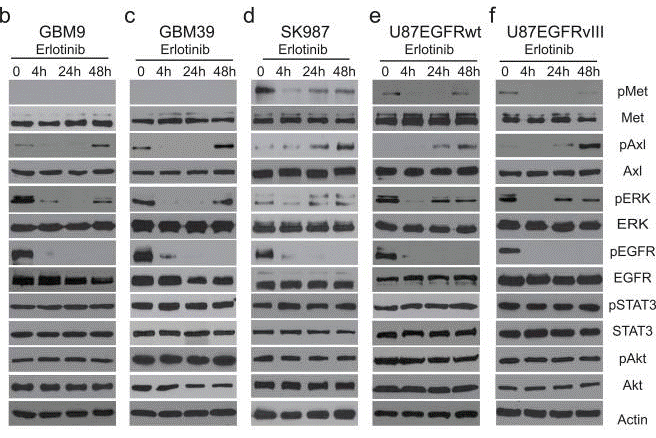
| Western blot | p-Met / Met / p-Axl / Axl / pERK / ERK / pEGFR / EGFR / p-STAT3 / STAT3 / p-Akt / Akt p-Raf-1 / Raf-1 / p-MEK / MEK cleaved PARP / PARP p27 / pS10-p27 / pT157-p27 / pT187-p27 Bcl-2 / Bcl-xl / Mcl-1 / Bax / Bak / Bad / Bim EL / PUMA |
|
28604685 |
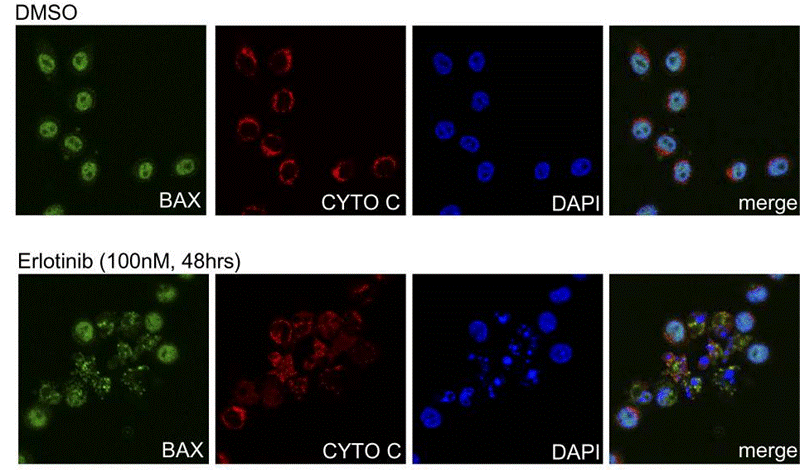
| Immunofluorescence | Bax / Cyto C E-cadherin / β-catenin / Vimentin EGFR |
|
17927446 |
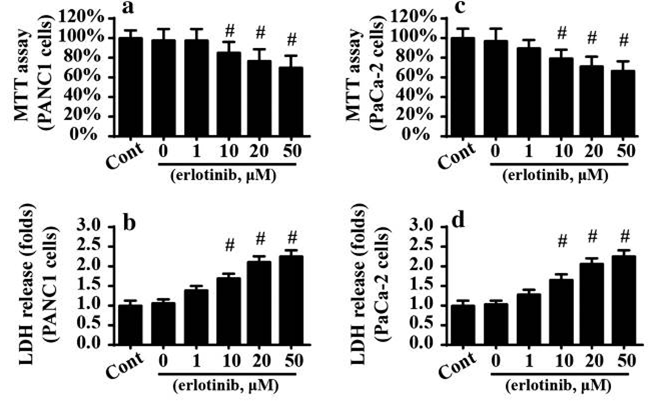
| Growth inhibition assay | Cell viability |
|
30377412 |
Clinical Trial Information
(data from https://clinicaltrials.gov, updated on 2024-05-22)
| NCT Number | Recruitment | Conditions | Sponsor/Collaborators | Start Date | Phases |
|---|---|---|---|---|---|
| NCT04172779 | Not yet recruiting | Cirrhosis Liver |
University of Texas Southwestern Medical Center|National Cancer Institute (NCI) |
July 2024 | Phase 2 |
| NCT06161558 | Not yet recruiting | Neoplasms |
National Cancer Institute (NCI)|National Institutes of Health Clinical Center (CC) |
May 15 2024 | Phase 1 |
| NCT05827614 | Recruiting | Non-small Cell Lung Cancer|Non-Small Cell Lung Adenocarcinoma|Non-Small Cell Squamous Lung Cancer|Head and Neck Squamous Cell Carcinoma|Esophageal Cancer|Gastric Cancer|Breast Cancer|Bladder Cancer|Ovarian Cancer|Endometrial Cancer|Liposarcoma |
Boundless Bio |
March 24 2023 | Phase 1 |
| NCT03460678 | Terminated | Carcinoma Non-Small-Cell Lung |
Hikma Pharmaceuticals LLC |
February 28 2018 | Phase 4 |
Tech Support
Tel: +1-832-582-8158 Ext:3
If you have any other enquiries, please leave a message.
Frequently Asked Questions
Question 1:
Whether it is suitable for mouse assays?
Answer:
It is a suspension for oral gavage, prepared by dissolving S1023 in 15% Captisol.
Signaling Pathway Map

Products are for research use only. Not for human use. We do not sell to patients.
©Copyright 2013 Selleck Chemicals. All Rights Reserved.