
-
 Argentina
-
 Australia
-
 Austria
-
 Belgium
-
 Brazil
-
 Canada
-
 China
China
-
 Czech Republic
-
 Denmark
-
 Finland
-
 France
-
 Germany
-
 Greece
-
 Hong Kong
-
 Hungary
-
 Iceland
-
 India
India
-
 Ireland
-
 Israel
-
 Italy
Italy
-
 Japan
Japan
-
 Korea
Korea
-
 Luxembourg
-
 Malaysia
-
 Netherlands
-
 New Zealand
-
 Norway
-
 Poland
-
 Portugal
-
 Qatar
Qatar
-
 Romania
-
 Saudi Arabia
-
 Singapore
-
 Spain
Spain
-
 Sweden
-
 Switzerland
-
 Taiwan
-
 Turkey
-
 United Kingdom
-
 United States
research use only
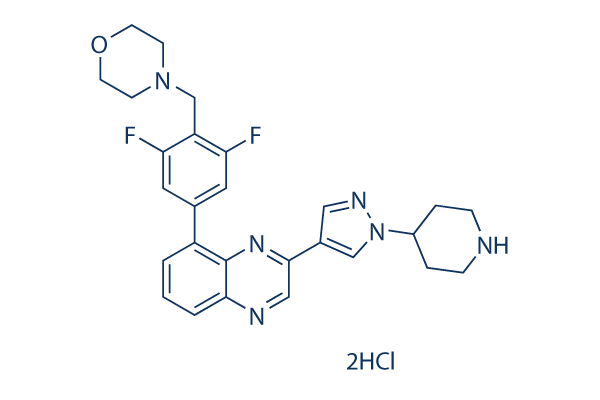
NVP-BSK805 2HCl JAK inhibitor
Cat.No.S2686
Quality Control
| Related Targets | EGFR STAT Pim |
|---|---|
| Other JAK Inhibitors | BMS-986165 (Deucravacitinib) AZD1480 WP1066 Filgotinib (GLPG0634) Momelotinib (CYT387) AT9283 Gandotinib (LY2784544) Pacritinib (SB1518) TG101209 Cerdulatinib (PRT062070) hydrochloride |
Solubility
|
In vitro |
DMSO
: 100 mg/mL
(177.47 mM)
Water : 100 mg/mL Ethanol : 6 mg/mL |
Molarity Calculator
|
In vivo |
|||||
In vivo Formulation Calculator (Clear solution)
Step 1: Enter information below (Recommended: An additional animal making an allowance for loss during the experiment)
Step 2: Enter the in vivo formulation (This is only the calculator, not formulation. Please contact us first if there is no in vivo formulation at the solubility Section.)
Calculation results:
Working concentration: mg/ml;
Method for preparing DMSO master liquid: mg drug pre-dissolved in μL DMSO ( Master liquid concentration mg/mL, Please contact us first if the concentration exceeds the DMSO solubility of the batch of drug. )
Method for preparing in vivo formulation: Take μL DMSO master liquid, next addμL PEG300, mix and clarify, next addμL Tween 80, mix and clarify, next add μL ddH2O, mix and clarify.
Method for preparing in vivo formulation: Take μL DMSO master liquid, next add μL Corn oil, mix and clarify.
Note: 1. Please make sure the liquid is clear before adding the next solvent.
2. Be sure to add the solvent(s) in order. You must ensure that the solution obtained, in the previous addition, is a clear solution before proceeding to add the next solvent. Physical methods such
as vortex, ultrasound or hot water bath can be used to aid dissolving.
Chemical Information, Storage & Stability
| Molecular Weight | 563.47 | Formula | C27H28F2N6O.2HCl |
Storage (From the date of receipt) | |
|---|---|---|---|---|---|
| CAS No. | 1942919-79-0 | Download SDF | Storage of Stock Solutions |
|
|
| Synonyms | BSK805 | SMILES | C1CNCCC1N2C=C(C=N2)C3=NC4=C(C=CC=C4N=C3)C5=CC(=C(C(=C5)F)CN6CCOCC6)F.Cl.Cl | ||
Read more about storage stability stock solution CAS number SMILES
Mechanism of Action
| Targets/IC50/Ki |
JAK2
(Cell-free assay) ~0.5 nM
TYK2
(Cell-free assay) 10.76 nM
JAK3
(Cell-free assay) 18.68 nM
JAK1
(Cell-free assay) 31.63 nM
|
|---|---|
| In vitro |
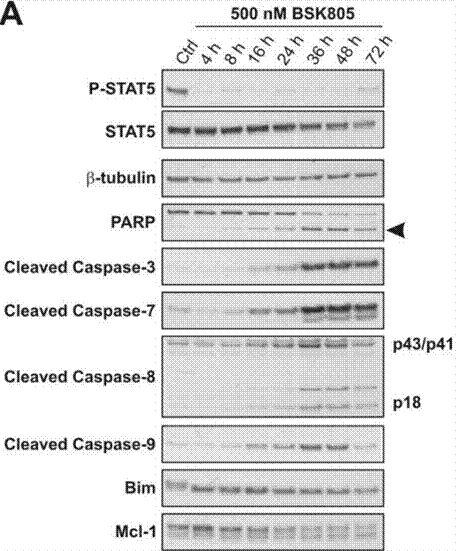
NVP-BSK805 is found to potently inhibit JAK2, whereas displaying more than 20-fold selectivity towards JAK1, JAK3, and TYK2. NVP-BSK805 causes half-maximal inhibition of full-length JAK2V617F and JAK2 wild-type enzymes at 0.5 nM. NVP-BSK805 blocks the growth of JAK2V617F cells (Ba/F3) and induces apoptosis with a GI50 at concentrations <100 nM. As constitutive STAT5 phosphorylation in dependent on JAK2, NVP-BSK805 is found to potently suppress STAT5 phophorylation at ≥ 100 nM concentrations in the JAK2 V617F -mutant cell lines, like MB-02. Incubation of SET-2 cells with 150 nM and 1µM of NVP-BSK805, which corresponds to concentration yielding 75% and 95% growth inhibition, respectively, for 24, 48, and 72 hours lead to concentration- and time- dependent induction of apoptosis. These results are evidenced by the detection of cleaved PARP, reduced Bcl-xL expression, and a strong increase in the number of cells with less than 2N DNA content. NVP-BSK805 triggered cell death requires activation of caspase cascades and is overcome by caspase inhibition in both SET-2 and MB-02 cells. NVP-BSK805 modulates the post-translational modification of Bim and levels of Mcl-1 in JAK2V617F cells, SET-2 and MB-02 cells.
|
| Kinase Assay |
Enzymatic Assays
|
|
The human JAK2 kinase domain (amino acids 840-1132) is contained in plasmid construct pAcG2TtevJAK2. The plasmid constructs for JAK3 (813-1124), TYK2 (888-1187), and JAK1(866-1154) are designed. The generation of the recombinant baculoviruses with BD BaculoGoldTM Bright linearized DNA, plaque assay, and virus amplification from single plaques is performed according to the manual (BD Biosciences Pharmingen). Janus kinase domains are expressed in Sf9 cells in 400 mL shake flasks with 100 mL ExCell420 culture medium (JRH Biosciences Ltd) with penicillin/streptomycin solution for 48 h at 27°C. Suspension culture cells are infected at a density of 1 × 10⁶ and the multiplicity of infection (MOI) for each virus is optimized for yield of soluble protein. The kinase domain of human JAK2 and of JAK1, JAK3, and TYK2 is expressed at an MOI of 1 and 0.5, respectively. Time of expression at 27°C is 48 hours for JAK2 and 48 hours or 72 hours for JAK1, JAK3, and TYK2. Forty-eight or seventy-two hours post-infection, the cells from a 100 mL expression culture are harvested by centrifugation at 3000 x g for 5 minutes and lysed with 12 mL lysis buffer (50 mM Tris-HCl, pH 7.5, 150 mM NaCl, 2 mM EDTA, 1 mM DTT, 1 mM sodium orthovanadate, 1 % Triton X-100, 10 % glycerol, 1 x EDTA-free complete protease inhibitor cocktail (Roche Diagnostics), and 12.5 U/mL Benzonase for 30 minutes at 4°C, followed by centrifugation at 14,000 × g for 45 minutes to pellet insoluble material. For GST-tag affinity purification of kinase domain proteins all steps are performed at 4°C. The cleared lysates are incubated with 0.2 mL of a 50 % slurry of washed Glutathione Sepharose 4B for 2 hours at 4°C, followed by 5 washes with 1 mL of 50 mM Tris-HCl, pH 7.5, 150 mM NaCl, 0.1 % Triton X-100, 1 mM DTT, and 10 % glycerol. Bound protein is eluted in 5 aliquots each starting with a 10 minutes incubation with 0.25 mL elution buffer (50 mM Tris-HCl, pH 7.5, 150 mM NaCl, 0.1 % Triton X-100, 1mM DTT, 10 % glycerol, 10 mM reduced L-glutathione). Eluates are concentrated about 5-fold with Amicon Ultra-4 spin columns. After addition of Brij35 to 0.1 % final concentration the protein is snap frozen in small aliquots and stored at -80 °C. In these conditions, kinase activities are stable for at least 6 months. The JAK kinasedomain enzymes are incubated for 30 minutes at room temperature in a medium containing 0.1 μM [γ33P]-ATP, 1 mM MnCl2, 5 mM MgCl2, 30 μM of synthetic peptide substrate EQEDEPEGDYFEWLE, 1 mM DTT, 1 % DMSO, 50 μg/mL BSA, 0.01 % Brij35, and 50 mM Tris-HCl pH 7.5. The ATP concentration is below the Km for all proteins. Curves are fitted by non-linearregression using the logistic equation and the global fit function of XLfit® (model 205). Expression and characterization of full-length wild type and V617F mutant JAK2 as well as kinase assay conditions have been described elsewhere. Kinase selectivity of NVP-BSK805 is assessed in an internal kinase panel: In the Caliper assays, kinase reactions are carried out with peptide substrates that migrate with different velocities in an electrical field when phosphorylated. The peptides carry a fluorescent label in order to allow the detection and quantification of the peptides in a capillary system. Peptide fluorescence intensities are quantified using the LC3000 instrument (Caliper Life Sciences, Hopkinton, MA, USA). Kinase activity is measured by quantifying the amount of ATP remaining in solution following a kinase reaction. In the LanthaScreen™ TR-FRET kinase assays, terbium is used as the lanthanide chelate combined with an antibody directed against the phosphorylated substrate.
|
|
| In vivo |
Oral bioavailability of NVP-BSK805 in mice is estimated to be 45%, while it is 50% in rats. Oral administration of NVP-BSK805 at 150 mg/kg suppresses STAT5 phosphorylation, splenomegaly, and leukemic cell spreading in a Ba/F3 JAK2V617F cell–driven mouse model. NVP-BSK805 suppresses rhEpo-induced STAT5 phosphorylation as well as rhEpo-mediated polycythemia and splenomegaly in BALB/c mice at doses of 25, 50, and 100 mg/kg orally.
|
References |
|
Applications
| Methods | Biomarkers | Images | PMID |
|---|---|---|---|
| Western blot | p-STAT5 / STAT5 / PARP / Cleaved Caspase-3 / Cleaved caspase-7 / Cleaved Caspase-8 / Cleaved Caspase-9 / Bim / Mcl-1 p-JAK2 / JAK2 |
|
21247487 |
Tech Support
Tel: +1-832-582-8158 Ext:3
If you have any other enquiries, please leave a message.
Signaling Pathway Map

Products are for research use only. Not for human use. We do not sell to patients.
©Copyright 2013 Selleck Chemicals. All Rights Reserved.