
Why did storing diluted Doxorubicin in polystyrene tubes drastically lower its cellular uptake?
Quick Answer
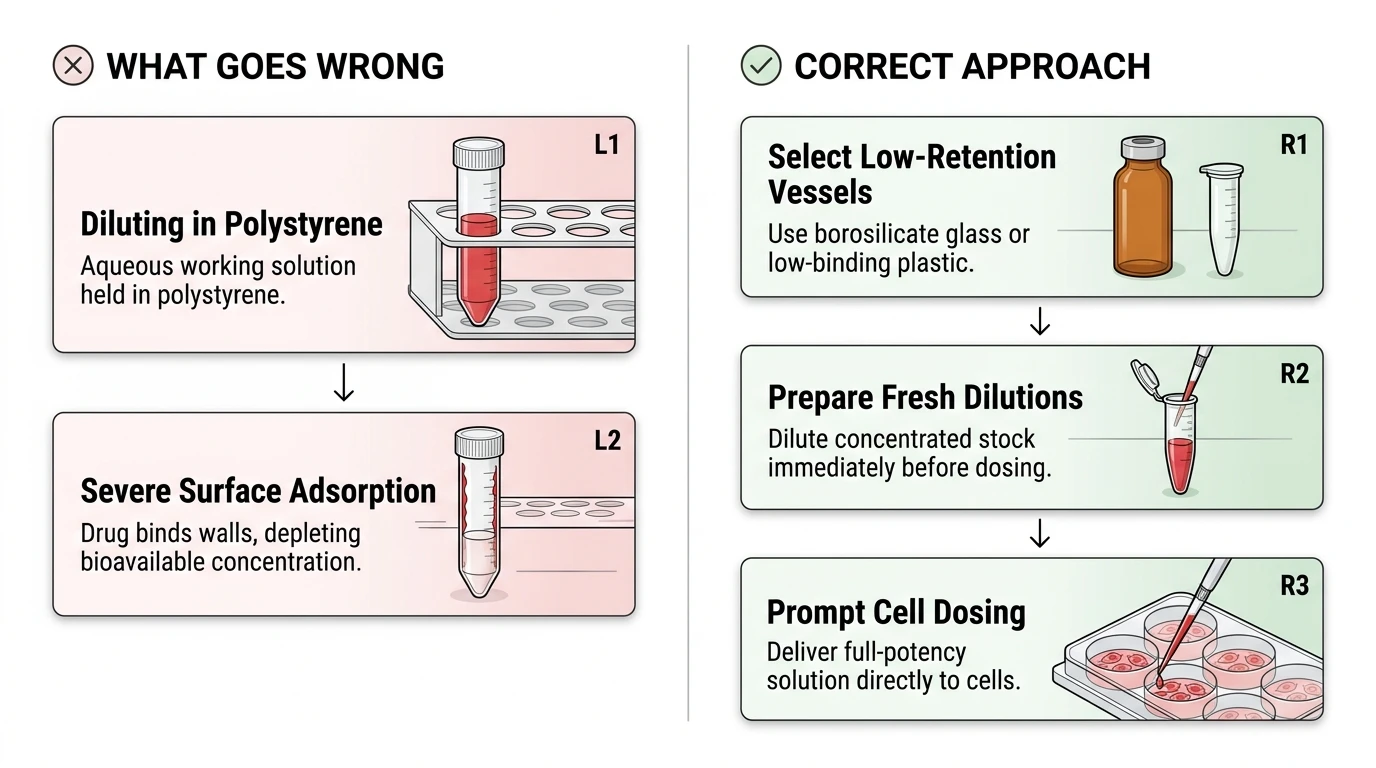
Recommended ApproachPrepare doxorubicin working dilutions freshly in low-retention polypropylene or borosilicate glass containers immediately before dosing cells.
Common CausesDiluted doxorubicin was stored in polystyrene tubes, causing the majority of the drug to adsorb nonspecifically onto the hydrophobic vessel walls and drastically depleting the bioavailable solution concentration.
How Should It Be Done Correctly?
Copy code to add this image to your page Copy Code
Container Compatibility and Handling Guidelines
Physicochemical properties, vessel surface compatibility, and preparation parameters for doxorubicin dosing solutions.
Standard Operating Procedure for Working Dilutions
-
Stock Solution Retrieval and Conditioning: Retrieve the 10 mM doxorubicin DMSO stock solution from storage. Allow the vial to warm completely to ambient room temperature protected from light, verifying that no precipitated solute remains before uncapping.
-
Selection of Consumables: Assemble dedicated low-retention (siliconized or low-binding polymer) microcentrifuge tubes or amber borosilicate glass vials for all serial dilution steps. Avoid standard polystyrene cell culture tubes, polystyrene 15 mL/50 mL conical tubes, or polystyrene multi-well dilution reservoirs.
-
Intermediate and Final Dilution Preparation: Dispense the required volume of complete cell culture medium or sterile physiological buffer into the low-binding vessel. Aspirate the concentrated stock using low-retention pipette tips and introduce it directly into the liquid phase, mixing immediately by gentle inversion or pipetting to prevent localized precipitation.
-
Immediate Cell Treatment: Deliver the diluted doxorubicin solution to seeded culture plates immediately following preparation. Do not pre-dilute working solutions hours or days in advance to hold on ice or at ambient temperature.
-
Post-Exposure Wash Routine: After the designated treatment period, wash cells gently with sterile PBS to remove non-internalized extracellular drug before evaluating fluorescence or lysing for analytical quantification [1, 2].
| Parameter | Polystyrene (PS) | Standard Polypropylene (PP) | Low-Retention PP / Glass | Recommended Protocol Specification |
|---|---|---|---|---|
| Surface Adsorption Tendency | Severe (hydrophobic + aromatic π–π) | Moderate | Negligible to minimal | Low-binding surface strictly required |
| Effective Drug Loss at <10 µM | >40–70% within 2–6 h | ~15–30% within 4 h | <5% over 6 h | <5% container adsorption loss |
| Primary Stock Storage | Not suitable | Acceptable for short term | Preferred (amber glass / low-bind PP) | 10 mM in DMSO at -80°C (1 yr) or -20°C (1 mo) |
| Working Solution Stability | Rapid depletion via adsorption | Gradual wall binding | Stable solution concentration | Formulate fresh; use within 30 min |
| Vessel Material Recommendation | Incompatible for working dilutions | Acceptable only for concentrated stock | Strongly recommended for all dilutions | Borosilicate glass or surface-passivated PP |
What Went Wrong?
Prolonged Exposure to Hydrophobic Polystyrene Surfaces
The primary procedural error was holding diluted aqueous solutions of doxorubicin inside polystyrene labware prior to cell dosing. Standard polystyrene vessels—commonly used for flow cytometry tubes, round-bottom tubes, and non-treated serial dilution racks—possess a rigid, non-polar plastic matrix. While concentrated DMSO stocks can tolerate brief handling, aqueous working dilutions (typically 0.1–10 µM) present a high surface-area-to-solute ratio, exacerbating container-surface contact.
Depletion of Bioavailable Extracellular Concentration
The immediate consequence of holding diluted doxorubicin in polystyrene containers is severe passive adsorption of the drug onto the inner walls of the tube. Within hours of contact, a major fraction of the solute molecules partition out of the aqueous bulk phase and adhere to the plastic matrix. Consequently, when the supernatant liquid is subsequently transferred onto cultured cells, the true extracellular concentration is merely a small fraction of the intended nominal dose. Because doxorubicin relies fundamentally on a concentration gradient across the plasma membrane to drive passive entry, this marked loss of solute abolishes the driving force required for intracellular accumulation [3].
Molecular Mechanics of Plastic Binding and Uptake Loss
Doxorubicin contains a rigid, planar tetracyclic anthraquinone aglycone core coupled to an amino sugar moiety [4, 5]. Polystyrene consists of repeating styrene units carrying pendant hydrophobic phenyl rings. When doxorubicin is dissolved in polar aqueous buffers or culture media, the hydrophobic effect energetically drives its planar aromatic ring system toward non-polar boundaries to minimize solvent disruption.
Furthermore, extensive π–π stacking occurs between the aromatic rings of the anthraquinone core and the delocalized π-electron systems of the polystyrene matrix. Although the primary amine on the daunosamine sugar is positively charged at physiological pH, the planar hydrophobic core dominates interfacial behavior at low micromolar concentrations [3, 6]. Free drug enters cells primarily through unassisted passive diffusion across the lipid bilayer [3]. By sequestering the active anthraquinone molecules onto the polystyrene surface, the equilibrium of free monomeric doxorubicin in the aqueous phase drops drastically, resulting in the observed steep decline in cellular uptake and downstream cytotoxicity [1, 7].
How Can I Avoid This in Future Experiments?
- Standardize Consumable Specifications: Eliminate all polystyrene-based containers, transfer pipettes, and dilution plates from doxorubicin handling pipelines, substituting exclusively certified low-binding polypropylene or high-grade borosilicate glassware.
- Incorporate Pre-Dosing Concentration Validation: When testing new container materials or modified handling protocols, verify the actual working concentration by measuring doxorubicin absorbance (around 480–495 nm) or intrinsic fluorescence in the supernatant before applying it to cells [1, 8].
- Adopt In Situ Dosing for Micromolar Screens: If serial dilutions must be handled across microplates, prepare concentrated intermediate dilutions immediately before dosing rather than letting sub-micromolar solutions incubate inside multi-well mixing plates.
References
- [1]Perillo E, et al. Oncotarget. 2016 Jan;7(4):4077-92.[IF: 5.168]
- [2]Bessone F, et al. Cancer drug resistance (Alhambra, Calif.). 2021 Jan;4(1):192-207.[IF: 3.7]
- [3]Imantay A, et al. Nanomaterials (Basel, Switzerland). 2025 Jan;15(2).[IF: 4.8]
- [4]Peter S, et al. Molecules (Basel, Switzerland). 2022 Jul;27(14).[IF: 4.6]
- [5]Xia W, et al. Bioengineering (Basel, Switzerland). 2025 Apr;12(4).[IF: 4.4]
- [6]Gayathri K, et al. Nanoscale advances. 2024 Aug;6(16):3992-4014.[IF: 4.6]
- [7]Kullenberg F, et al. Cells. 2021 Jul;10(7).[IF: 7.666]
- [8]Zlotnikov ID, et al. International journal of molecular sciences. 2023 Apr;24(9).[IF: 4.9]