
Why did Doxorubicin fail to dissolve when I attempted reconstitution in pure ethanol?
Quick Answer
Recommended ApproachReconstitute Doxorubicin in anhydrous DMSO to a standard 10 mM stock concentration, or in sterile water, instead of pure ethanol.
Common CausesDoxorubicin failed to dissolve because it is a hydrochloride salt with an ethanol solubility below 1 mg/mL, rendering it practically insoluble in pure alcohol.
How Should It Be Done Correctly?
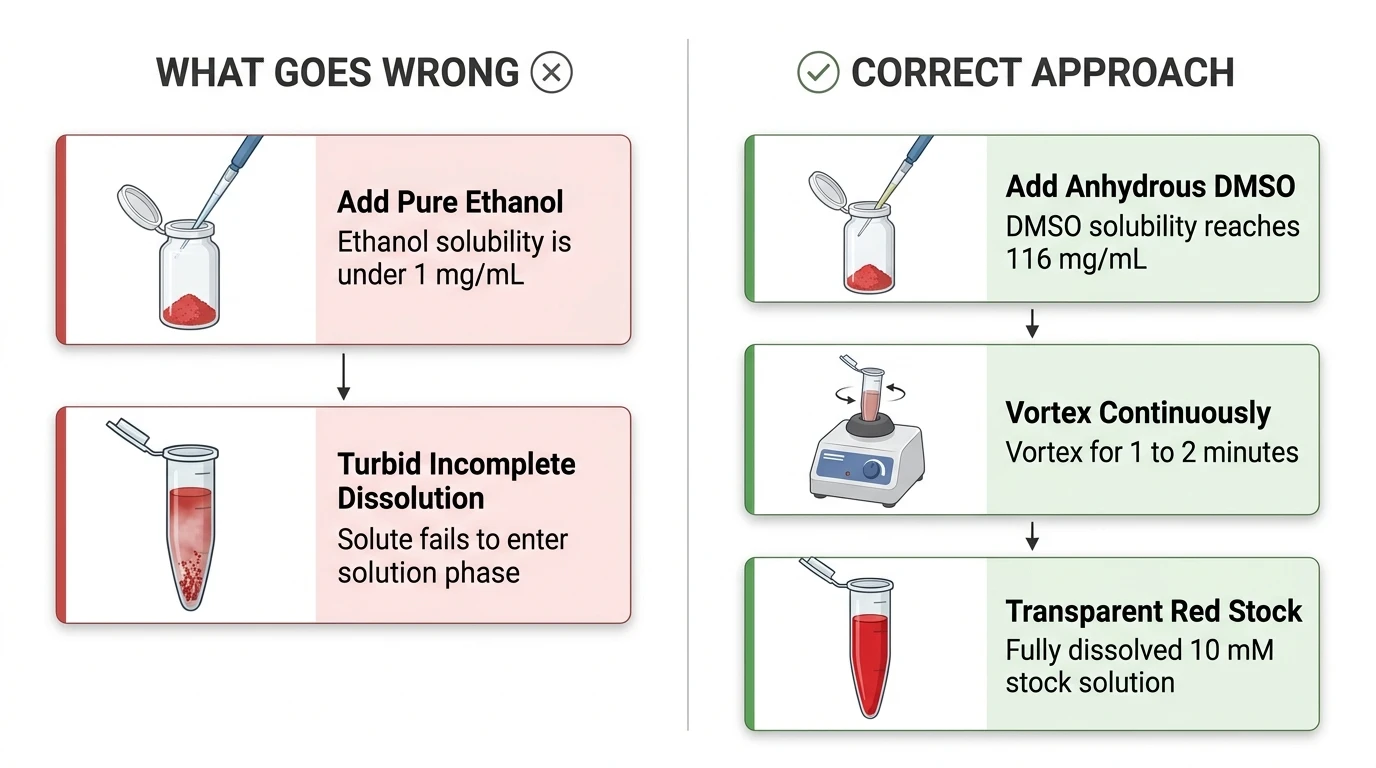
Copy code to add this image to your page Copy Code
Reconstitution Parameters and Solvent Solubility Reference
To ensure complete solubilization and prevent batch loss, choose reconstitution vehicles that match the thermodynamic and polar characteristics of the anthracycline salt.
Standard Reconstitution and Stock Aliquoting Protocol
- Equilibrate the vial before unsealing: Remove the lyophilized Doxorubicin powder vial from -20°C storage and allow it to equilibrate to room temperature (20°C to 25°C) inside a desiccator or sealed secondary container for at least 20 to 30 minutes. Opening a cold vial introduces atmospheric moisture, which causes localized caking and hampers subsequent solvent penetration.
- Solvent selection and precise addition: Select high-grade, anhydrous DMSO (or sterile deionized water) rather than alcohols. Using a calibrated positive-displacement or standard micropipette, inject the exact calculated volume of solvent to achieve a 10 mM stock solution (requiring 5.7998 mg powder per mL of DMSO, or roughly 1.724 mL solvent for a standard 10 mg vial).
- Dissolution and mechanical agitation: Cap the vial tightly and vortex continuously for 1 to 2 minutes. Inspect the red-orange fluid under direct illumination against a white and black background; it should form an intensely colored, transparent red solution completely free of turbidity or settling crystalline specks. If minute particulates linger when approaching high concentrations, sonicate the tube in a water bath at room temperature for 5 to 10 minutes [Source: ResearchGate]. Avoid warming above 37°C during sonication to preserve compound stability.
- Sterile filtration and sub-aliquoting: If downstream cell culture requires sterility and non-sterile solvent was used, pass the solution through a 0.22 µm or 0.45 µm PTFE syringe filter (for DMSO) or a PVDF/cellulose filter (for aqueous solutions) [1]. Working quickly under low ambient light, dispense the stock into single-use, sterile, amber microcentrifuge tubes (e.g., 20–50 µL per aliquot) to minimize dead volume and prevent repeated freeze-thaw cycles.
- Storage and thaw verification: Purge the aliquot headspace with nitrogen or argon gas if available, seal, and transfer immediately to -80°C for long-term storage (up to 1 year) or -20°C (up to 1 month). When retrieving an aliquot for experiments, thaw completely at room temperature, vortex thoroughly to resolve any micro-phase separation or cryo-concentration, and dilute directly into pre-warmed culture medium immediately before cell treatment.
| Solvent / Parameter | Solubility Limit | Recommended Stock Target | Storage & Rated Shelf Life | Operational Suitability |
|---|---|---|---|---|
| Anhydrous DMSO | 116 mg/mL | 10 mM (5.80 mg/mL) | -80°C (1 year) / -20°C (1 month) | Primary standard for in vitro cell assays; high capacity |
| Sterile Distilled Water | 9 mg/mL (up to 50–100 mg/mL by lot) | 2–5 mM (1.16–2.90 mg/mL) | -80°C (1 year) / -20°C (1 month) | Best for solvent-sensitive cultures and liposomal preparation [1] |
| Pure Ethanol | <1 mg/mL | Not feasible (<1.7 mM) | Not recommended | Practically insoluble; precipitates as visible suspension |
| Powder (Solid State) | N/A | N/A | -20°C (3 years) | Desiccated, protected from light [2] |
What Went Wrong?
Solvent Mismatch and Severe Solubility Deficit
The primary procedural error was selecting pure ethanol as a primary reconstitution vehicle for Doxorubicin. Doxorubicin is officially rated as practically insoluble in ethanol, with a solubility ceiling below 1 mg/mL (<1.72 mM). Attempting to dissolve typical experimental target masses (such as preparing common 5 mM, 10 mM, or even 2 mM stocks) in pure ethanol requires concentrations far exceeding this saturation threshold. Consequently, the solute cannot enter the solution phase, yielding an opaque, cloudy suspension containing coarse, undissolved crystalline aggregates.
High Lattice Energy and Insufficient Alcoholic Solvation
Solid Doxorubicin is supplied as a hydrochloride salt (MW 579.98, CAS 25316-40-9), existing in a stable, highly ordered crystalline lattice held together by strong ionic bonds between the protonated daunosamine amino group and chloride counterions, alongside dense intermolecular hydrogen bonding [2, 3]. Overcoming this crystal lattice energy requires a solvent that exhibits both a high dielectric constant and exceptional hydrogen-bond donating/accepting capabilities. While water and DMSO easily break these lattice interactions through intense dipole interactions and dipole-charge shielding, pure ethanol has a significantly lower dielectric constant (ε ≈ 24–25 vs. ~47 for DMSO and ~80 for water) and lower polarity. Ethanol cannot provide sufficient free energy of solvation to counterbalance the high crystalline lattice enthalpy of the salt, halting dissolution.
Molecular Polarity and Counterion Aggregation
The molecular structure of Doxorubicin comprises a rigid, tetracyclic planar anthraquinone aglycone conjugated to an aminoglycosidic daunosamine sugar moiety [3, 4]. At physiological and neutral conditions, the primary amine on the daunosamine residue is largely protonated, giving the molecule a hydrophilic, cationic character [5]. In a non-aqueous, lower-polarity solvent like absolute ethanol, ion pairing between the protonated amino group and the chloride anion remains tightly coupled. Furthermore, the amphiphilic anthraquinone chromophores undergo rapid self-association driven by hydrophobic π–π stacking, while the polar sugar and phenolic hydroxyl substituents fail to be efficiently solvated by the ethyl carbon chain of ethanol. Instead of dispersing as solvated monomers, the molecules rapidly cluster into microcrystalline precipitates and macroscopic flakes.
How Can I Avoid This in Future Experiments?
To prevent reconstitution failures, always consult the manufacturer's solvent-specific solubility thresholds before adding liquid to high-value lyophilized compounds. For Doxorubicin, establish anhydrous DMSO as the universal default vehicle for in vitro screening, targeting a 10 mM stock concentration, or use sterile aqueous buffers (pH 4.0–6.0) if ethanol- or solvent-free conditions are required for specialized formulations [1, 6]. If an experimental protocol strictly demands ethanolic delivery (e.g., specific lipid nanoparticle assembly), first dissolve the drug in a minimal volume of sterile water or DMSO to establish a homogeneous solution before slowly blending it into ethanol-containing mixtures, ensuring the final single-phase concentration remains strictly below the precipitation limit.
References
- [1]García MC, et al. Pharmaceutics. 2021 Jun;13(7).[IF: 6.525]
- [2]Kaczmarek A, et al. TheScientificWorldJournal. 2013 Jan;2013:258758.[IF: 1.524]
- [3]Peter S, et al. Molecules (Basel, Switzerland). 2022 Jul;27(14).[IF: 4.6]
- [4]Lee J, et al. Pharmaceuticals (Basel, Switzerland). 2023 May;16(6).[IF: 4.3]
- [5]Khabibullin VR, et al. International journal of molecular sciences. 2023 Feb;24(5).[IF: 4.9]
- [6]Kono Y, et al. Pharmaceutics. 2025 Jul;17(8).[IF: 6.9]