
-
 Australia
-
 Austria
-
 Belgium
-
 Brazil
-
 Canada
-
 China
China
-
 Czech Republic
-
 Denmark
-
 Finland
-
 France
-
 Germany
-
 Greece
-
 Hong Kong
-
 Hungary
-
 Iceland
-
 India
India
-
 Ireland
-
 Israel
-
 Italy
Italy
-
 Japan
Japan
-
 Korea
Korea
-
 Luxembourg
-
 Malaysia
-
 Netherlands
-
 New Zealand
-
 Norway
-
 Poland
-
 Qatar
Qatar
-
 Romania
-
 Saudi Arabia
-
 Singapore
-
 Spain
Spain
-
 Sweden
-
 Switzerland
-
 Taiwan
-
 Turkey
-
 United Kingdom
-
 United States
mTOR Activators
| Cat.No. | Product Name | Information | Product Use Citations | Product Validations |
|---|---|---|---|---|
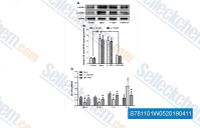
| S7811 | MHY1485 | MHY1485 is a potent, and cell-permeable mTOR activator, and this compound also potently inhibits autophagy. |
|
|
| S8317 | 3BDO | 3BDO, a butyrolactone derivative, could target FKBP1A and activate the mTOR signaling pathway. It inhibits autophagy in HUVECs. This compound inhibits oxLDL-induced apoptosis. |
|
|
| S2396 | Salidroside | Salidroside (Rhodioloside), a phenylpropanoid glycoside isolated from Rhodiola rosea, has been reported to have a broad spectrum of pharmacological properties. This compound is a prolyl endopeptidase inhibitor. It alleviates cachexia symptoms in mouse models of cancer cachexia via activating mTOR signalling. This chemical protects dopaminergic neurons by enhancing PINK1/Parkin-mediated mitophagy. |
|
|
| S3753 | L-Leucine | Leucine ((S)-Leucine, Leu) is one of nine essential amino acids in humans which is important for protein synthesis and many metabolic functions. It contributes to regulation of blood-sugar levels; growth and repair of muscle and bone tissue; growth hormone production; and wound healing. L-Leucine is an essential branched-chain amino acid (BCAA), which activates the mTOR signaling pathway. |
|
|

Products are for research use only. Not for human use. We do not sell to patients.
©Copyright 2013 Selleck Chemicals. All Rights Reserved.