
-
 Argentina
-
 Australia
-
 Austria
-
 Belgium
-
 Brazil
-
 Canada
-
 China
China
-
 Czech Republic
-
 Denmark
-
 Finland
-
 France
-
 Germany
-
 Greece
-
 Hong Kong
-
 Hungary
-
 Iceland
-
 India
India
-
 Ireland
-
 Israel
-
 Italy
Italy
-
 Japan
Japan
-
 Korea
Korea
-
 Luxembourg
-
 Malaysia
-
 Netherlands
-
 New Zealand
-
 Norway
-
 Poland
-
 Portugal
-
 Qatar
Qatar
-
 Romania
-
 Saudi Arabia
-
 Singapore
-
 Spain
Spain
-
 Sweden
-
 Switzerland
-
 Taiwan
-
 Turkey
-
 United Kingdom
-
 United States
ACE Activators
| Cat.No. | Product Name | Information | Product Use Citations | Product Validations |
|---|---|---|---|---|
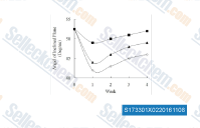
| S1733 | Methylprednisolone | Methylprednisolone is a synthetic glucocorticoid receptor agonist, used to achieve prompt suppression of inflammation. This compound activates ACE2 and reduces IL-6 levels, thus improves severe or critical COVID-19. It markedly reduces autophagy and apoptosis. |
|
|
| S4104 | Diminazene Aceturate | Diminazene(Diminazene diaceturate) is a di-amidine also known as 4,4-(1-Triazene–1,3–diyl)bis(benzenecarboximidamide), used as an effective trypanocidal agent. The main biochemical mechanism of the trypanocidal actions of Diminazene aceturate is by binding to trypanosomal kinetoplast DNA (kDNA) in a non-intercalative manner through specific interaction with sites rich in adenine-thymine base pairs. Diminazene aceturate is also an angiotensin-converting enzyme 2 (ACE2) activator and has strong and potent anti-inflammatory properties. |
|
|
| S5973 | Methylprednisolone Acetate | Methylprednisolone (NSC-19987, Medrol) acetate is a synthetic glucocorticoid receptor agonist, used to achieve prompt suppression of inflammation. Methylprednisolone activates ACE2 and reduces IL-6 levels, thus improves severe or critical COVID-19. Methylprednisolone markedly reduces autophagy and apoptosis. |
|
|

Products are for research use only. Not for human use. We do not sell to patients.
©Copyright 2013 Selleck Chemicals. All Rights Reserved.