
-
 Australia
-
 Austria
-
 Belgium
-
 Brazil
-
 Canada
-
 China
China
-
 Czech Republic
-
 Denmark
-
 Finland
-
 France
-
 Germany
-
 Greece
-
 Hong Kong
-
 Hungary
-
 Iceland
-
 India
India
-
 Ireland
-
 Israel
-
 Italy
Italy
-
 Japan
Japan
-
 Korea
Korea
-
 Luxembourg
-
 Malaysia
-
 Netherlands
-
 New Zealand
-
 Norway
-
 Poland
-
 Qatar
Qatar
-
 Romania
-
 Saudi Arabia
-
 Singapore
-
 Spain
Spain
-
 Sweden
-
 Switzerland
-
 Taiwan
-
 Turkey
-
 United Kingdom
-
 United States
research use only
Bisacodyl
Cat.No.S4047
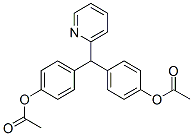
Chemical Structure
Molecular Weight: 361.39
Quality Control
Solubility
|
In vitro |
DMSO
: 72 mg/mL
(199.23 mM)
Water : Insoluble Ethanol : Insoluble |
Molarity Calculator
|
In vivo |
|||||
In vivo Formulation Calculator (Clear solution)
Step 1: Enter information below (Recommended: An additional animal making an allowance for loss during the experiment)
Step 2: Enter the in vivo formulation (This is only the calculator, not formulation. Please contact us first if there is no in vivo formulation at the solubility Section.)
Calculation results:
Working concentration: mg/ml;
Method for preparing DMSO master liquid: mg drug pre-dissolved in μL DMSO ( Master liquid concentration mg/mL, Please contact us first if the concentration exceeds the DMSO solubility of the batch of drug. )
Method for preparing in vivo formulation: Take μL DMSO master liquid, next addμL PEG300, mix and clarify, next addμL Tween 80, mix and clarify, next add μL ddH2O, mix and clarify.
Method for preparing in vivo formulation: Take μL DMSO master liquid, next add μL Corn oil, mix and clarify.
Note: 1. Please make sure the liquid is clear before adding the next solvent.
2. Be sure to add the solvent(s) in order. You must ensure that the solution obtained, in the previous addition, is a clear solution before proceeding to add the next solvent. Physical methods such
as vortex, ultrasound or hot water bath can be used to aid dissolving.
Chemical Information, Storage & Stability
| Molecular Weight | 361.39 | Formula | C22H19NO4 |
Storage (From the date of receipt) | |
|---|---|---|---|---|---|
| CAS No. | 603-50-9 | Download SDF | Storage of Stock Solutions |
|
|
| Synonyms | N/A | Smiles | CC(=O)OC1=CC=C(C=C1)C(C2=CC=C(C=C2)OC(=O)C)C3=CC=CC=N3 | ||
Mechanism of Action
| In vitro |
Bisacodyl (10 μg/mL) increases mRNA expression level of TNF-α, COX2 and PGE2 in Raw264.7 cells.
|
|---|---|
| In vivo |
Bisacodyl (20 mg/kg) results in a decrease in AQP3 protein expression and increased mRNA expression level of TNF-α in the colon of rats. This compound inhibits water absorption in rat jejunum, ileum, and colon, the degree of inhibition is linearly related to the logarithm of the bisacodyl concentration over the range of 0.05 mg to 2.0 mg per 100 mL. This chemical (10 mg/kg, intragastrically) induces a significant decrease in jejunal NOS activity in rats. It (10 mg/kg, intragastrically) increases the distance traveled by the marker in all time periods. It (5.9 mg/kg) decreases significantly jejunal and colonic (Na + K) ATPase activity as compared to saline-treated rats. This compound (5.9 mg/kg) increases significantly jejunal and colonic PGE2 content and stimulates jejunal and colonic adenyl cyclase activity as compared to those in control rats without affecting cAMP content. It (4.3 mg/kg) coupled with AOM increases the number of crypt per focus, but not the number of tumors in rats. This chemical (43 mg/kg) significantly increases the number of crypt per focus and tumors in rats.
|
References |
|
Clinical Trial Information
(data from https://clinicaltrials.gov, updated on 2024-05-22)
| NCT Number | Recruitment | Conditions | Sponsor/Collaborators | Start Date | Phases |
|---|---|---|---|---|---|
| NCT06219707 | Not yet recruiting | Irritable Bowel Syndrome With Constipation |
Nanyang Technological University|National University of Singapore |
March 1 2024 | Not Applicable |
| NCT05770960 | Completed | Opioid-Induced Constipation |
Universitaire Ziekenhuizen KU Leuven |
June 27 2018 | Phase 4 |
| NCT03279341 | Completed | Chronic Constipation |
University Hospital Gasthuisberg |
December 3 2012 | Phase 4 |
| NCT01424228 | Completed | Constipation |
Shire|Takeda |
April 6 2011 | Phase 4 |
Tech Support
Tel: +1-832-582-8158 Ext:3
If you have any other enquiries, please leave a message.

Products are for research use only. Not for human use. We do not sell to patients.
©Copyright 2013 Selleck Chemicals. All Rights Reserved.