
-
 Argentina
-
 Australia
-
 Austria
-
 Belgium
-
 Brazil
-
 Canada
-
 China
China
-
 Czech Republic
-
 Denmark
-
 Finland
-
 France
-
 Germany
-
 Greece
-
 Hong Kong
-
 Hungary
-
 Iceland
-
 India
India
-
 Ireland
-
 Israel
-
 Italy
Italy
-
 Japan
Japan
-
 Korea
Korea
-
 Luxembourg
-
 Malaysia
-
 Netherlands
-
 New Zealand
-
 Norway
-
 Poland
-
 Qatar
Qatar
-
 Romania
-
 Saudi Arabia
-
 Singapore
-
 Spain
Spain
-
 Sweden
-
 Switzerland
-
 Taiwan
-
 Turkey
-
 United Kingdom
-
 United States
research use only
Sunitinib (SU11248) Malate Tyrosine Kinase Inhibitor
Cat.No.S1042
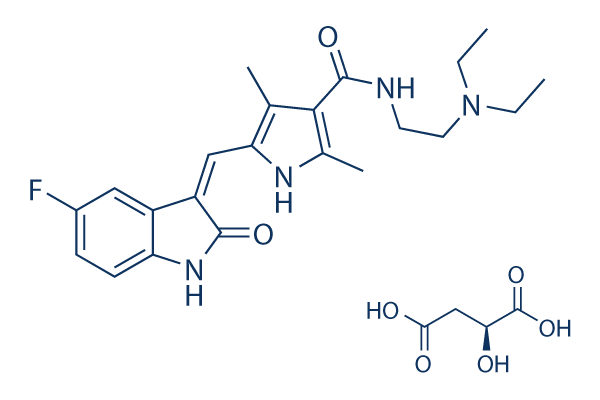
Chemical Structure
Molecular Weight: 532.56
Quality Control
| Related Targets | EGFR VEGFR FGFR c-Met Src MEK CSF-1R FLT3 HER2 c-Kit |
|---|---|
| Other PDGFR Inhibitors | CP-673451 Orantinib (SU6668) Tyrphostin AG 1296 Trapidil PP121 AZD2932 Sennoside B Tyrphostin AG1433 AG 1295 N-(p-Coumaroyl) Serotonin |
Cell Culture, Treatment & Working Concentration
| Cell Lines | Assay Type | Concentration | Incubation Time | Formulation | Activity Description | PMID |
|---|---|---|---|---|---|---|
| 3T3 | Kinase Assay | Inhibition of PDGF-induced BrdU incorporation with IC50 of 0.007 μM | 12646019 | |||
| 3T3 | Growth Inhibition Assay | Inhibition of Platelet-derived growth factor induced 3T3 cell proliferation with IC50 of 0.01 μM | 12646019 | |||
| 3T3 | Function Assay | Inhibition of Vascular endothelial growth factor receptor with IC50 of 0.05 μM | 12646019 | |||
| 3T3 | Kinase Assay | 20 min | DMSO | Cellular inhibition of VEGF induced human KDR phosphorylation with IC50 of 0.022 μM | 16162008 | |
| NIH3T3 | Kinase Assay | 20 min | DMSO | inhibit human KDR kinase expressed with IC50 of 0.018 μM | 16162008 | |
| A549 | Function Assay | DMSO | Inhibition of c-Met dependent HGF-induced human A549 cell migration with IC50 of 2 μM | 18434145 | ||
| DU145 | Function Assay | DMSO | Inhibition of c-Met dependent HGF-induced human DU145 cell scattering with IC50 of 10 μM | 18434145 | ||
| KB3-1 | Cytotoxic Assay | 72 h | DMSO | Cytotoxicity against human P-gp-negative KB-3-1 cells with IC50 of 2.3 μM | 19397322 | |
| KBV1 | Cytotoxic Assay | 72 h | DMSO | Cytotoxicity against human P-glycoprotein-expressing KBV1 cells with IC50 of 4.1 μM | 19397322 | |
| A375 | Cytotoxic Assay | 72 h | DMSO | IC50=5.4 μM | 19654408 | |
| RS4-11 | Function Assay | 2 h | Inhibition of FLT3 autophosphorylation with IC50 of 0.0099 μM | 19654408 | ||
| RS4-11 | Function Assay | 2 h | Inhibition of FLT3 ITD mutant autophosphorylation with IC50 of 0.034 μM | 19654408 | ||
| Sf9 | Kinase Assay | 30 min | Inhibition of GST-tagged VEGFR expressed with IC50 of 0.185 μM | 19854051 | ||
| Ba/F3 | Growth Inhibition Assay | 72 h | IC50=1.2 μM | 20117004 | ||
| BaPTC2 | Growth Inhibition Assay | 72 h | IC50=0.22 μM | 20117004 | ||
| Sf9 | Function Assay | 1 h | DMSO | Inhibition of human recombinant His-tagged RET expressed with IC50 of 1.3 μM | 20117004 | |
| H4 | Cytotoxic Assay | 10 μM | Toxicity in human H4 cells | 20350806 | ||
| SF-539 | Kinase Assay | 333 μM | 60 min | DMSO | Inhibition of PDGFRbeta phosphorylation with IC50 of 12.2 μM | 20403700 |
| U251 | Kinase Assay | 333 μM | 60 min | DMSO | Inhibition of VEGFR2 phosphorylation with IC50 of 18.9 μM | 20403700 |
| A431 | Kinase Assay | Inhibition of PDGFRbeta expressed with IC50 of 12.2 μM | 20558072 | |||
| A431 | Kinase Assay | Inhibition of VEGFR2 expressed with IC50 of 18.9 μM | 20558072 | |||
| HepG2 | Growth Inhibition Assay | 72 h | IC50=3.81 μM | 20570526 | ||
| Kasumi-1 | Growth Inhibition Assay | 72 h | IC50=0.016 μM | 20570526 | ||
| RS4-11 | Growth Inhibition Assay | 72 h | IC50=1 μM | 20570526 | ||
| THP1 | Growth Inhibition Assay | 72 h | IC50=0.5 μM | 20570526 | ||
| Kasumi-1 | Function Assay | Inhibition of c-Kit autophosphorylation with IC50 of 0.015 μM | 20833039 | |||
| A549 | Growth Inhibition Assay | 16 h | Antitumor activity against human A549 cells | 21450463 | ||
| HL60 | Growth Inhibition Assay | 16 h | Antitumor activity against human HL60 cells | 21450463 | ||
| HUVEC | Growth Inhibition Assay | 16 h | Inhibition of VEGF-induced cell proliferation with IC50 of 2.75 μM | 21450463 | ||
| HUVEC | Growth Inhibition Assay | 16 h | Inhibition of bFGF-induced cell proliferation with IC50 of 4.04 μM | 21450463 | ||
| IM9 | Growth Inhibition Assay | 16 h | Antitumor activity against human IM9 cells | 21450463 | ||
| K562 | Growth Inhibition Assay | 16 h | Antitumor activity against human K562 cells | 21450463 | ||
| MDA-MB-231 | Growth Inhibition Assay | 16 h | Antitumor activity against human MDA-MB-231 cells | 21450463 | ||
| H460 | Cytotoxic Assay | 72 h | IC50=2.7 μM | 21621880 | ||
| SMMC7721 | Cytotoxic Assay | 72 h | IC50=6.47 μM | 21621880 | ||
| WI38 | Cytotoxic Assay | 72 h | IC50=8.56 μM | 21621880 | ||
| HEK293 | Kinase Assay | 100 nM | 1 h | does not inhibit VEGF-induced autophosphorylation of tyrosine 1175 residue on VEGFR2 expressed in HEK293 cells | 21885287 | |
| HUVEC | Function Assay | 1 μM | 24 h | Antiangiogenic activity assessed as decrease in VEGF-induced cell migration | 21963305 | |
| HUVEC | Function Assay | 1 μM | 1 h | Inhibition of ERK phosphorylation at Thr202/Tyr204 in VEGF-stimulated HUVEC | 21963305 | |
| HUVEC | Function Assay | 1 μM | 1 h | Inhibition of eNOS phosphorylation at Ser-1172 in VEGF-stimulated HUVEC | 21963305 | |
| HUVEC | Kinase Assay | 1 μM | 1 h | Inhibition of VEGFR2 phosphorylation at tyr-1175 in VEGF-stimulated HUVEC | 21963305 | |
| HUVEC | Function Assay | 1 μM | 1 h | does not inhibit AKT phosphorylation at Ser-473 in VEGF-stimulated HUVEC | 21963305 | |
| HL60 | Cytotoxic Assay | 50 μM | 48 h | DMSO | IC50=15.5 μM | 22019188 |
| K562 | Cytotoxic Assay | 50 μM | 48 h | DMSO | IC50=21.9 μM | 22019188 |
| PC3 | Cytotoxic Assay | 50 μM | 48 h | DMSO | IC50=25.1 μM | 22019188 |
| SF-539 | Kinase Assay | 333 μM | 60 min | Inhibition of PDGFRbeta tyrosine kinase activity in PDGF-BB-stimulated human SF-539 cells with IC50 of 12.2 μM | 22204741 | |
| HAEC | Growth Inhibition Assay | 100 μM | 72 h | Antiproliferative activity against human HAEC cells expressing VEGFR with IC50 of 0.1 μM | 22444679 | |
| HT-29 | Growth Inhibition Assay | 100 μM | 72 h | Antiproliferative activity against human HT-29 cells expressing VEGFR with IC50 of 0.33 μM | 22444679 | |
| MV4-11 | Cytotoxic Assay | 72 h | IC50=0.003 μM | 22452518 | ||
| HepG2 | Cytotoxic Assay | 48 h | IC50=13.24 μM | 22483608 | ||
| PC9 | Cytotoxic Assay | 48 h | IC50=10.97 μM | 22483608 | ||
| CAKI-1 | Growth Inhibition Assay | 100 μM | 48 h | DMSO | GI50=0.63 μM | 22560627 |
| EKVX | Growth Inhibition Assay | 100 μM | 48 h | DMSO | GI50=7.9 μM | 22560627 |
| MCF7 | Growth Inhibition Assay | 100 μM | 48 h | DMSO | GI51=2 μM | 22560627 |
| MDA-MB-435 | Growth Inhibition Assay | 100 μM | 48 h | DMSO | GI52=2 μM | 22560627 |
| OVCAR3 | Growth Inhibition Assay | 100 μM | 48 h | DMSO | GI53=3.2 μM | 22560627 |
| SNB19 | Growth Inhibition Assay | 100 μM | 48 h | DMSO | GI54=10 μM | 22560627 |
| SW620 | Growth Inhibition Assay | 100 μM | 48 h | DMSO | GI55=1.3 μM | 22560627 |
| TK10 | Growth Inhibition Assay | 100 μM | 48 h | DMSO | GI56=6.3 μM | 22560627 |
| UACC257 | Growth Inhibition Assay | 100 μM | 48 h | DMSO | GI57=4 μM | 22560627 |
| HAEC | Cytotoxic Assay | 100 μM | 72 h | DMSO | Cytotoxicity against VEGFR expressing HAEC with IC50 of 0.1 μM | 23131541 |
| HT-29 | Cytotoxic Assay | 100 μM | 72 h | DMSO | Cytotoxicity against VEGFR expressing human HT-29 cells with IC50 of 0.33 μM | 23131541 |
| HCT116 | Function Assay | 24 h | DMSO | Antimigratory activity assessed as inhibition of cell migration | 23153200 | |
| HUVEC | Function Assay | 2 μM | 18 h | DMSO | Antiangiogenic activity in HUVECs under hypoxic condition assessed as inhibition of tube formation | 23153200 |
| ACHN | Cytotoxic Assay | 6 d | IC50=2.5 μM | 23360104 | ||
| A498 | Cytotoxic Assay | 100 μM | 72 h | DMSO | IC50=4.3 μM | 23489626 |
| HUVEC | Growth Inhibition Assay | 3 μM | 24 h | DMSO | Antiangiogenic activity assessed as inhibition of VEGF-induced tube formation with EC50 of 0.645 μM | 23583911 |
| HUVEC | Kinase Assay | 200 μM | DMSO | Inhibition of VEGFR2 phosphorylation in growth factor-stimulated HUVEC | 23583911 | |
| HUVEC | Kinase Assay | 200 μM | DMSO | Inhibition of VEGFR1 phosphorylation in growth factor-stimulated HUVEC | 23583911 | |
| A549 | Cytotoxic Assay | 72 h | DMSO | IC50=2.44 μM | 23602441 | |
| HCT116 | Cytotoxic Assay | 72 h | DMSO | IC50=4.71 μM | 23602441 | |
| MCF7 | Cytotoxic Assay | 72 h | DMSO | IC50=6.29 μM | 23602441 | |
| BGC | Growth Inhibition Assay | 72 h | DMSO | IC50=4.78 μM | 23999040 | |
| BxPC3 | Growth Inhibition Assay | 72 h | DMSO | IC50=3.63 μM | 23999040 | |
| HT-29 | Growth Inhibition Assay | 72 h | DMSO | IC50=1.47 μM | 23999040 | |
| T24 | Growth Inhibition Assay | 72 h | DMSO | IC50=2.44 μM | 23999040 | |
| 4T1 | Cytotoxic Assay | 72 h | DMSO | IC50=0.016 μM | 24890652 | |
| MCF7 | Cytotoxic Assay | 72 h | DMSO | IC50=0.0271 μM | 24890652 | |
| MCF7 | Cytotoxic Assay | 72 h | DMSO | IC50=0.0293 μM | 24890652 | |
| MDA-MB-231 | Cytotoxic Assay | 72 h | DMSO | IC50=0.0223 μM | 24890652 | |
| MDA-MB-435 | Cytotoxic Assay | 72 h | DMSO | IC50=0.0097 μM | 24890652 | |
| MDA-MB-468 | Cytotoxic Assay | 72 h | DMSO | IC50=0.0061 μM | 24890652 | |
| A431 | Kinase Assay | 10 μM | 1 h | DMSO | Inhibition of EGFR with IC50 of 0.1721 μM | 24890652 |
| SH-SY5Y | Kinase Assay | 10 μM | 1 h | DMSO | Inhibition of PDGFRbeta with IC50 of 0.0831 μM | 24890652 |
| U251 | Kinase Assay | 10 μM | 1 h | DMSO | Inhibition of VEGFR2 with IC50 of 0.0189 μM | 24890652 |
| Bel7402 | Growth Inhibition Assay | 72 h | DMSO | IC50=2.67 μM | 24904961 | |
| HK2 | Growth Inhibition Assay | 72 h | DMSO | IC50=5.85 μM | 24904961 | |
| LO2 | Growth Inhibition Assay | 72 h | DMSO | IC50=19.93 μM | 24904961 | |
| MV4-11 | Growth Inhibition Assay | 48 h | DMSO | IC50=0.003 μM | 24904961 | |
| NCI-H3122 | Growth Inhibition Assay | 72 h | DMSO | IC50=0.83 μM | 24904961 | |
| NCI-H460 | Growth Inhibition Assay | 72 h | DMSO | IC50=4.31 μM | 24904961 | |
| NCI-H526 | Growth Inhibition Assay | 72 h | DMSO | IC50=1.01 μM | 24904961 | |
| TT | Growth Inhibition Assay | 72 h | DMSO | IC50=0.04 μM | 24904961 | |
| 3T3 | Antiproliferative assay | 72 hrs | Antiproliferative activity against mouse 3T3 cells expressing human CSF1R after 72 hrs by Celltiter assay, Activity = 0.09 μM. | 18694641 | ||
| MV4-11 | Antiproliferative assay | 72 hrs | Antiproliferative activity against human MV4-11 cells after 72 hrs by cell titer-blue cell viability assay, IC50 = 0.0043 μM. | 19754199 | ||
| HEK293 | Function assay | Binding affinity to FLT3 catalytic domain expressed in HEK293 cells by competitive binding assay, Kd = 0.00047 μM. | 19754199 | |||
| FDC-P1 | Function assay | 48 hrs | Inhibition of human FMS expressed in growth factor dependent mouse FDC-P1 cells assessed as inhibition of FMS-mediated cell proliferation in presence human CSF1 after 48 hrs by resazurin dye reduction assay, IC50 = 0.155 μM. | 20156689 | ||
| primary leukemia cells | Cytotoxicity assay | 72 hrs | Cytotoxicity against human primary leukemia cells isolated from acute myeloid leukemia patient expressing FLT3-ITD mutation assessed as cell viability after 72 hrs by luciferase assay, IC50 = 0.03 μM. | 22221201 | ||
| primary leukemia cells | Cytotoxicity assay | 72 hrs | Cytotoxicity against human primary leukemia cells isolated from acute myeloid leukemia patient expressing wild type FLT3 assessed as cell viability after 72 hrs by luciferase assay, IC50 = 0.03 μM. | 22221201 | ||
| primary leukemia cells | Cytotoxicity assay | 72 hrs | Cytotoxicity against human primary leukemia cells isolated from acute myeloid leukemia patient expressing FLT3-D835Y mutation assessed as cell viability after 72 hrs by luciferase assay, IC50 = 1.1 μM. | 22221201 | ||
| endothelial precursor cells | Function assay | Inhibition of endothelial cord area formation in endothelial precursor cells by CD31 cord area detection based phenotypic drug discovery based assay, IC50 = 0.0096 μM. | 22409666 | |||
| endothelial precursor cells | Function assay | Inhibition of cell migration in endothelial precursor cells by Oris cell migration kit based phenotypic drug discovery based assay, IC50 = 13.6 μM. | 22409666 | |||
| U251 | Function assay | 60 mins | Inhibition of VEGFR2 in human U251 cells pretreated for 60 mins measured after 1 hr by ELISA, IC50 = 18.9 μM. | 22739090 | ||
| U251 | Function assay | 60 mins | Inhibition of VEGF-induced VEGFR2 phosphorylation in human U251 cells overexpressing Flk-1 pretreated for 60 mins prior to VEGF addition measured after 10 mins by phosphotyrosine ELISA cytoblot analysis, IC50 = 18.9 μM. | 23375090 | ||
| U251 | Function assay | 60 mins | Inhibition of VEGFR2 in human U251 cells assessed as inhibition of VEGF-induced tyrosine phosphorylation incubated for 60 mins prior to VEGF-activation measured 10 mins by ELISA, IC50 = 18.9 μM. | 23434139 | ||
| CHO | Function assay | Inhibition of Cav1.2 current measured using QPatch automatic path clamp system in CHO cells expressing Cav1.2, beta-2 and alpha-2/delta-1 subunits, IC50 = 33.4 μM. | 23812503 | |||
| U251 | Function assay | Inhibition of VEGFR2 in human U251 cells by phosphotyrosine ELISA, IC50 = 0.0189 μM. | 24900865 | |||
| MCF7 | Antiproliferative assay | 48 hrs | Antiproliferative activity against human MCF7 cells after 48 hrs by MTT assay, IC50 = 10.5 μM. | 25064347 | ||
| HepG2 | Antiproliferative assay | 48 hrs | Antiproliferative activity against human HepG2 cells after 48 hrs by MTT assay, IC50 = 13.6 μM. | 25064347 | ||
| CHO | Function assay | Inhibition of rapid delayed inward rectifying potassium current (IKr) in Chinese hamster ovary (CHO) cells stable expressing hERG measured using IonWorks Barracuda automated patch clamp platform, IC50 = 7.94328 μM. | 25087753 | |||
| CHO K1 | Function assay | Inhibition of rapid delayed inward rectifying potassium current (IKr) in Chinese hamster ovary (CHO) K1 cells stably expressing hERG measured using IonWorks Quattro automated patch clamp platform, IC50 = 10 μM. | 25087753 | |||
| CHO K1 | Function assay | Inhibition of fast sodium current (INa) in Chinese Hamster Ovary (CHO) K1 cells transfected with human Nav1.5 measured using IonWorks Quattro automated patch clamp platform, IC50 = 15.8489 μM. | 25087753 | |||
| HEK293 | Function assay | Inhibition of fast sodium current (INa) in HEK293 cells transfected with human Nav1.5 measured using IonWorks Quattro automated patch clamp platform, IC50 = 39.8107 μM. | 25087753 | |||
| MOLM13 | Cytotoxicity assay | 48 hrs | Cytotoxicity against human MOLM13 cells assessed as cell viability after 48 hrs by MTT assay, IC50 = 0.0177 μM. | 25089810 | ||
| MV4-11 | Cytotoxicity assay | 48 hrs | Cytotoxicity against human MV4-11 cells assessed as cell viability after 48 hrs by MTT assay, IC50 = 0.0243 μM. | 25089810 | ||
| HL60 | Cytotoxicity assay | 48 hrs | Cytotoxicity against human HL60 cells assessed as cell viability after 48 hrs by MTT assay, IC50 = 0.0368 μM. | 25089810 | ||
| THP1 | Cytotoxicity assay | 48 hrs | Cytotoxicity against human THP1 cells assessed as cell viability after 48 hrs by MTT assay, IC50 = 0.0457 μM. | 25089810 | ||
| ACHN | Cytotoxicity assay | 72 hrs | Cytotoxicity against human ACHN cells after 72 hrs by MTT assay, IC50 = 2 μM. | 25124114 | ||
| U251 | Function assay | 60 min | Inhibition of VEGFR2 in human U251 cells compound pretreated for 60 min before VEGF stimulation for 10 mins by phosphotyrosine ELISA cytoblot method, IC50 = 0.0189 μM. | 25882519 | ||
| U251 | Function assay | 60 min | Inhibition of PDGFR-beta in human U251 cells compound pretreated for 60 min before PDGF-BB stimulation for 10 mins by phosphotyrosine ELISA cytoblot method, IC50 = 0.0831 μM. | 25882519 | ||
| A431 | Function assay | 60 min | Inhibition of EGFR in human A431 cells compound pretreated for 60 min before EGF stimulation for 10 mins by phosphotyrosine ELISA cytoblot method, IC50 = 0.1721 μM. | 25882519 | ||
| HT-29 | Cytotoxicity assay | 48 hrs | Cytotoxicity against human HT-29 cells assessed as inhibition of cell viability after 48 hrs by SRB assay, IC50 = 4.7 μM. | 26009164 | ||
| A549 | Cytotoxicity assay | 48 hrs | Cytotoxicity against human A549 cells assessed as inhibition of cell viability after 48 hrs by SRB assay, IC50 = 7.93 μM. | 26009164 | ||
| SKOV3 | Cytotoxicity assay | 48 hrs | Cytotoxicity against human SKOV3 cells assessed as inhibition of cell viability after 48 hrs by SRB assay, IC50 = 9.21 μM. | 26009164 | ||
| PANC1 | Cytotoxicity assay | 48 hrs | Cytotoxicity against human PANC1 cells assessed as inhibition of cell viability after 48 hrs by SRB assay, IC50 = 14.94 μM. | 26009164 | ||
| HepG2 | Cytotoxicity assay | 48 hrs | Cytotoxicity against human HepG2 cells assessed as inhibition of cell viability after 48 hrs by SRB assay, IC50 = 16.06 μM. | 26009164 | ||
| MCF7 | Cytotoxicity assay | 48 hrs | Cytotoxicity against human MCF7 cells assessed as inhibition of cell viability after 48 hrs by SRB assay, IC50 = 25.41 μM. | 26009164 | ||
| Bel7402 | Photocytotoxicity assay | 5 hrs | Photocytotoxicity against human Bel7402 cells assessed as cell viability preincubated for 5 hrs with cells followed by UVA-1 irradiation at 3.0 mW/cm'2 for 20 mins measured after 48 hrs by CCK8 assay, EC50 = 11 μM. | 26584085 | ||
| PANC1 | Photocytotoxicity assay | 5 hrs | Photocytotoxicity against human PANC1 cells assessed as cell viability preincubated for 5 hrs with cells followed by UVA-1 irradiation at 3.0 mW/cm'2 for 20 mins measured after 48 hrs by CCK8 assay, EC50 = 13 μM. | 26584085 | ||
| SVEC4-10 | Cytotoxicity assay | 24 hrs | Cytotoxicity against mouse SVEC4-10 cells assessed as cell viability after 24 hrs by MTS assay, IC50 = 8 μM. | 26912111 | ||
| HUVEC | Antiangiogenic assay | 10 uM | 5 hrs | Antiangiogenic activity in human HUVEC cells assessed as angiogenesis rate at 10 uM after 5 hrs by endothelial tube formation assay relative to control | 26912111 | |
| HT-29 | Cytotoxicity assay | Cytotoxicity against human HT-29 cells by MTT assay, IC50 = 1.7 μM. | 26920800 | |||
| A549 | Cytotoxicity assay | Cytotoxicity against human A549 cells by MTT assay, IC50 = 9.1 μM. | 26920800 | |||
| MDA-MB-435 | Cytotoxicity assay | Cytotoxicity against human MDA-MB-435 cells by MTT assay, IC50 = 9.3 μM. | 26920800 | |||
| MV4-11 | Antiproliferative assay | 72 hrs | Antiproliferative activity against FLT3-ITD dependent human MV4-11 cells assessed as reduction in cell viability after 72 hrs by celltiter-glo/CCK8 assay, GI50 = 0.001 μM. | 27077705 | ||
| HL60 | Antiproliferative assay | 72 hrs | Antiproliferative activity against human HL60 cells assessed as reduction in cell viability after 72 hrs by celltiter-glo/CCK8 assay, GI50 = 0.001 μM. | 27077705 | ||
| BAF3 | Function assay | 72 hrs | Inhibition of Tel-fused cKIT T670I mutant (unknown origin) transfected in mouse BAF3 cells assessed as decrease in cell proliferation after 72 hrs by celltiter-glo/CCK8 assay, GI50 = 0.002 μM. | 27077705 | ||
| MOLM14 | Antiproliferative assay | 72 hrs | Antiproliferative activity against FLT3-ITD dependent human MOLM14 cells assessed as reduction in cell viability after 72 hrs by celltiter-glo/CCK8 assay, GI50 = 0.005 μM. | 27077705 | ||
| BAF3 | Function assay | 72 hrs | Inhibition of Tel-fused cKIT V559D/V654A double mutant (unknown origin) transfected in mouse BAF3 cells assessed as decrease in cell proliferation after 72 hrs by celltiter-glo/CCK8 assay, GI50 = 0.006 μM. | 27077705 | ||
| BAF3 | Function assay | 72 hrs | Inhibition of Tel-fused cKIT V559D mutant (unknown origin) transfected in mouse BAF3 cells assessed as decrease in cell proliferation after 72 hrs by celltiter-glo/CCK8 assay, GI50 = 0.009 μM. | 27077705 | ||
| BAF3 | Function assay | 72 hrs | Inhibition of Tel-fused cKIT V654A mutant (unknown origin) transfected in mouse BAF3 cells assessed as decrease in cell proliferation after 72 hrs by celltiter-glo/CCK8 assay, GI50 = 0.02 μM. | 27077705 | ||
| BAF3 | Function assay | 72 hrs | Inhibition of Tel-fused cKIT L567P mutant (unknown origin) transfected in mouse BAF3 cells assessed as decrease in cell proliferation after 72 hrs by celltiter-glo/CCK8 assay, GI50 = 0.023 μM. | 27077705 | ||
| GISTT1 | Antiproliferative assay | 72 hrs | Antiproliferative activity against cKIT dependent human GISTT1 cells assessed as reduction in cell viability after 72 hrs by celltiter-glo/CCK8 assay, GI50 = 0.041 μM. | 27077705 | ||
| BAF3 | Function assay | 72 hrs | Inhibition of Tel-fused cKIT T670I/V559D double mutant (unknown origin) transfected in mouse BAF3 cells assessed as decrease in cell proliferation after 72 hrs by celltiter-glo/CCK8 assay, GI50 = 0.053 μM. | 27077705 | ||
| BAF3 | Function assay | 72 hrs | Inhibition of Tel-fused cKIT (unknown origin) transfected in mouse BAF3 cells assessed as decrease in cell proliferation after 72 hrs by celltiter-glo/CCK8 assay, GI50 = 0.078 μM. | 27077705 | ||
| GIST882 | Antiproliferative assay | 72 hrs | Antiproliferative activity against cKIT dependent human GIST882 cells assessed as reduction in cell viability after 72 hrs by celltiter-glo/CCK8 assay, GI50 = 0.11 μM. | 27077705 | ||
| BAF3 | Function assay | 72 hrs | Inhibition of Tel-fused cKIT N822K mutant (unknown origin) transfected in mouse BAF3 cells assessed as decrease in cell proliferation after 72 hrs by celltiter-glo/CCK8 assay, GI50 = 0.51 μM. | 27077705 | ||
| Rec1 | Antiproliferative assay | 72 hrs | Antiproliferative activity against human Rec1 cells assessed as reduction in cell viability after 72 hrs by celltiter-glo/CCK8 assay, GI50 = 0.87 μM. | 27077705 | ||
| K562 | Antiproliferative assay | 72 hrs | Antiproliferative activity against BCR-ABL dependent human K562 cells assessed as reduction in cell viability after 72 hrs by celltiter-glo/CCK8 assay, GI50 = 1 μM. | 27077705 | ||
| KU812 | Antiproliferative assay | 72 hrs | Antiproliferative activity against BCR-ABL dependent human KU812 cells assessed as reduction in cell viability after 72 hrs by celltiter-glo/CCK8 assay, GI50 = 1.1 μM. | 27077705 | ||
| BCR-ABL dependent MEG01 | Antiproliferative assay | 72 hrs | Antiproliferative activity against human BCR-ABL dependent MEG01 cells assessed as reduction in cell viability after 72 hrs by celltiter-glo/CCK8 assay, GI50 = 1.2 μM. | 27077705 | ||
| BAF3 | Function assay | 72 hrs | Inhibition of Tel-fused cKIT D816V mutant (unknown origin) transfected in mouse BAF3 cells assessed as decrease in cell proliferation after 72 hrs by celltiter-glo/CCK8 assay, GI50 = 1.38 μM. | 27077705 | ||
| U937 | Antiproliferative assay | 72 hrs | Antiproliferative activity against human U937 cells assessed as reduction in cell viability after 72 hrs by celltiter-glo/CCK8 assay, GI50 = 1.7 μM. | 27077705 | ||
| GIST48B | Antiproliferative assay | 72 hrs | Antiproliferative activity against human GIST48B cells assessed as reduction in cell viability after 72 hrs by celltiter-glo/CCK8 assay, GI50 = 2.01 μM. | 27077705 | ||
| CHO | Antiproliferative assay | 72 hrs | Antiproliferative activity against CHO cells assessed as reduction in cell viability after 72 hrs by celltiter-glo/CCK8 assay, GI50 = 2.03 μM. | 27077705 | ||
| CHL | Antiproliferative assay | 72 hrs | Antiproliferative activity against CHL cells assessed as reduction in cell viability after 72 hrs by celltiter-glo/CCK8 assay, GI50 = 2.48 μM. | 27077705 | ||
| BAF3 | Antiproliferative assay | Antiproliferative activity against mouse BAF3 cells, GI50 = 2.78 μM. | 27077705 | |||
| MDA-MB-231 | Cytotoxicity assay | 48 hrs | Cytotoxicity against human MDA-MB-231 cells after 48 hrs by MTT assay, IC50 = 7.4 μM. | 27128173 | ||
| BT549 | Cytotoxicity assay | 48 hrs | Cytotoxicity against human BT549 cells after 48 hrs by MTT assay, IC50 = 15.5 μM. | 27128173 | ||
| DU145 | Cytotoxicity assay | 48 hrs | Cytotoxicity against human DU145 cells after 48 hrs by MTT assay, IC50 = 16.4 μM. | 27128173 | ||
| PC3 | Cytotoxicity assay | 48 hrs | Cytotoxicity against human PC3 cells after 48 hrs by MTT assay, IC50 = 19.6 μM. | 27128173 | ||
| RWPE1 | Cytotoxicity assay | 48 hrs | Cytotoxicity against human RWPE1 cells after 48 hrs by MTT assay, IC50 = 23 μM. | 27128173 | ||
| MCF7 | Function assay | 1 uM | 24 hrs | Inhibition of VEGFR2 phosphorylation in human MCF7 cells assessed as reduction in expression of phosphorylated ERK1/2 at 1 uM incubated for 24 hrs by Western blot analysis | 27176944 | |
| MCF7 | Function assay | 1 uM | 24 hrs | Inhibition of VEGFR2 phosphorylation in human MCF7 cells assessed as reduction in expression of phosphorylated Raf1 at 1 uM incubated for 24 hrs by Western blot analysis | 27176944 | |
| PA1 | Cytotoxicity assay | 48 hrs | Cytotoxicity against human PA1 cells assessed as decrease in cell viability after 48 hrs by MTT assay, IC50 = 7.97 μM. | 27210438 | ||
| LNCAP | Cytotoxicity assay | 48 hrs | Cytotoxicity against human LNCAP cells assessed as decrease in cell viability after 48 hrs by MTT assay, IC50 = 12.61 μM. | 27210438 | ||
| RWPE1 | Cytotoxicity assay | 48 hrs | Cytotoxicity against human RWPE1 cells assessed as decrease in cell viability after 48 hrs by MTT assay, IC50 = 23 μM. | 27210438 | ||
| MCF7 | Cytotoxicity assay | 48 hrs | Cytotoxicity against human MCF7 cells assessed as decrease in cell viability after 48 hrs by MTT assay, IC50 = 23.76 μM. | 27210438 | ||
| MDA-MB-231 | Cytotoxicity assay | 48 hrs | Cytotoxicity against human MDA-MB-231 cells assessed as reduction in cell viability after 48 hrs by MTT assay, IC50 = 7.44 μM. | 27448916 | ||
| A549 | Cytotoxicity assay | 48 hrs | Cytotoxicity against human A549 cells assessed as reduction in cell viability after 48 hrs by MTT assay, IC50 = 14.4 μM. | 27448916 | ||
| BT549 | Cytotoxicity assay | 48 hrs | Cytotoxicity against human BT549 cells assessed as reduction in cell viability after 48 hrs by MTT assay, IC50 = 15.54 μM. | 27448916 | ||
| DU145 | Cytotoxicity assay | 48 hrs | Cytotoxicity against human DU145 cells assessed as reduction in cell viability after 48 hrs by MTT assay, IC50 = 16.38 μM. | 27448916 | ||
| PC3 | Cytotoxicity assay | 48 hrs | Cytotoxicity against human PC3 cells assessed as reduction in cell viability after 48 hrs by MTT assay, IC50 = 19.6 μM. | 27448916 | ||
| MCF7 | Cytotoxicity assay | 48 hrs | Cytotoxicity against human MCF7 cells assessed as reduction in cell viability after 48 hrs by MTT assay, IC50 = 23.8 μM. | 27448916 | ||
| MDA-MB-231 | Cytotoxicity assay | 48 hrs | Cytotoxicity against human MDA-MB-231 cells assessed as cell growth inhibition after 48 hrs by MTT assay, IC50 = 7.4 μM. | 27639369 | ||
| HeLa | Cytotoxicity assay | 48 hrs | Cytotoxicity against human HeLa cells assessed as cell growth inhibition after 48 hrs by MTT assay, IC50 = 10.4 μM. | 27639369 | ||
| PC3 | Cytotoxicity assay | 48 hrs | Cytotoxicity against human PC3 cells assessed as cell growth inhibition after 48 hrs by MTT assay, IC50 = 12.6 μM. | 27639369 | ||
| A549 | Cytotoxicity assay | 48 hrs | Cytotoxicity against human A549 cells assessed as cell growth inhibition after 48 hrs by MTT assay, IC50 = 14.4 μM. | 27639369 | ||
| BT549 | Cytotoxicity assay | 48 hrs | Cytotoxicity against human BT549 cells assessed as cell growth inhibition after 48 hrs by MTT assay, IC50 = 15.5 μM. | 27639369 | ||
| DU145 | Cytotoxicity assay | 48 hrs | Cytotoxicity against human DU145 cells assessed as cell growth inhibition after 48 hrs by MTT assay, IC50 = 16.3 μM. | 27639369 | ||
| RWPE1 | Cytotoxicity assay | 48 hrs | Cytotoxicity against human RWPE1 cells assessed as cell growth inhibition after 48 hrs by MTT assay, IC50 = 25.2 μM. | 27639369 | ||
| L02 | Cytotoxicity assay | 72 hrs | Cytotoxicity against human L02 cells after 72 hrs by CCK-8 assay, IC50 = 4.62 μM. | 27643639 | ||
| HL60 | Cytotoxicity assay | 72 hrs | Cytotoxicity against human HL60 cells after 72 hrs by CCK-8 assay, IC50 = 4.95 μM. | 27643639 | ||
| U251 | Function assay | 60 mins | Inhibition of VEGFR-2 in human U251 cells assessed as reduction in VEGF induced phosphorylation preincubated for 60 mins followed by VEGF addition measured after 10 mins by ELISA method, IC50 = 0.0189 μM. | 27894589 | ||
| SF539 | Function assay | 60 mins | Inhibition of PDGFR-beta in human SF539 cells assessed as reduction in PDGF-BB induced phosphorylation preincubated for 60 mins followed by PDGF-BB addition measured after 10 mins by ELISA method, IC50 = 0.0831 μM. | 27894589 | ||
| HuH7 | Growth inhibition assay | 48 hrs | Growth inhibition of human HuH7 cells after 48 hrs by MTT assay, IC50 = 3.03 μM. | 27956344 | ||
| HCT116 | Growth inhibition assay | 48 hrs | Growth inhibition of human HCT116 cells after 48 hrs by MTT assay, IC50 = 5.62 μM. | 27956344 | ||
| SW620 | Growth inhibition assay | 48 hrs | Growth inhibition of human SW620 cells after 48 hrs by MTT assay, IC50 = 6.25 μM. | 27956344 | ||
| MV4-11 | Antiproliferative assay | 72 hrs | Antiproliferative activity against human MV4-11 cells harboring FLT3 ITD mutant after 72 hrs by MTS assay, IC50 = 0.0385 μM. | 28038328 | ||
| CHO | Function assay | Inhibition of human ERG expressed in CHO cells by Qpatch assay, IC50 = 0.5 μM. | 28038328 | |||
| HepG2 | Antiproliferative assay | 48 hrs | Antiproliferative activity against human HepG2 cells after 48 hrs by MTT assay, IC50 = 16.06 μM. | 28057423 | ||
| MCF7 | Antiproliferative assay | 48 hrs | Antiproliferative activity against human MCF7 cells after 48 hrs by MTT assay, IC50 = 25.41 μM. | 28057423 | ||
| HEK293 | Function assay | 2 mins | Inhibition of human OCT1 expressed in HEK293 cells assessed as decrease in uptake of ASP+ after 2 mins by fluorescence assay, IC50 = 6.1 μM. | 28230985 | ||
| RCC4 | Anticancer assay | 48 hrs | Anticancer activity against human RCC4 cells after 48 hrs by XTT assay, IC50 = 4 μM. | 28325600 | ||
| MDA-MB-231 | Anticancer assay | 48 hrs | Anticancer activity against human MDA-MB-231 cells after 48 hrs by XTT assay, IC50 = 6 μM. | 28325600 | ||
| COLO205 | Cytotoxicity assay | 24 hrs | Cytotoxicity against human COLO205 cells after 24 hrs by MTT assay, IC50 = 8 μM. | 28756024 | ||
| K562 | Cytotoxicity assay | 24 hrs | Cytotoxicity against human K562 cells after 24 hrs by MTT assay, IC50 = 14 μM. | 28756024 | ||
| MDA-MB-231 | Cytotoxicity assay | 24 hrs | Cytotoxicity against human MDA-MB-231 cells after 24 hrs by MTT assay, IC50 = 32 μM. | 28756024 | ||
| MDA-MB-231 | Cytotoxicity assay | 24 hrs | Cytotoxicity in human MDA-MB-231 cells assessed as reduction in cell viability incubated for 24 hrs by MTT assay, IC50 = 6.98 μM. | 28760313 | ||
| MCF7 | Function assay | 4 uM | 24 hrs | Inhibition of VEGFR2 phosphorylation in human MCF7 cells at 4 uM incubated for 24 hrs by Western blot method | 28942113 | |
| GISTT1 | Cytotoxicity assay | 72 hrs | Cytotoxicity against human GISTT1 cells assessed as cell growth inhibition after 72 hrs by CellTiterGlo assay, GI50 = 0.04 μM. | 28991465 | ||
| GISTT1 | Cytotoxicity assay | 72 hrs | Cytotoxicity against human GISTT1 cells harboring KIT T670I mutant assessed as cell growth inhibition after 72 hrs by CellTiterGlo assay, GI50 = 0.09 μM. | 28991465 | ||
| GIST430 | Cytotoxicity assay | 72 hrs | Cytotoxicity against human GIST430 cells harboring KIT V654A mutant assessed as cell growth inhibition after 72 hrs by CellTiterGlo assay, GI50 = 0.098 μM. | 28991465 | ||
| GISTT1 | Cytotoxicity assay | 72 hrs | Cytotoxicity against human GISTT1 cells harboring KIT D816E mutant assessed as cell growth inhibition after 72 hrs by CellTiterGlo assay, GI50 = 5.88 μM. | 28991465 | ||
| HuH7 | Antiproliferative assay | 48 hrs | Antiproliferative activity against human HuH7 cells after 48 hrs by MTT assay, IC50 = 4.707 μM. | 29057042 | ||
| A498 | Antiproliferative assay | 48 hrs | Antiproliferative activity against human A498 cells after 48 hrs by MTT assay, IC50 = 7.981 μM. | 29057042 | ||
| NCI-H727 | Antiproliferative assay | 48 hrs | Antiproliferative activity against human NCI-H727 cells after 48 hrs by MTT assay, IC50 = 10.12 μM. | 29057042 | ||
| MV4-11 | Antiproliferative assay | 72 hrs | Antiproliferative activity against human MV4-11 cells after 72 hrs by Celltiter-Glo luminescent cell viability assay, IC50 = 0.01 μM. | 29935772 | ||
| HuH7 | Antiproliferative assay | Antiproliferative activity against human HuH7 cells by MTT assay, IC50 = 3.03 μM. | 30059803 | |||
| HCT116 | Antiproliferative assay | Antiproliferative activity against human HCT116 cells by MTT assay, IC50 = 5.62 μM. | 30059803 | |||
| SW620 | Antiproliferative assay | Antiproliferative activity against human SW620 cells by MTT assay, IC50 = 6.25 μM. | 30059803 | |||
| HepG2 | Antiproliferative assay | Antiproliferative activity against human HepG2 cells by MTT assay, IC50 = 7.78 μM. | 30059803 | |||
| U251 | Function assay | 60 mins | Inhibition of VEGF-induced VEGFR2 activation in human U251 cells pretreated for 60 mins followed by VEGF addition and measured after 10 mins by ELISA, IC50 = 0.0189 μM. | 30098869 | ||
| SH-SY5Y | Function assay | 60 mins | Inhibition of PDGF-BB-induced PDGFRbeta activation in human SH-SY5Y cells pretreated for 60 mins followed by PDGF-BB addition and measured after 10 mins by ELISA, IC50 = 0.0831 μM. | 30098869 | ||
| A431 | Function assay | 60 mins | Inhibition of EGF-induced EGFR activation in human A431 cells pretreated for 60 mins followed by EGF addition and measured after 10 mins by ELISA, IC50 = 0.1721 μM. | 30098869 | ||
| BA/F3 | Function assay | 72 hrs | Inhibition of Kit exon 11 deletion (557 to 558 residues) mutant (unknown origin) transfected in mouse BA/F3 cells assessed as inhibition of cell growth incubated for 72 hrs by MTS assay, GI50 = 0.004 μM. | 30204441 | ||
| BA/F3 | Function assay | 72 hrs | Inhibition of Kit exon 11 deletion (557 to 558 residues) and D816H mutant and T670I mutant (unknown origin) transfected in mouse BA/F3 cells assessed as inhibition of cell growth incubated for 72 hrs by MTS assay, GI50 = 0.005 μM. | 30204441 | ||
| BA/F3 | Function assay | 72 hrs | Inhibition of Kit exon 11 deletion (557 to 558 residues) and V654A mutant (unknown origin) transfected in mouse BA/F3 cells assessed as inhibition of cell growth incubated for 72 hrs by MTS assay, GI50 = 0.006 μM. | 30204441 | ||
| BA/F3 | Function assay | 72 hrs | Inhibition of Kit exon 9 AY502 to 503 insertion mutant (unknown origin) transfected in mouse BA/F3 cells assessed as inhibition of cell growth incubated for 72 hrs by MTS assay, GI50 = 0.007 μM. | 30204441 | ||
| BA/F3 | Function assay | 72 hrs | Inhibition of Kit V560D/V654A mutant (unknown origin) transfected in mouse BA/F3 cells assessed as inhibition of cell growth incubated for 72 hrs by MTS assay, GI50 = 0.007 μM. | 30204441 | ||
| BA/F3 | Function assay | 72 hrs | Inhibition of Kit exon 9 AY502 to 503 insertion and V654 mutant (unknown origin) transfected in mouse BA/F3 cells assessed as inhibition of cell growth incubated for 72 hrs by MTS assay, GI50 = 0.012 μM. | 30204441 | ||
| BA/F3 | Function assay | 72 hrs | Inhibition of Kit exon 11 deletion (560 to 578 residues) mutant (unknown origin) transfected in mouse BA/F3 cells assessed as inhibition of cell growth incubated for 72 hrs by MTS assay, GI50 = 0.024 μM. | 30204441 | ||
| BA/F3 | Function assay | 72 hrs | Inhibition of Kit V560D mutant (unknown origin) transfected in mouse BA/F3 cells assessed as inhibition of cell growth incubated for 72 hrs by MTS assay, GI50 = 0.027 μM. | 30204441 | ||
| BA/F3 | Function assay | 72 hrs | Inhibition of TEL-fused PDGFRalpha (unknown origin) transfected in mouse BA/F3 cells assessed as inhibition of cell growth incubated for 72 hrs by MTS assay, GI50 = 0.03 μM. | 30204441 | ||
| BA/F3 | Function assay | 72 hrs | Inhibition of KDR (unknown origin) transfected in mouse BA/F3 cells assessed as inhibition of cell growth incubated for 72 hrs by MTS assay, GI50 = 0.033 μM. | 30204441 | ||
| BA/F3 | Function assay | 72 hrs | Inhibition of TEL-fused PDGFRbeta (unknown origin) transfected in mouse BA/F3 cells assessed as inhibition of cell growth incubated for 72 hrs by MTS assay, GI50 = 0.114 μM. | 30204441 | ||
| BA/F3 | Function assay | 72 hrs | Inhibition of Kit exon 11 deletion (557 to 558 residues) and D820A mutant and D820A mutant (unknown origin) transfected in mouse BA/F3 cells assessed as inhibition of cell growth incubated for 72 hrs by MTS assay, GI50 = 0.214 μM. | 30204441 | ||
| BA/F3 | Function assay | 72 hrs | Inhibition of Kit exon 11 deletion (557 to 558 residues) and N822K mutant and Y823D mutant (unknown origin) transfected in mouse BA/F3 cells assessed as inhibition of cell growth incubated for 72 hrs by MTS assay, GI50 = 0.271 μM. | 30204441 | ||
| BA/F3 | Function assay | 72 hrs | Inhibition of Kit exon 11 deletion (557 to 558 residues) and D816H mutant (unknown origin) transfected in mouse BA/F3 cells assessed as inhibition of cell growth incubated for 72 hrs by MTS assay, GI50 = 0.398 μM. | 30204441 | ||
| BA/F3 | Function assay | 72 hrs | Inhibition of Kit exon 11 deletion (557 to 558 residues) and A829P mutant and Y823D mutant (unknown origin) transfected in mouse BA/F3 cells assessed as inhibition of cell growth incubated for 72 hrs by MTS assay, GI50 = 0.43 μM. | 30204441 | ||
| BA/F3 | Function assay | 72 hrs | Inhibition of Kit exon 9 AY502 to 503 insertion and D816 mutant (unknown origin) transfected in mouse BA/F3 cells assessed as inhibition of cell growth incubated for 72 hrs by MTS assay, GI50 = 0.584 μM. | 30204441 | ||
| BA/F3 | Function assay | 72 hrs | Inhibition of PDGFRalpha V561D/D842V mutant (unknown origin) transfected in mouse BA/F3 cells assessed as inhibition of cell growth incubated for 72 hrs by MTS assay, GI50 = 0.631 μM. | 30204441 | ||
| BA/F3 | Function assay | 72 hrs | Inhibition of Kit D816V mutant (unknown origin) transfected in mouse BA/F3 cells assessed as inhibition of cell growth incubated for 72 hrs by MTS assay, GI50 = 0.638 μM. | 30204441 | ||
| BA/F3 | Function assay | 72 hrs | Inhibition of Kit V560D/D816H mutant (unknown origin) transfected in mouse BA/F3 cells assessed as inhibition of cell growth incubated for 72 hrs by MTS assay, GI50 = 0.696 μM. | 30204441 | ||
| BA/F3 | Function assay | 72 hrs | Inhibition of Kit exon 11 deletion (557 to 558 residues) and Y823D mutant (unknown origin) transfected in mouse BA/F3 cells assessed as inhibition of cell growth incubated for 72 hrs by MTS assay, GI50 = 0.782 μM. | 30204441 | ||
| BA/F3 | Cytotoxicity assay | 72 hrs | Cytotoxicity in mouse parental BA/F3 cells incubated for 72 hrs by MTS assay, GI50 = 4.789 μM. | 30204441 | ||
| Sf21 | Function assay | 60 mins | Inhibition of recombinant human N-terminal His6-tagged KDR (790 to end residues) expressed in baculovirus infected Sf21 insect cells after 60 mins by ELISA, IC50 = 0.0047 μM. | 30241010 | ||
| EoL-1-cell | Growth Inhibition Assay | IC50=1.64 pM | SANGER | |||
| MV-4-11 | Growth Inhibition Assay | IC50=272 pM | SANGER | |||
| NOS-1 | Growth Inhibition Assay | IC50=15.3 nM | SANGER | |||
| CGTH-W-1 | Growth Inhibition Assay | IC50=30.94 nM | SANGER | |||
| MONO-MAC-6 | Growth Inhibition Assay | IC50=33.8 nM | SANGER | |||
| ALL-PO | Growth Inhibition Assay | IC50=79.89 nM | SANGER | |||
| NKM-1 | Growth Inhibition Assay | IC50=98.52 nM | SANGER | |||
| KM12 | Growth Inhibition Assay | IC50=350.14 nM | SANGER | |||
| TE-15 | Growth Inhibition Assay | IC50=507.61 nM | SANGER | |||
| 697 | Growth Inhibition Assay | IC50=614.25 nM | SANGER | |||
| MOLT-16 | Growth Inhibition Assay | IC50=631.32 nM | SANGER | |||
| GB-1 | Growth Inhibition Assay | IC50=710.23 nM | SANGER | |||
| TE-12 | Growth Inhibition Assay | IC50=804.55 nM | SANGER | |||
| ES6 | Growth Inhibition Assay | IC50=981.06 nM | SANGER | |||
| LC-2-ad | Growth Inhibition Assay | IC50=1.11407 μM | SANGER | |||
| BL-70 | Growth Inhibition Assay | IC50=1.11846 μM | SANGER | |||
| ETK-1 | Growth Inhibition Assay | IC50=1.2858 μM | SANGER | |||
| A4-Fuk | Growth Inhibition Assay | IC50=1.34141 μM | SANGER | |||
| OCI-AML2 | Growth Inhibition Assay | IC50=1.36851 μM | SANGER | |||
| SIG-M5 | Growth Inhibition Assay | IC50=1.37009 μM | SANGER | |||
| NCI-SNU-16 | Growth Inhibition Assay | IC50=1.46486 μM | SANGER | |||
| PSN1 | Growth Inhibition Assay | IC50=1.50676 μM | SANGER | |||
| SR | Growth Inhibition Assay | IC50=1.54572 μM | SANGER | |||
| A3-KAW | Growth Inhibition Assay | IC50=1.62546 μM | SANGER | |||
| KS-1 | Growth Inhibition Assay | IC50=1.69247 μM | SANGER | |||
| CTV-1 | Growth Inhibition Assay | IC50=1.72751 μM | SANGER | |||
| LB1047-RCC | Growth Inhibition Assay | IC50=1.81624 μM | SANGER | |||
| EMG-01 | Growth Inhibition Assay | IC50=1.83563 μM | SANGER | |||
| TE-11 | Growth Inhibition Assay | IC50=1.83985 μM | SANGER | |||
| CMK | Growth Inhibition Assay | IC50=1.95517 μM | SANGER | |||
| NB1 | Growth Inhibition Assay | IC50=1.96117 μM | SANGER | |||
| HAL-01 | Growth Inhibition Assay | IC50=2.05946 μM | SANGER | |||
| DEL | Growth Inhibition Assay | IC50=2.08482 μM | SANGER | |||
| RL95-2 | Growth Inhibition Assay | IC50=2.11137 μM | SANGER | |||
| KARPAS-299 | Growth Inhibition Assay | IC50=2.11313 μM | SANGER | |||
| EW-16 | Growth Inhibition Assay | IC50=2.13508 μM | SANGER | |||
| RS4-11 | Growth Inhibition Assay | IC50=2.17924 μM | SANGER | |||
| BB30-HNC | Growth Inhibition Assay | IC50=2.22375 μM | SANGER | |||
| DOHH-2 | Growth Inhibition Assay | IC50=2.33431 μM | SANGER | |||
| RPMI-8402 | Growth Inhibition Assay | IC50=2.33618 μM | SANGER | |||
| BV-173 | Growth Inhibition Assay | IC50=2.3366 μM | SANGER | |||
| TE-10 | Growth Inhibition Assay | IC50=2.34384 μM | SANGER | |||
| TE-8 | Growth Inhibition Assay | IC50=2.37038 μM | SANGER | |||
| K052 | Growth Inhibition Assay | IC50=2.40202 μM | SANGER | |||
| KARPAS-45 | Growth Inhibition Assay | IC50=2.49446 μM | SANGER | |||
| SK-NEP-1 | Growth Inhibition Assay | IC50=2.60237 μM | SANGER | |||
| KGN | Growth Inhibition Assay | IC50=2.60339 μM | SANGER | |||
| ML-2 | Growth Inhibition Assay | IC50=2.63512 μM | SANGER | |||
| LAMA-84 | Growth Inhibition Assay | IC50=2.69545 μM | SANGER | |||
| LXF-289 | Growth Inhibition Assay | IC50=2.72989 μM | SANGER | |||
| A101D | Growth Inhibition Assay | IC50=2.78304 μM | SANGER | |||
| KY821 | Growth Inhibition Assay | IC50=2.79758 μM | SANGER | |||
| ES4 | Growth Inhibition Assay | IC50=2.80628 μM | SANGER | |||
| SCC-3 | Growth Inhibition Assay | IC50=2.82891 μM | SANGER | |||
| NALM-6 | Growth Inhibition Assay | IC50=2.90473 μM | SANGER | |||
| BL-41 | Growth Inhibition Assay | IC50=2.91222 μM | SANGER | |||
| OPM-2 | Growth Inhibition Assay | IC50=3.05954 μM | SANGER | |||
| SF126 | Growth Inhibition Assay | IC50=3.06198 μM | SANGER | |||
| BE-13 | Growth Inhibition Assay | IC50=3.23111 μM | SANGER | |||
| SF268 | Growth Inhibition Assay | IC50=3.32869 μM | SANGER | |||
| MOLT-4 | Growth Inhibition Assay | IC50=3.39838 μM | SANGER | |||
| PF-382 | Growth Inhibition Assay | IC50=3.4457 μM | SANGER | |||
| HEL | Growth Inhibition Assay | IC50=3.48005 μM | SANGER | |||
| RPMI-6666 | Growth Inhibition Assay | IC50=3.54171 μM | SANGER | |||
| QIMR-WIL | Growth Inhibition Assay | IC50=3.63391 μM | SANGER | |||
| ATN-1 | Growth Inhibition Assay | IC50=3.67114 μM | SANGER | |||
| BB49-HNC | Growth Inhibition Assay | IC50=3.70508 μM | SANGER | |||
| HCE-4 | Growth Inhibition Assay | IC50=3.78642 μM | SANGER | |||
| SK-LMS-1 | Growth Inhibition Assay | IC50=3.83338 μM | SANGER | |||
| MS-1 | Growth Inhibition Assay | IC50=3.83778 μM | SANGER | |||
| JAR | Growth Inhibition Assay | IC50=3.98832 μM | SANGER | |||
| KE-37 | Growth Inhibition Assay | IC50=4.06158 μM | SANGER | |||
| LB996-RCC | Growth Inhibition Assay | IC50=4.12168 μM | SANGER | |||
| HH | Growth Inhibition Assay | IC50=4.20914 μM | SANGER | |||
| HL-60 | Growth Inhibition Assay | IC50=4.21065 μM | SANGER | |||
| HOP-62 | Growth Inhibition Assay | IC50=4.3352 μM | SANGER | |||
| NOMO-1 | Growth Inhibition Assay | IC50=4.33699 μM | SANGER | |||
| DU-4475 | Growth Inhibition Assay | IC50=4.36729 μM | SANGER | |||
| LC4-1 | Growth Inhibition Assay | IC50=4.3807 μM | SANGER | |||
| MC116 | Growth Inhibition Assay | IC50=4.43081 μM | SANGER | |||
| SW982 | Growth Inhibition Assay | IC50=4.55307 μM | SANGER | |||
| SK-N-DZ | Growth Inhibition Assay | IC50=4.67099 μM | SANGER | |||
| EW-1 | Growth Inhibition Assay | IC50=4.67911 μM | SANGER | |||
| SU-DHL-1 | Growth Inhibition Assay | IC50=4.80174 μM | SANGER | |||
| L-363 | Growth Inhibition Assay | IC50=4.80621 μM | SANGER | |||
| OS-RC-2 | Growth Inhibition Assay | IC50=4.8731 μM | SANGER | |||
| HD-MY-Z | Growth Inhibition Assay | IC50=5.17301 μM | SANGER | |||
| MHH-PREB-1 | Growth Inhibition Assay | IC50=5.32312 μM | SANGER | |||
| HC-1 | Growth Inhibition Assay | IC50=5.43291 μM | SANGER | |||
| SK-MM-2 | Growth Inhibition Assay | IC50=5.4782 μM | SANGER | |||
| SH-4 | Growth Inhibition Assay | IC50=5.4837 μM | SANGER | |||
| MHH-CALL-2 | Growth Inhibition Assay | IC50=5.76719 μM | SANGER | |||
| KG-1 | Growth Inhibition Assay | IC50=6.02878 μM | SANGER | |||
| J-RT3-T3-5 | Growth Inhibition Assay | IC50=6.07909 μM | SANGER | |||
| MMAC-SF | Growth Inhibition Assay | IC50=6.10949 μM | SANGER | |||
| IST-SL2 | Growth Inhibition Assay | IC50=6.12519 μM | SANGER | |||
| SW954 | Growth Inhibition Assay | IC50=6.27517 μM | SANGER | |||
| HDLM-2 | Growth Inhibition Assay | IC50=6.32109 μM | SANGER | |||
| ST486 | Growth Inhibition Assay | IC50=6.3471 μM | SANGER | |||
| DG-75 | Growth Inhibition Assay | IC50=6.43069 μM | SANGER | |||
| EW-3 | Growth Inhibition Assay | IC50=6.43207 μM | SANGER | |||
| 8-MG-BA | Growth Inhibition Assay | IC50=6.51507 μM | SANGER | |||
| GT3TKB | Growth Inhibition Assay | IC50=6.60763 μM | SANGER | |||
| KU812 | Growth Inhibition Assay | IC50=6.6942 μM | SANGER | |||
| CESS | Growth Inhibition Assay | IC50=7.10438 μM | SANGER | |||
| BC-1 | Growth Inhibition Assay | IC50=7.24812 μM | SANGER | |||
| MZ1-PC | Growth Inhibition Assay | IC50=7.30389 μM | SANGER | |||
| NCI-H82 | Growth Inhibition Assay | IC50=7.3785 μM | SANGER | |||
| NCI-H1355 | Growth Inhibition Assay | IC50=7.45804 μM | SANGER | |||
| RPMI-8226 | Growth Inhibition Assay | IC50=7.50739 μM | SANGER | |||
| ARH-77 | Growth Inhibition Assay | IC50=7.53597 μM | SANGER | |||
| MN-60 | Growth Inhibition Assay | IC50=7.54088 μM | SANGER | |||
| IMR-5 | Growth Inhibition Assay | IC50=7054876 μM | SANGER | |||
| KARPAS-422 | Growth Inhibition Assay | IC50=7.57206 μM | SANGER | |||
| CA46 | Growth Inhibition Assay | IC50=7.58012 μM | SANGER | |||
| SJSA-1 | Growth Inhibition Assay | IC50=7.66061 μM | SANGER | |||
| no-11 | Growth Inhibition Assay | IC50=7.77557 μM | SANGER | |||
| IST-SL1 | Growth Inhibition Assay | IC50=8.02417 μM | SANGER | |||
| NCI-H209 | Growth Inhibition Assay | IC50=8.11652 μM | SANGER | |||
| TALL-1 | Growth Inhibition Assay | IC50=8.18384 μM | SANGER | |||
| KMOE-2 | Growth Inhibition Assay | IC50=8.1942 μM | SANGER | |||
| HCC1599 | Growth Inhibition Assay | IC50=8.19987 μM | SANGER | |||
| CI-1 | Growth Inhibition Assay | IC50=8.20411 μM | SANGER | |||
| NCI-H1304 | Growth Inhibition Assay | IC50=8.20661 μM | SANGER | |||
| Daudi | Growth Inhibition Assay | IC50=8.23546 μM | SANGER | |||
| CPC-N | Growth Inhibition Assay | IC50=8.29199 μM | SANGER | |||
| MC-CAR | Growth Inhibition Assay | IC50=8.3358 μM | SANGER | |||
| SW872 | Growth Inhibition Assay | IC50=8.34758 μM | SANGER | |||
| OVCAR-4 | Growth Inhibition Assay | IC50=8.50351 μM | SANGER | |||
| OCUB-M | Growth Inhibition Assay | IC50=8.56508 μM | SANGER | |||
| SK-PN-DW | Growth Inhibition Assay | IC50=8.60985 μM | SANGER | |||
| NCCIT | Growth Inhibition Assay | IC50=8.71745 μM | SANGER | |||
| NCI-H1648 | Growth Inhibition Assay | IC50=9.13834 μM | SANGER | |||
| COR-L279 | Growth Inhibition Assay | IC50=9.3909 μM | SANGER | |||
| LS-123 | Growth Inhibition Assay | IC50=9.68161 μM | SANGER | |||
| LP-1 | Growth Inhibition Assay | IC50=9.78083 μM | SANGER | |||
| NB13 | Growth Inhibition Assay | IC50=9.79994 μM | SANGER | |||
| ONS-76 | Growth Inhibition Assay | IC50=9.81016 μM | SANGER | |||
| VA-ES-BJ | Growth Inhibition Assay | IC50=9.99933 μM | SANGER | |||
| GR-ST | Growth Inhibition Assay | IC50=10.2207 μM | SANGER | |||
| ES1 | Growth Inhibition Assay | IC50=10.2984 μM | SANGER | |||
| NB14 | Growth Inhibition Assay | IC50=10.9277 μM | SANGER | |||
| Ramos-2G6-4C10 | Growth Inhibition Assay | IC50=11.265 μM | SANGER | |||
| RXF393 | Growth Inhibition Assay | IC50=11.4834 μM | SANGER | |||
| NCI-H2107 | Growth Inhibition Assay | IC50=11.5984 μM | SANGER | |||
| K562 | Growth Inhibition Assay | IC50=11.8702 μM | SANGER | |||
| LOUCY | Growth Inhibition Assay | IC50=11.9875 μM | SANGER | |||
| TGBC1TKB | Growth Inhibition Assay | IC50=12.002 μM | SANGER | |||
| COLO-320-HSR | Growth Inhibition Assay | IC50=12.1565 μM | SANGER | |||
| K5 | Growth Inhibition Assay | IC50=12.2985 μM | SANGER | |||
| BC-3 | Growth Inhibition Assay | IC50=12.4651 μM | SANGER | |||
| REH | Growth Inhibition Assay | IC50=12.6498 μM | SANGER | |||
| NEC8 | Growth Inhibition Assay | IC50=12.6887 μM | SANGER | |||
| IST-MEL1 | Growth Inhibition Assay | IC50=12.8694 μM | SANGER | |||
| NCI-H128 | Growth Inhibition Assay | IC50=13.0723 μM | SANGER | |||
| NCI-H1694 | Growth Inhibition Assay | IC50=13.1144 μM | SANGER | |||
| TGW | Growth Inhibition Assay | IC50=13.3276 μM | SANGER | |||
| NCI-SNU-1 | Growth Inhibition Assay | IC50=13.345 μM | SANGER | |||
| IST-MES1 | Growth Inhibition Assay | IC50=13.6729 μM | SANGER | |||
| CTB-1 | Growth Inhibition Assay | IC50=13.7294 μM | SANGER | |||
| HUTU-80 | Growth Inhibition Assay | IC50=13.7573 μM | SANGER | |||
| LAN-6 | Growth Inhibition Assay | IC50=14.2457 μM | SANGER | |||
| KP-N-YS | Growth Inhibition Assay | IC50=14.2894 μM | SANGER | |||
| CCRF-CEM | Growth Inhibition Assay | IC50=14.4169 μM | SANGER | |||
| NCI-H1770 | Growth Inhibition Assay | IC50=14.5369 μM | SANGER | |||
| MZ2-MEL | Growth Inhibition Assay | IC50=15.2251 μM | SANGER | |||
| COR-L88 | Growth Inhibition Assay | IC50=16.0012 μM | SANGER | |||
| LOXIMVI | Growth Inhibition Assay | IC50=16.256 μM | SANGER | |||
| KALS-1 | Growth Inhibition Assay | IC50=16.5931 μM | SANGER | |||
| D-283MED | Growth Inhibition Assay | IC50=16.8489 μM | SANGER | |||
| NCI-H719 | Growth Inhibition Assay | IC50=16.9161 μM | SANGER | |||
| MLMA | Growth Inhibition Assay | IC50=16.9907 μM | SANGER | |||
| EVSA-T | Growth Inhibition Assay | IC50=17.0485 μM | SANGER | |||
| SK-N-FI | Growth Inhibition Assay | IC50=17.6913 μM | SANGER | |||
| NTERA-S-cl-D1 | Growth Inhibition Assay | IC50=17.8572 μM | SANGER | |||
| NCI-H1882 | Growth Inhibition Assay | IC50=17.9834 μM | SANGER | |||
| A704 | Growth Inhibition Assay | IC50=17.9904 μM | SANGER | |||
| L-428 | Growth Inhibition Assay | IC50=18.0151 μM | SANGER | |||
| HCC1187 | Growth Inhibition Assay | IC50=18.0187 μM | SANGER | |||
| NCI-H1581 | Growth Inhibition Assay | IC50=18.0866 μM | SANGER | |||
| BB65-RCC | Growth Inhibition Assay | IC50=18.4162 μM | SANGER | |||
| EM-2 | Growth Inhibition Assay | IC50=18.5672 μM | SANGER | |||
| Raji | Growth Inhibition Assay | IC50=19.9565 μM | SANGER | |||
| TE-1 | Growth Inhibition Assay | IC50=20.4104 μM | SANGER | |||
| SW962 | Growth Inhibition Assay | IC50=20.4293 μM | SANGER | |||
| MHH-NB-11 | Growth Inhibition Assay | IC50=20.5521 μM | SANGER | |||
| no-10 | Growth Inhibition Assay | IC50=21.0264 μM | SANGER | |||
| GDM-1 | Growth Inhibition Assay | IC50=21.9414 μM | SANGER | |||
| KMS-12-PE | Growth Inhibition Assay | IC50=22.274 μM | SANGER | |||
| NCI-H510A | Growth Inhibition Assay | IC50=24.1278 μM | SANGER | |||
| ES5 | Growth Inhibition Assay | IC50=24.7349 μM | SANGER | |||
| JiyoyeP-2003 | Growth Inhibition Assay | IC50=26.2742 μM | SANGER | |||
| NMC-G1 | Growth Inhibition Assay | IC50=27.1822 μM | SANGER | |||
| NCI-H446 | Growth Inhibition Assay | IC50=27.4946 μM | SANGER | |||
| NB7 | Growth Inhibition Assay | IC50=27.9229 μM | SANGER | |||
| A388 | Growth Inhibition Assay | IC50=28.0074 μM | SANGER | |||
| JVM-2 | Growth Inhibition Assay | IC50=28.2898 μM | SANGER | |||
| HT-144 | Growth Inhibition Assay | IC50=28.69 μM | SANGER | |||
| NCI-H747 | Growth Inhibition Assay | IC50=28.9195 μM | SANGER | |||
| NCI-H1650 | Growth Inhibition Assay | IC50=29.0176 μM | SANGER | |||
| EB-3 | Growth Inhibition Assay | IC50=29.5309 μM | SANGER | |||
| KLE | Growth Inhibition Assay | IC50=29.619 μM | SANGER | |||
| TK10 | Growth Inhibition Assay | IC50=30.126 μM | SANGER | |||
| COLO-668 | Growth Inhibition Assay | IC50=30.792 μM | SANGER | |||
| NCI-H23 | Growth Inhibition Assay | IC50=31.1063 μM | SANGER | |||
| GOTO | Growth Inhibition Assay | IC50=31.6085 μM | SANGER | |||
| MSTO-211H | Growth Inhibition Assay | IC50=31.8678 μM | SANGER | |||
| LB831-BLC | Growth Inhibition Assay | IC50=32.3843 μM | SANGER | |||
| SCH | Growth Inhibition Assay | IC50=32.8485 μM | SANGER | |||
| EHEB | Growth Inhibition Assay | IC50=34.1193 μM | SANGER | |||
| U-266 | Growth Inhibition Assay | IC50=34.2781 μM | SANGER | |||
| EW-11 | Growth Inhibition Assay | IC50=34.4725 μM | SANGER | |||
| TE-9 | Growth Inhibition Assay | IC50=37.0401 μM | SANGER | |||
| ES3 | Growth Inhibition Assay | IC50=37.5004 μM | SANGER | |||
| NCI-H2141 | Growth Inhibition Assay | IC50=38.0843 μM | SANGER | |||
| MPP-89 | Growth Inhibition Assay | IC50=42.0586 μM | SANGER | |||
| SK-MEL-2 | Growth Inhibition Assay | IC50=42.6405 μM | SANGER | |||
| LC-1F | Growth Inhibition Assay | IC50=43.3682 μM | SANGER | |||
| NH-12 | Growth Inhibition Assay | IC50=43.9359 μM | SANGER | |||
| RKO | Growth Inhibition Assay | IC50=44.1252 μM | SANGER | |||
| KM-H2 | Growth Inhibition Assay | IC50=44.9577 μM | SANGER | |||
| SK-UT-1 | Growth Inhibition Assay | IC50=49.8825 μM | SANGER | |||
| Click to View More Cell Line Experimental Data | ||||||
Solubility
|
In vitro |
DMSO
: 70 mg/mL
(131.44 mM)
Water : Insoluble Ethanol : Insoluble |
Molarity Calculator
|
In vivo |
|||||
In vivo Formulation Calculator (Clear solution)
Step 1: Enter information below (Recommended: An additional animal making an allowance for loss during the experiment)
Step 2: Enter the in vivo formulation (This is only the calculator, not formulation. Please contact us first if there is no in vivo formulation at the solubility Section.)
Calculation results:
Working concentration: mg/ml;
Method for preparing DMSO master liquid: mg drug pre-dissolved in μL DMSO ( Master liquid concentration mg/mL, Please contact us first if the concentration exceeds the DMSO solubility of the batch of drug. )
Method for preparing in vivo formulation: Take μL DMSO master liquid, next addμL PEG300, mix and clarify, next addμL Tween 80, mix and clarify, next add μL ddH2O, mix and clarify.
Method for preparing in vivo formulation: Take μL DMSO master liquid, next add μL Corn oil, mix and clarify.
Note: 1. Please make sure the liquid is clear before adding the next solvent.
2. Be sure to add the solvent(s) in order. You must ensure that the solution obtained, in the previous addition, is a clear solution before proceeding to add the next solvent. Physical methods such
as vortex, ultrasound or hot water bath can be used to aid dissolving.
Chemical Information, Storage & Stability
| Molecular Weight | 532.56 | Formula | C22H27FN4O2.C4H6O5 |
Storage (From the date of receipt) | |
|---|---|---|---|---|---|
| CAS No. | 341031-54-7 | Download SDF | Storage of Stock Solutions |
|
|
| Synonyms | SU11248 malate | Smiles | CCN(CC)CCNC(=O)C1=C(NC(=C1C)C=C2C3=C(C=CC(=C3)F)NC2=O)C.C(C(C(=O)O)O)C(=O)O | ||
Mechanism of Action
| Targets/IC50/Ki |
IRE1α
Kit
(Cell-free assay) FLT3
(Cell-free assay) PDGFRβ
(Cell-free assay) 2 nM
VEGFR2
(Cell-free assay) 80 nM
|
|---|---|
| In vitro |
Sunitinib also potently inhibits Kit and FLT-3. Sunitinib is a potent ATP-competitive inhibitor of VEGFR2 (Flk1) and PDGFRβ with Ki of 9 nM and 8 nM, respectively, displaying >10-fold higher selectivity for VEGFR2 and PDGFR than FGFR-1, EGFR, Cdk2, Met, IGFR-1, Abl, and src. In serum-starved NIH-3T3 cells expressing VEGFR2 or PDGFRβ, Sunitinib inhibits VEGF-dependent VEGFR2 phosphorylation and PDGF-dependent PDGFRβ phosphorylation with IC50 of 10 nM and 10 nM, respectively. Sunitinib inhibits VEGF-induced proliferation of serum-starved HUVECs with IC50 of 40 nM, and inhibits PDGF-induced proliferation of NIH-3T3 cells overexpressing PDGFRβ or PDGFRα with IC50 of 39 nM and 69 nM, respectively. Sunitinib inhibits phosphorylation of wild-type FLT3, FLT3-ITD, and FLT3-Asp835 with IC50 of 250 nM, 50 nM, and 30 nM, respectively. Sunitinib inhibits the proliferation of MV4;11 and OC1-AML5 cells with IC50 of 8 nM and 14 nM, respectively, and induces apoptosis in a dose-dependent manner. |
| Kinase Assay |
Biochemical Tyrosine Kinase Assays
|
|
IC50 values for Sunitinib against VEGFR2 (Flk-1) and PDGFRβ are determined using glutathione S-transferasefusion proteins containing the complete cytoplasmic domain of the RTK. Biochemical tyrosine kinase assays to quantitate the trans-phosphorylation activity of VEGFR2 (Flk-1) and PDGFRβ are performed in 96-well microtiter plates precoated (20 μg/well in PBS; incubated overnight at 4 °C) with the peptide substrate poly-Glu,Tyr (4:1). Excess protein binding sites are blocked with the addition of 1-5% (w/v) BSA in PBS. Purified GST-fusion proteins are produced in baculovirus-infected insect cells. GST-VEGFR2 and GST-PDGFRβ are then added to the microtiter wells in 2 × concentration kinase dilution buffer consisting of 100 mM HEPES, 50 mM NaCl, 40 μM NaVO4, and 0.02% (w/v) BSA. The final enzyme concentration for GST-VEGFR2 or GST-PDGFRβ is 50 ng/mL. Twenty-five μL of diluted Sunitinib are subsequently added to each reaction well to produce a range of inhibitor concentrations appropriate for each enzyme. The kinase reaction is initiated by the addition of different concentrations of ATP in a solution of MnCl2 so that the final ATP concentrations spanned the Km for the enzyme, and the final concentration of MnCl2 is 10 mM. The plates are incubated for 5-15 minutes at room temperature before stopping the reaction with the addition of EDTA. The plates are then washed three times with TBST. Rabbit polyclonal antiphosphotyrosine antisera are added to the wells at a 1:10,000 dilution in TBST containing 0.5% (w/v) BSA, 0.025% (w/v) nonfat dry milk, and 100 μM NaVO4 and incubated for 1 hour at 37 °C. The plates are then washed three times with TBST, followed by the addition of goat antirabbit antisera conjugated with horseradish peroxidase (1:10,000 dilution in TBST). The plates are incubated for 1 hour at 37 °C and then washed three times with TBST. The amount of phosphotyrosine in each well is quantitated after the addition of 2,2′-azino-di-[3-ethylbenzthiazoline sulfonate] as substrate.
|
|
| In vivo |
Consistent with the substantial and selective inhibition of VEGFR2 or PDGFR phosphorylation and signaling in vivo, Sunitinib (20-80 mg/kg/day) exhibits broad and potent dose-dependent anti-tumor activity against a variety of tumor xenograft models including HT-29, A431, Colo205, H-460, SF763T, C6, A375, or MDA-MB-435. Sunitinib dosing at 80 mg/kg/day for 21 days leads to complete tumor regression in six of eight mice, without tumor re-growing during a 110-day observation period after the end of treatment. Second round of treatment with Sunitinib remains efficacious against tumors that are not fully regressed during the first round of treatment. Sunitinib treatment results in significant decrease in tumor MVD, with ~40% reduction in SF763T glioma tumors. SU11248 treatment results in a complete inhibition of additional tumor growth of luciferase-expressing PC-3M xenografts, despite no reduction in tumor size. Sunitinib treatment (20 mg/kg/day) dramatically suppresses the growth subcutaneous MV4;11 (FLT3-ITD) xenografts and prolongs survival in the FLT3-ITD bone marrow engraftment model. |
References |
|
Applications
| Methods | Biomarkers | Images | PMID |
|---|---|---|---|
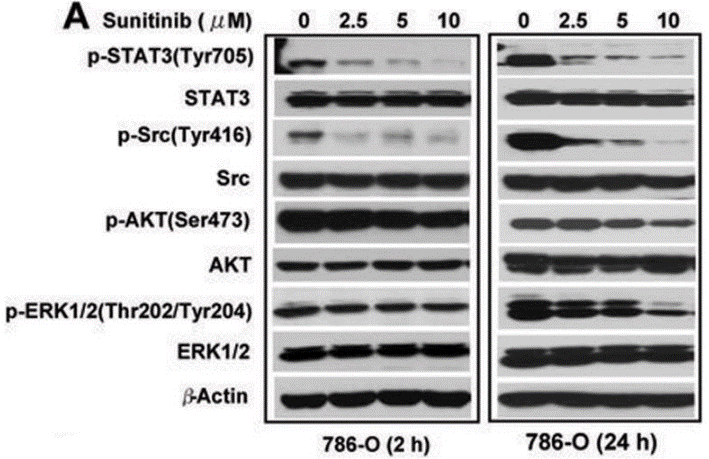
| Western blot | p-STAT3 / STAT3 / p-Src / Src / p-AKT / AKT / p-ERK / ERK p-GSK3β / GSK3β / MYCN p-AKT / AKT / p-ERK / ERK |
|
19244102 |
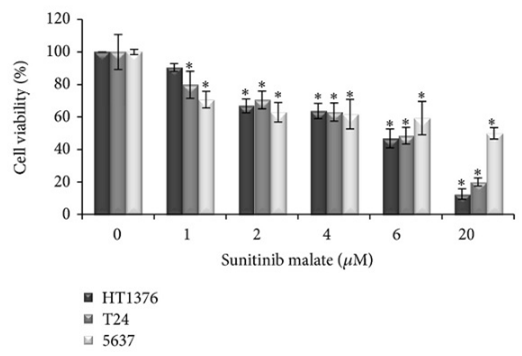
| Growth inhibition assay | Cell viability |
|
24369536 |
Clinical Trial Information
(data from https://clinicaltrials.gov, updated on 2024-05-22)
| NCT Number | Recruitment | Conditions | Sponsor/Collaborators | Start Date | Phases |
|---|---|---|---|---|---|
| NCT06222593 | Not yet recruiting | Carcinoma Renal Cell |
State University of New York at Buffalo |
June 1 2024 | Phase 1|Phase 2 |
| NCT06208748 | Not yet recruiting | Gastrointestinal Stromal Tumors|GIST |
Sarcoma Alliance for Research through Collaboration|Cogent Biosciences Inc.|Dana-Farber Cancer Institute|The Life Raft Group |
March 2024 | Phase 2 |
| NCT05745142 | Completed | Carcinoma Renal Cell|Clear-cell Metastatic Renal Cell Carcinoma |
Pfizer |
February 23 2023 | -- |
| NCT05043090 | Recruiting | Papillary Renal Cell Carcinoma |
AstraZeneca |
October 28 2021 | Phase 3 |
| NCT04669366 | Completed | Kidney Neoplasms |
Pfizer |
January 20 2021 | -- |
Tech Support
Tel: +1-832-582-8158 Ext:3
If you have any other enquiries, please leave a message.
Frequently Asked Questions
Question 1:
I was wondering whether it is in its cis or trans form?
Answer:
It is Z form.
Question 2:
What is the difference between it (S1042) and Sunitinib (S7781)?
Answer:
S1042 is the Malate salt form of Sunitinib. The biological activities of these two compounds are the same, but their solubility in aqueous solvent differs.
Signaling Pathway Map

Products are for research use only. Not for human use. We do not sell to patients.
©Copyright 2013 Selleck Chemicals. All Rights Reserved.