
-
 Australia
-
 Austria
-
 Belgium
-
 Brazil
-
 Canada
-
 China
China
-
 Czech Republic
-
 Denmark
-
 Finland
-
 France
-
 Germany
-
 Greece
-
 Hong Kong
-
 Hungary
-
 Iceland
-
 India
India
-
 Ireland
-
 Israel
-
 Italy
Italy
-
 Japan
Japan
-
 Korea
Korea
-
 Luxembourg
-
 Malaysia
-
 Netherlands
-
 New Zealand
-
 Norway
-
 Poland
-
 Qatar
Qatar
-
 Romania
-
 Saudi Arabia
-
 Singapore
-
 Spain
Spain
-
 Sweden
-
 Switzerland
-
 Taiwan
-
 Turkey
-
 United Kingdom
-
 United States
research use only
7,8-Dihydroxyflavone Trk receptor agonist
Cat.No.S8319
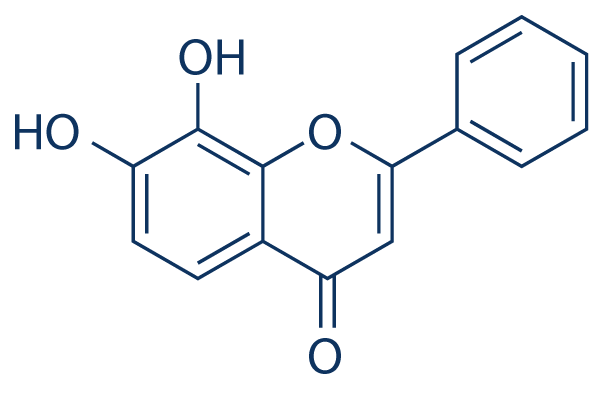
Chemical Structure
Molecular Weight: 254.24
Quality Control
| Related Targets | EGFR VEGFR PDGFR FGFR c-Met Src MEK CSF-1R FLT3 HER2 |
|---|---|
| Other Trk receptor Inhibitors | ANA-12 GW441756 GNF-5837 Selitrectinib (LOXO-195) Altiratinib N-Acetyl-5-hydroxytryptamine LM22A-4 CH7057288 PF-06273340 LM22B-10 |
Solubility
|
In vitro |
DMSO
: 51 mg/mL
(200.59 mM)
Ethanol : 4 mg/mL Water : Insoluble |
Molarity Calculator
|
In vivo |
|||||
In vivo Formulation Calculator (Clear solution)
Step 1: Enter information below (Recommended: An additional animal making an allowance for loss during the experiment)
Step 2: Enter the in vivo formulation (This is only the calculator, not formulation. Please contact us first if there is no in vivo formulation at the solubility Section.)
Calculation results:
Working concentration: mg/ml;
Method for preparing DMSO master liquid: mg drug pre-dissolved in μL DMSO ( Master liquid concentration mg/mL, Please contact us first if the concentration exceeds the DMSO solubility of the batch of drug. )
Method for preparing in vivo formulation: Take μL DMSO master liquid, next addμL PEG300, mix and clarify, next addμL Tween 80, mix and clarify, next add μL ddH2O, mix and clarify.
Method for preparing in vivo formulation: Take μL DMSO master liquid, next add μL Corn oil, mix and clarify.
Note: 1. Please make sure the liquid is clear before adding the next solvent.
2. Be sure to add the solvent(s) in order. You must ensure that the solution obtained, in the previous addition, is a clear solution before proceeding to add the next solvent. Physical methods such
as vortex, ultrasound or hot water bath can be used to aid dissolving.
Chemical Information, Storage & Stability
| Molecular Weight | 254.24 | Formula | C15H10O4 |
Storage (From the date of receipt) | |
|---|---|---|---|---|---|
| CAS No. | 38183-03-8 | Download SDF | Storage of Stock Solutions |
|
|
| Synonyms | 7,8-DHF | Smiles | C1=CC=C(C=C1)C2=CC(=O)C3=C(O2)C(=C(C=C3)O)O | ||
Mechanism of Action
| Targets/IC50/Ki |
TrkB receptor
(Cell-free assay) 320 nM(Kd)
|
|---|---|
| In vitro |
7,8-DHF is one of the positive compounds that specifically activate TrkB, but not TrkA or TrkC, at a concentration of 250 nM. In addition to cortical and hippocampal neurons, 7,8-DHF also protects other cell types including the RGC (retinal ganglion cells) and PC12 cells from excitotoxic and oxidative stress-induced apoptosis and cell death. Thus, it has neuroprotective properties.
|
| In vivo |
7,8-Dihydroxyflavone is a bioavailable chemical that can pass through the BBB to provoke TrkB and its downstream PI3K/Akt and MAPK activation in mouse brain upon intraperitoneal or oral administration. 7,8-DHF promotes the survival and reduces apoptosis in cortical neurons of traumatic brain injury as administration of 7,8-DHF at 3 h post-injury reduces brain tissue damage via the PI3K/Akt pathway. Its treatment does not induce any apparent toxicity in mice and is not toxic to the mice during the chronic treatment. 7,8-DHF displays robust therapeutic efficacy toward Alzheimer's disease and inhibits obesity through activating muscular TrkB.
|
References |
|
Tech Support
Tel: +1-832-582-8158 Ext:3
If you have any other enquiries, please leave a message.
Signaling Pathway Map

Products are for research use only. Not for human use. We do not sell to patients.
©Copyright 2013 Selleck Chemicals. All Rights Reserved.