
-
 Argentina
-
 Australia
-
 Austria
-
 Belgium
-
 Brazil
-
 Canada
-
 China
China
-
 Czech Republic
-
 Denmark
-
 Finland
-
 France
-
 Germany
-
 Greece
-
 Hong Kong
-
 Hungary
-
 Iceland
-
 India
India
-
 Ireland
-
 Israel
-
 Italy
Italy
-
 Japan
Japan
-
 Korea
Korea
-
 Luxembourg
-
 Malaysia
-
 Netherlands
-
 New Zealand
-
 Norway
-
 Poland
-
 Portugal
-
 Qatar
Qatar
-
 Romania
-
 Saudi Arabia
-
 Singapore
-
 Spain
Spain
-
 Sweden
-
 Switzerland
-
 Taiwan
-
 Turkey
-
 United Kingdom
-
 United States
research use only
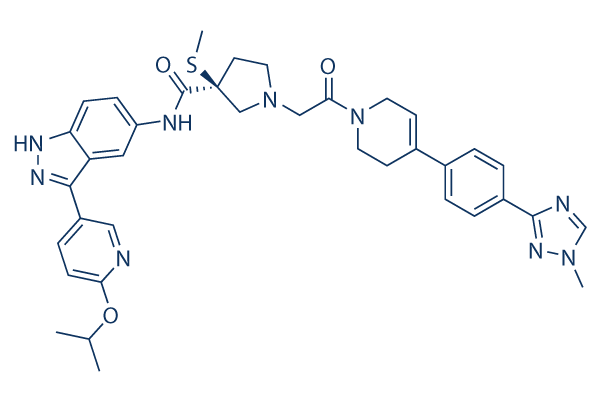
MK-8353 (SCH900353) ERK inhibitor
Cat.No.S8701
Quality Control
| Related Targets | p38 MAPK Raf JNK MEK Ras KRas S6 Kinase MAP4K TAK1 Mixed Lineage Kinase |
|---|---|
| Other ERK Inhibitors | Ravoxertinib (GDC-0994) Ulixertinib (BVD-523) SCH772984 LY3214996 (Temuterkib) FR 180204 VX-11e XMD8-92 AZD0364 (ATG-017) ERK5-IN-1 Senkyunolide I |
Solubility
|
In vitro |
DMSO
: 50 mg/mL
(72.27 mM)
Water : Insoluble Ethanol : Insoluble |
Molarity Calculator
|
In vivo |
|||||
In vivo Formulation Calculator (Clear solution)
Step 1: Enter information below (Recommended: An additional animal making an allowance for loss during the experiment)
Step 2: Enter the in vivo formulation (This is only the calculator, not formulation. Please contact us first if there is no in vivo formulation at the solubility Section.)
Calculation results:
Working concentration: mg/ml;
Method for preparing DMSO master liquid: mg drug pre-dissolved in μL DMSO ( Master liquid concentration mg/mL, Please contact us first if the concentration exceeds the DMSO solubility of the batch of drug. )
Method for preparing in vivo formulation: Take μL DMSO master liquid, next addμL PEG300, mix and clarify, next addμL Tween 80, mix and clarify, next add μL ddH2O, mix and clarify.
Method for preparing in vivo formulation: Take μL DMSO master liquid, next add μL Corn oil, mix and clarify.
Note: 1. Please make sure the liquid is clear before adding the next solvent.
2. Be sure to add the solvent(s) in order. You must ensure that the solution obtained, in the previous addition, is a clear solution before proceeding to add the next solvent. Physical methods such
as vortex, ultrasound or hot water bath can be used to aid dissolving.
Chemical Information, Storage & Stability
| Molecular Weight | 691.84 | Formula | C37H41N9O3S |
Storage (From the date of receipt) | 3 years -20°C powder |
|---|---|---|---|---|---|
| CAS No. | 1184173-73-6 | -- | Storage of Stock Solutions |
|
|
| Synonyms | N/A | SMILES | CC(C)OC1=NC=C(C=C1)C2=NNC3=C2C=C(C=C3)NC(=O)C4(CCN(C4)CC(=O)N5CCC(=CC5)C6=CC=C(C=C6)C7=NN(C=N7)C)SC | ||
Read more about storage stability stock solution CAS number SMILES
Mechanism of Action
| Targets/IC50/Ki |
ERK2
(Cell-free assay) 7 nM
ERK1
(Cell-free assay) 20 nM
|
|---|---|
| In vitro |
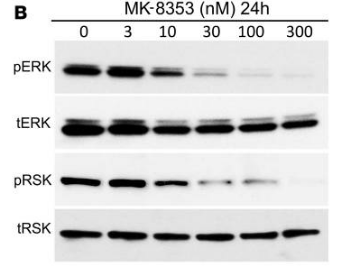
MK-8353 (SCH900353) is a potent and selective inhibitor of both active and inactive ERK1 and ERK2 kinases (IC50=20 and 7 nM, respectively). It is not a potent inhibitor of human CYPs 1A2, 2C9, 2C19 or 2D6 but inhibits CYP 3A4 (pre-incubation) in vitro and shows inhibition of CYP 3A4 and 2C8 (IC50 = 1.7 & 3.5 μM), which can cause drug-drug interactions when co administered with drugs that are primarily metabolized by CYP 2C8 or 3A4. This compound is a weak inhibitor of hERG current, producing 16% inhibition at 0.6 μM. The IC50 values for inhibiting cell prolifertion are 371, 51, and 23 nM in A2058, HT-29, and Colo-205 cells respectively. In addition to inhibiting the kinase activity of ERK, it prevents the phosphorylation of ERK by MEK. It demonstrates kinase selectivity over a 227-human kinase panel; no additional kinase in the panel is inhibited by more than 35% at the 0.1 μM concentration, and only 3 kinases (CLK2, FLT4, and Aurora B) are inhibited >50% at the 1.0 μM concentration. |
| In vivo |
The in vivo pharmacokinetics and metabolism of MK-8353 (SCH900353) are evaluated in male CD1 mice, Sprague Dawley (SD) rats, guinea pigs, beagle dogs, and cynomologus monkeys. With the exception of monkeys, it shows moderate clearance after IV administration in all species, with a half-life range of 1.3-2.8 hr and a mean residence time range of 1.5-4.0 hr. Acceptable oral bioavailability is seen in mice, rats and dogs (23-80%) but low oral bioavailability in monkeys (2%). The permeability observed in Caco-2 cells was high (135 nm/sec), suggesting that intestinal absorption and permeability in humans should also be high. The steady-state volume of distribution in mice, dogs and monkeys are in the range of 0.9-3.3 L/kg, while in rats it is 0.1 L/kg. This compound displays anti-tumor efficacy in several BRAF-mutant models. |
References |
|
Applications
| Methods | Biomarkers | Images | PMID |
|---|---|---|---|
| Western blot | pERK / ERK / pRSK / RSK pERK / ERK / pRSK / RSK |
|
29467321 |
Clinical Trial Information
(data from https://clinicaltrials.gov, updated on 2024-11-21)
| NCT Number | Recruitment | Conditions | Sponsor/Collaborators | Start Date | Phases |
|---|---|---|---|---|---|
| NCT02972034 | TERMINATED | Neoplasms; Colorectal Cancer |
Merck Sharp & Dohme LLC |
2017-01-13 | PHASE1 |
| NCT03745989 | COMPLETED | Solid Tumors |
Merck Sharp & Dohme LLC |
2019-02-22 | PHASE1 |
| NCT03745989 | Completed | Solid Tumors |
Merck Sharp & Dohme LLC |
2019-02-22 | Phase 1 |
| NCT01358331 | TERMINATED | Tumor, Solid |
Merck Sharp & Dohme LLC |
2011-11-04 | PHASE1 |
Read more about Clinical Trials
Tech Support
Tel: +1-832-582-8158 Ext:3
If you have any other enquiries, please leave a message.
Signaling Pathway Map

Products are for research use only. Not for human use. We do not sell to patients.
©Copyright 2013 Selleck Chemicals. All Rights Reserved.