
-
 Argentina
-
 Australia
-
 Austria
-
 Belgium
-
 Brazil
-
 Canada
-
 China
China
-
 Czech Republic
-
 Denmark
-
 Finland
-
 France
-
 Germany
-
 Greece
-
 Hong Kong
-
 Hungary
-
 Iceland
-
 India
India
-
 Ireland
-
 Israel
-
 Italy
Italy
-
 Japan
Japan
-
 Korea
Korea
-
 Luxembourg
-
 Malaysia
-
 Netherlands
-
 New Zealand
-
 Norway
-
 Poland
-
 Portugal
-
 Qatar
Qatar
-
 Romania
-
 Saudi Arabia
-
 Singapore
-
 Spain
Spain
-
 Sweden
-
 Switzerland
-
 Taiwan
-
 Turkey
-
 United Kingdom
-
 United States
research use only
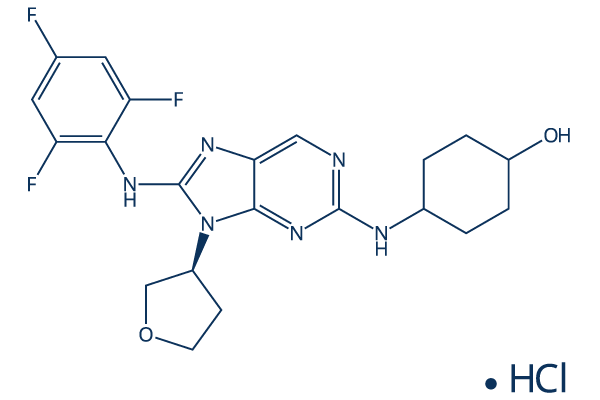
Tanzisertib Hydrochloride (CC-930) JNK inhibitor
Cat.No.S8490
Quality Control
| Related Targets | ERK p38 MAPK Raf MEK Ras KRas S6 Kinase MAP4K TAK1 Mixed Lineage Kinase |
|---|---|
| Other JNK Inhibitors | CC-90001 SP600125 JNK-IN-8 Anisomycin (Flagecidin) JNK Inhibitor IX JNK Inhibitor VIII Bentamapimod (AS602801) Polyphyllin I BI-78D3 DTP3 |
Cell Culture, Treatment & Working Concentration
| Cell Lines | Assay Type | Concentration | Incubation Time | Formulation | Activity Description | PMID |
|---|---|---|---|---|---|---|
| Jurkat T cells | Function assay | Inhibition of JNK-mediated GST tagged c-Jun phosphorylation in human Jurkat T cells compound treated for 30 mins prior anisomycin stimulation measured after 40 mins by fluorescence spectrophotometry, IC50=0.2 μM | 22244937 | |||
| Click to View More Cell Line Experimental Data | ||||||
Solubility
|
In vitro |
DMSO
: 97 mg/mL
(200.04 mM)
Water : Insoluble Ethanol : Insoluble |
Molarity Calculator
|
In vivo |
|||||
In vivo Formulation Calculator (Clear solution)
Step 1: Enter information below (Recommended: An additional animal making an allowance for loss during the experiment)
Step 2: Enter the in vivo formulation (This is only the calculator, not formulation. Please contact us first if there is no in vivo formulation at the solubility Section.)
Calculation results:
Working concentration: mg/ml;
Method for preparing DMSO master liquid: mg drug pre-dissolved in μL DMSO ( Master liquid concentration mg/mL, Please contact us first if the concentration exceeds the DMSO solubility of the batch of drug. )
Method for preparing in vivo formulation: Take μL DMSO master liquid, next addμL PEG300, mix and clarify, next addμL Tween 80, mix and clarify, next add μL ddH2O, mix and clarify.
Method for preparing in vivo formulation: Take μL DMSO master liquid, next add μL Corn oil, mix and clarify.
Note: 1. Please make sure the liquid is clear before adding the next solvent.
2. Be sure to add the solvent(s) in order. You must ensure that the solution obtained, in the previous addition, is a clear solution before proceeding to add the next solvent. Physical methods such
as vortex, ultrasound or hot water bath can be used to aid dissolving.
Chemical Information, Storage & Stability
| Molecular Weight | 484.9 | Formula | C21H23F3N6O2.HCl |
Storage (From the date of receipt) | |
|---|---|---|---|---|---|
| CAS No. | 2517855-91-1 | Download SDF | Storage of Stock Solutions |
|
|
| Synonyms | JNK-930, JNKI-1 | SMILES | C1CC(CCC1NC2=NC=C3C(=N2)N(C(=N3)NC4=C(C=C(C=C4F)F)F)C5CCOC5)O | ||
Read more about storage stability stock solution CAS number SMILES
Mechanism of Action
| Targets/IC50/Ki |
JNK3
(Cell-free assay) 0.006 μM
JNK2
(Cell-free assay) 0.007 μM
JNK1
(Cell-free assay) 0.061 μM
|
|---|---|
| In vitro |
Tanzisertib HCl (CC-930) inhibits the formation of phospho-cJun in human PBMC stimulated by phorbol-12-myristate-13-acetate and phytohemeagglutinin (IC50 = 1 μM). It shows remarkable selectivity in a panel of 240 kinases, EGFR being the only non-MAP kinase inhibited more than 50% at 3 μM (IC50 = 0.38 μM). This compound inhibits no receptor at greater than 50% at 10 μM concentration in a panel of 75 receptors, ion channels and neurotransmitter transporters. It does not inhibit CYP P450 enzymes significantly and is metabolized by CYP 3A4 and 2D6. |
| In vivo |
In the acute rat LPS-induced TNFα production PK-PD model, Tanzisertib HCl (CC-930) inhibits the production of TNFα by 23% and 77% at 10 and 30 mg/kg oral dose respectively. It is well-tolerated and exposure is dose-proportional. |
References |
Clinical Trial Information
(data from https://clinicaltrials.gov, updated on 2019-11-19)
| NCT Number | Recruitment | Conditions | Sponsor/Collaborators | Start Date | Phases |
|---|---|---|---|---|---|
| NCT01466725 | TERMINATED | Discoid Lupus |
Celgene |
2011-11-01 | PHASE2 |
| NCT01203943 | TERMINATED | Idiopathic Pulmonary Fibrosis; Pulmonary Fibrosis; Fibrosis; Interstitial Lung Disease; Lung Diseases, Interstitial |
Celgene |
2011-01-01 | PHASE2 |
| NCT01466725 | Terminated | Discoid Lupus |
Celgene |
2011-11-01 | Phase 2 |
Read more about Clinical Trials
Tech Support
Tel: +1-832-582-8158 Ext:3
If you have any other enquiries, please leave a message.
Signaling Pathway Map

Products are for research use only. Not for human use. We do not sell to patients.
©Copyright 2013 Selleck Chemicals. All Rights Reserved.