
-
 Argentina
-
 Australia
-
 Austria
-
 Belgium
-
 Brazil
-
 Canada
-
 China
China
-
 Czech Republic
-
 Denmark
-
 Finland
-
 France
-
 Germany
-
 Greece
-
 Hong Kong
-
 Hungary
-
 Iceland
-
 India
India
-
 Ireland
-
 Israel
-
 Italy
Italy
-
 Japan
Japan
-
 Korea
Korea
-
 Luxembourg
-
 Malaysia
-
 Netherlands
-
 New Zealand
-
 Norway
-
 Poland
-
 Portugal
-
 Qatar
Qatar
-
 Romania
-
 Saudi Arabia
-
 Singapore
-
 Spain
Spain
-
 Sweden
-
 Switzerland
-
 Taiwan
-
 Turkey
-
 United Kingdom
-
 United States
IFN Activators
| Cat.No. | Product Name | Information | Product Use Citations | Product Validations |
|---|---|---|---|---|
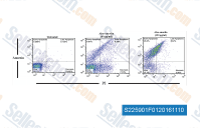
| S2259 | Aloe-emodin | Aloe-emodin (NSC 38628, Rhabarberone) is an interferon-inducing agent with IC50 of about 1 μg/mL for JEV and of about 0.33 μg/mL for EV71. |
|
|
| S5020 | Tilorone dihydrochloride | Tilorone dihydrochloride is a broad-spectrum, orally active antiviral agent that activates interferon production. It has antitumor, anti-inflammatory properties. | ||
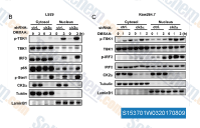
| S1537 | Vadimezan (DMXAA) | Vadimezan (DMXAA) is a vascular disrupting agents (VDA) and competitive inhibitor of DT-diaphorase with Ki of 20 μM and IC50 of 62.5 μM in cell-free assays, respectively. It is also a STING agonist with potential antineoplastic activity, potently inducing IFN-β but relatively low TNF-α expression in vitro. This compound has antiviral activity. Phase 3. |
|
|
| S8133 | Resiquimod (R-848) | Resiquimod (R-848, S28463) is an immune response modifier that acts as a potent TLR 7/TLR 8 agonist, inducing the upregulation of cytokines such as TNF-α, IL-6 and IFN-α. This compound reduces hepatitis C virus (HCV) infection. Phase 2. |
|
|
| S8954 | G10 (STING agonist-1) | G10 (STING agonist-1) is a novel human-specific STING agonist that triggers IFN regulatory factor 3 (IRF3)/ type I interferon (IFN)-associated transcription in human fibroblasts. This compound potently reduces growth of Chikungunya virus (CHIKV) with IC90 of 8.01 μM and blocks replication of Alphavirus species Venezuelan Equine Encephalitis Virus (VEEV) with IC90 of 24.57 μM. |
|
|
| S7905 | 3',3'-cGAMP | 3',3'-cGAMP (3',3'-cyclic GMP-AMP, Cyclic GMP-AMP, cGAMP) activates the endoplasmic reticulum (ER)-resident receptor stimulator of interferon genes (STING), thereby inducing an antiviral state and the secretion of type I IFNs. | ||

Products are for research use only. Not for human use. We do not sell to patients.
©Copyright 2013 Selleck Chemicals. All Rights Reserved.