
-
 Argentina
-
 Australia
-
 Austria
-
 Belgium
-
 Brazil
-
 Canada
-
 China
China
-
 Czech Republic
-
 Denmark
-
 Finland
-
 France
-
 Germany
-
 Greece
-
 Hong Kong
-
 Hungary
-
 Iceland
-
 India
India
-
 Ireland
-
 Israel
-
 Italy
Italy
-
 Japan
Japan
-
 Korea
Korea
-
 Luxembourg
-
 Malaysia
-
 Netherlands
-
 New Zealand
-
 Norway
-
 Poland
-
 Portugal
-
 Qatar
Qatar
-
 Romania
-
 Saudi Arabia
-
 Singapore
-
 Spain
Spain
-
 Sweden
-
 Switzerland
-
 Taiwan
-
 Turkey
-
 United Kingdom
-
 United States
RIP kinase Inhibitors
| Cat.No. | Product Name | Information | Product Use Citations | Product Validations |
|---|---|---|---|---|
| S8775 | HS-1371 | HS-1371 is a potent RIP3 kinase inhibitor with an IC50 of 20.8 nM. It binds to the ATP binding pocket of RIP3 and inhibits ATP binding to prevent RIP3 enzymatic activity in vitro. |
|
|
| S8927 | GSK2983559 (compound 3) | GSK2983559 (compound 3, RIP2 kinase inhibitor 1, RIPK2-IN-1) is a potent inhibitor of receptor interacting protein 2 (RIP2) kinase with good kinase specificity. |
|
|
| S3443 | GSK-843 | GSK-843 (GSK'843) is a selective inhibitor of receptor-interacting protein kinase 3 (RIP3 or RIPK3) that binds to the RIP3 kinase domain with an IC50 of 8.6 nM and effectively inhibits its enzymatic activity with an IC50 of 6.5 nM. |
|
|
| S8787 | GSK'547 | GSK'547 is a highly selective and potent inhibitor of RIP1 (RIPK1) exhibiting a 400-fold improvement in mouse pharmacokinetic oral exposure compared with GSK'963 |
|
|
| S8845 | GSK3145095 | GSK3145095 is a potent and orally active RIP1 kinase inhibitor with IC50 of 6.3 nM with potential antineoplastic and immunomodulatory activities. |
|
|
| S8169 | GSK481 | GSK481 is a RIP1(Receptor Interacting Protein Kinase1, RIPK1) inhibitor. Inhibition of this compound has been shown to hinder cell necrotic death. |
|
|
| E2822 | GSK2983559 active metabolite | GSK2983559 active metabolite is an active metabolite of GSK2983559, also is a receptor interacting protein-2 (RIP2) kinase inhibitor extracted from patent WO/2014043446 A1, compound example 1. | ||
| E2367 | PK68 | PK68 is a potent orally active and specific inhibitor of receptor-interacting kinase 1 (RIPK1) with an IC50 of ~90 nM. | ||
| E6815New | Ocadusertib | Ocadusertib (LY3871801; R-552) is a potent, selective allosteric RIPK1 inhibitor that blocks RIPK1 enzymatic activity with an IC50 of 12–38 nM and inhibits necroptosis in cell-based assays. | ||
| E5857 | GSK-872 hydrochloride | GSK-872 hydrochloride is an inhibitor of RIPK3, which binds the RIP3 kinase domain with an IC50 of 1.8 nM and inhibits kinase activity with an IC50 of 1.3 nM. It exhibits the potential in alleviating early brain injury by inhibiting neuronal necroptosis and HMGB1-mediated inflammation. | ||
| E6737New | flizasertib | flizasertib (GDC-8264) is orally active, reversible, and selective inhibitor of receptor-interacting protein kinase 1 (RIP1), exhibiting Ki app values of 0.00071 μM against human RIP1 and 0.0013 μM against cynomolgus monkey RIP1. | ||
| E0301 | Necrostatin-34 (Nec-34) | Necrostatin-34 (Nec-34) is a small molecule inhibitor of RIPK1 kinase with an IC50 of 0.13 μM in L929 cells. | ||
| E4640 | Oditrasertib | Oditrasertib (DNL-788, SAR 443820) is a first-in-class, selective, orally bioavailable, brain penetrant inhibitor of Receptor-interacting serine/threonine protein kinase 1 (RIPK1). It can be used in research of myotrophic lateral sclerosis and multiple sclerosis. | ||
| E2648 | RIPK1-IN-7 | RIPK1-IN-7 is a potent and selective receptor-interacting serine/threonine-protein kinase 1 (RIPK1) inhibitor with a Kd of 4 nM and an enzymatic IC50 of 11 nM. | ||
| E1734 | OD36 | OD36 is an inhibitor of RIPK2 with an IC50 value of 5.3 nM. This compound is a macrocyclic inhibitor with potent binding to the ALK2 kinase ATP pocket. | ||
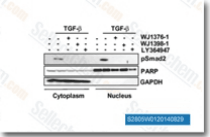
| S2805 | LY364947 | LY364947 (HTS 466284) is a potent ATP-competitive inhibitor of TGFβR-I with IC50 of 59 nM in a cell-free assay, shows 7-fold selectivity over TGFβR-II. |
|
|
| S9786 | Tuxobertinib (BDTX-189) | BDTX-189 (Tuxobertinib) is a potent and selective inhibitor of allosteric EGFR and HER2 oncogenic mutations with Kd of 0.2 nM, 0.76 nM, 13 nM and 1.2 nM for EGFR, HER2, BLK and RIPK2, reapectively. This compound exhibits anticancer activity. |
|
|
| S5584 | Citronellol | Citronellol (Dihydrogeraniol, (±)-β-Citronellol), a constituent of rose and geranium oils, is used in perfumes and insect repellents. This compound can cause necrotic apoptosis of NCI-H1299 cells by up-regulating TNF-α, RIP1 / RIP3 activities, and down-regulating caspase-3 / caspase-8 activities. It also results in a biphasic increase in ROS production at 1 h and at 12 h in NCI-H1299 cells. | ||

Products are for research use only. Not for human use. We do not sell to patients.
©Copyright 2013 Selleck Chemicals. All Rights Reserved.