
Why did adding MG132 after rather than before ligand stimulation fail to rescue receptor degradation?
Quick Answer
Recommended ApproachPre-incubate cells with MG132 prior to ligand stimulation so the proteasome is fully inhibited before ligand-induced receptor endocytosis and early endosomal sorting occur.
Common CausesAdding MG132 after ligand stimulation was ineffective because activated receptors had already undergone proteasome-dependent sorting and entered the multivesicular body pathway, where degradation is executed by lysosomal proteases rather than the proteasome.
How Should It Be Done Correctly?
Proteasome Inhibition Regimen and Control Reference
| Parameter | Experimental Specification | Strategic Purpose |
|---|---|---|
| Pre-Incubation Window | 30–60 min prior to ligand challenge | Establishes peak intracellular target occupancy before endocytic trigger |
| Working Inhibitor Range | 5–10 µM in serum-free medium | Blocks 20S core chymotrypsin-like proteolysis without immediate cytotoxicity |
| Vehicle Control Standard | DMSO (≤ 0.1% v/v matched volume) | Eliminates organic solvent artifacts on membrane fluidity and vesicular transport |
| Ligand Stimulation Phase | 30 min to 2 h co-incubation | Allows tracking of receptor clearance within the acute trafficking window |
| Lysosomal Reference Block | Bafilomycin A1 (100–200 nM) | Verifies contribution of vacuolar ATPase-dependent terminal degradation |
| Endosomal Sorting Control | Wortmannin (100 nM) | Delineates phosphoinositide-mediated early endosomal sorting checkpoints |
Sequential Workflow for Receptor Turn-Over Assays
- Starvation and Membrane Synchronization: Equilibrate target cells in serum-free basal medium to clear residual growth factors, synchronize cell-surface receptor expression, and minimize basal baseline turnover [1]. Inspect cell morphology prior to treatment to ensure tight monolayer integrity.
- Proteasomal Pre-Inhibition: Aspirate starvation media and apply freshly diluted inhibitor solution [2, 3]. Return cultures to the incubator for the defined pre-incubation window to allow complete intracellular diffusion and full suppression of catalytic proteasome subunits prior to receptor activation [3, 4]. Include parallel wells receiving matched vehicle control.
- Ligand Challenge and Tracking: Directly spike the stimulating ligand into the pre-treated wells without washing out the inhibitor, maintaining continuous proteasome suppression throughout the induction phase [3]. For experiments tracking degradation kinetics across time, stagger the stimulation start times so that all sample harvesting occurs simultaneously.
- Dual Compartmental Controls: In parallel culture vessels, apply lysosomal acidification antagonists alongside or instead of the proteasome inhibitor to unambiguously identify whether receptor loss is executed via the lysosome [3]. Combine sorting inhibitors with proteasomal blocks when dissecting early versus late vesicle arrest points [3].
- Rapid Termination and Protein Extraction: Immediately transfer plates onto ice, aspirate media, and wash twice with ice-cold phosphate-buffered saline containing protease inhibitors to halt all membrane trafficking instantaneously. Lyse cells directly in detergent-supplemented buffer containing deubiquitinase inhibitors to prevent post-lysis receptor deubiquitination or cleavage [3].
What Went Wrong?
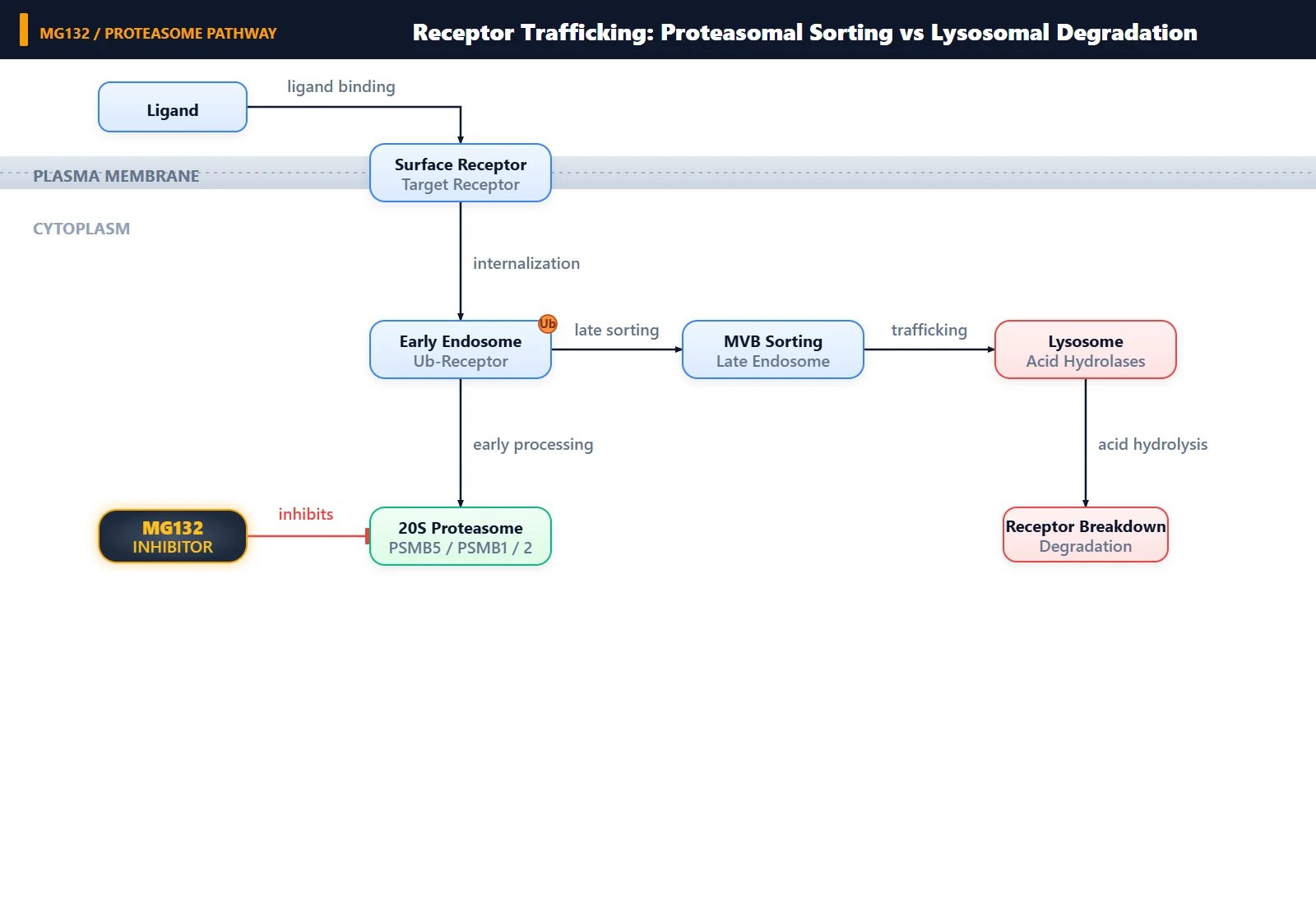
Copy code to add this image to your page Copy Code
Mistimed Post-Stimulation Inhibitor Administration
The fundamental operational flaw was introducing MG132 to the culture media subsequent to ligand stimulation rather than establishing a proteasome-inhibited baseline prior to ligand exposure. When ligand is introduced first, the biological signaling cascades governing receptor clearance are immediately initiated in the absence of any enzymatic blockade [3]. Applying the inhibitor post-stimulation assumes that proteasome activity is continuously required during the ultimate destruction phase, which disregards the temporal sequence of transmembrane receptor down-regulation.
Rapid Endocytic Commitment and Organellar Sequestration
Receptor-ligand engagement triggers virtually instantaneous phosphorylation, ubiquitination, and clathrin- or caveolae-mediated internalization, with substantial surface receptor fractions entering early endosomes within 5 to 15 minutes of stimulation. Proteasome inhibitors such as MG132 require adequate time to permeate the plasma membrane and inactivate the 20S catalytic core [2]. By the time post-added MG132 reached effective intracellular concentrations, the activated receptors had already cleared the plasma membrane, passed the initial endosomal sorting checkpoints, and progressed downstream toward late endocytic structures [3, 4].
Spatial Compartmentalization and Terminal Lysosomal Clearance
Cell-surface receptors undergo a multi-step clearance mechanism where the proteasome and the lysosome govern distinct spatial stages [3]. Proteasomal activity is strictly required upstream at the early endosome (EE) to facilitate receptor processing, regulated cleavage, or escort through endosomal sorting complexes [3]. Once this proteasome-dependent sorting threshold is crossed, ubiquitinated receptors are invaginated into the intraluminal vesicles of multivesicular bodies (MVBs) [3]. Inside these luminal vesicles, receptors become physically segregated from the cytoplasm where proteasomes reside. Subsequent fusion of MVBs with late endosomes and lysosomes delivers the receptors directly to acid hydrolases, which execute terminal protein degradation independently of the proteasome [3, 4]. Consequently, inhibiting the proteasome after cargo enters the MVB/lysosome pathway cannot prevent receptor destruction [3].
How Can I Avoid This in Future Experiments?
To prevent mistimed intervention in future receptor turnover studies, always perform a preliminary time-course pilot utilizing cell-surface biotinylation or fluorescent ligand tracking to establish the exact internalization half-life of your receptor under specific culture conditions. When evaluating whether clearance depends on the ubiquitin-proteasome system versus the lysosomal pathway, always test proteasome inhibitors (such as MG132) and lysosomal inhibitors (such as Bafilomycin A1 or chloroquine) side-by-side, maintaining strict 30-to-60-minute pre-incubation periods before adding ligand. Furthermore, monitor both full-length receptor bands and intermediate cleavage isoforms via western blotting, as selective inhibition of upstream proteasomal sorting frequently manifests as an accumulation of polyubiquitinated full-length precursor at early endosomal compartments rather than a simple restoration of native basal patterns.
References
- [1]Kalb D, et al. Scientific reports. 2021 Jul;11(1):13692.[IF: 4.996]
- [2]Sesta A, et al. Endocrine. 2018 Sep;61(3):511-517.[IF: 3.296]
- [3]Castagnola P, et al. Oncotarget. 2016 Dec;7(51):85411-85429.[IF: 5.168]
- [4]Deissler HL, et al. Albrecht von Graefes Archiv fur klinische und experimentelle Ophthalmologie. 2019 Jan;257(1):83-94.[IF: 2.396]