
Why did my MG132 DMSO stock lose activity after four months stored at -20°C?
Quick Answer
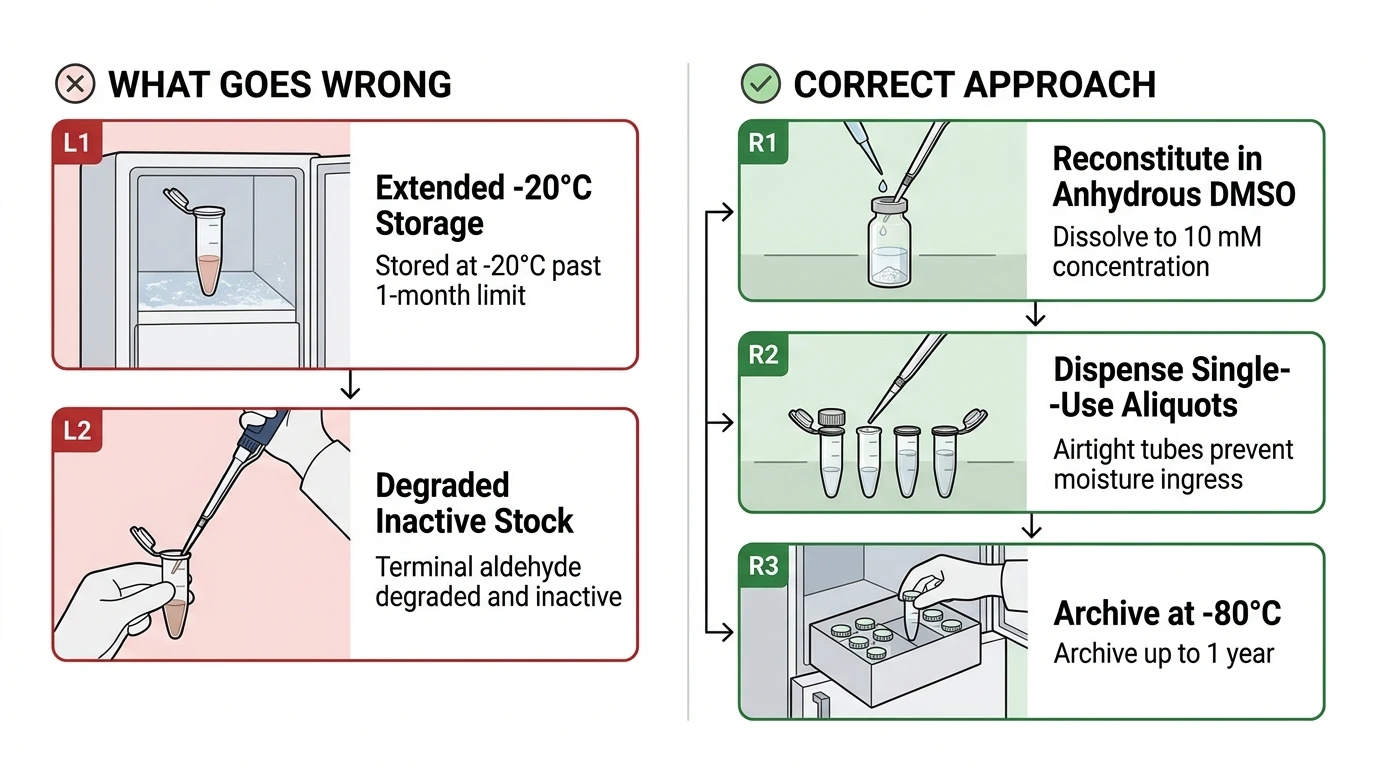
Recommended ApproachPrepare MG132 as a 10 mM stock solution in high-grade anhydrous DMSO, dispense into single-use aliquots to prevent moisture absorption, and store at -80°C for up to 1 year or at -20°C for strictly no longer than 1 month.
Common CausesThe stock solution lost potency because storing reconstituted MG132 in solvent at -20°C for four months substantially exceeded the manufacturer's rated 1-month shelf life, resulting in chemical degradation of the reactive terminal aldehyde group.
How Should It Be Done Correctly?
Copy code to add this image to your page Copy Code
Official Storage Parameters and Handling Guidelines
Manufacturer-defined storage specifications, shelf-life limits, and solubility parameters for MG132 stock solutions.
Preparation and Storage Protocol
-
Solvent Equilibration and Working Environment: Prior to opening the anhydrous DMSO bottle and the MG132 lyophilized powder vial, equilibrate both containers to room temperature inside a desiccator for at least 20–30 minutes. Opening cold containers draws ambient moisture into hygroscopic DMSO and dry peptide powders.
-
Reconstitution: Dissolve the solid compound in anhydrous DMSO to reach the recommended concentration of 10 mM (e.g., add 1 mL of anhydrous DMSO to 4.7562 mg of solid MG132). Mix by gentle inversion and brief vortexing until the solution is completely clear and free of particulate matter. Avoid prolonged heating or excessive sonication.
-
Fractionation and Aliquoting: Immediately divide the freshly reconstituted 10 mM stock into small, single-use aliquots (typically 10–50 µL) inside sterile, low-binding, screw-cap microcentrifuge tubes fitted with O-rings or airtight gaskets. Avoid large master vials that necessitate repeated freeze-thaw cycles or multiple tube openings.
-
Storage Assignment and Temperature Control: Archive all single-use aliquots at -80°C if the solution is intended for use over an extended period (up to 1 year). If only a -20°C standard freezer is available, clearly label the vials with an expiration date set to exactly 1 month from the date of reconstitution, and discard any unused solution past this window.
-
Thawing and Experimental Application: Thaw an individual aliquot at room temperature immediately prior to the assay. Confirm that the solution is clear and fully thawed before diluting directly into pre-warmed culture medium to achieve targeted working concentrations (typically 0.5–20 µM depending on assay duration and cell line) [1, 2, 3, 4]. Discard any residual thawed stock solution rather than returning it to the freezer.
| Parameter | Specification / Validated Range | Operational Relevance |
|---|---|---|
| Stock Concentration | 10 mM (4.7562 mg/mL) | Standard concentrated stock for downstream in vitro dilution |
| Recommended Solvent | Anhydrous DMSO | Achieves complete dissolution (solubility limit: 95 mg/mL) |
| Alternative Solvent | Ethanol | High solubility (95 mg/mL); water insoluble (<1 mg/mL) |
| Solution Shelf Life (-80°C) | 1 year | Recommended condition for long-term solution archiving |
| Solution Shelf Life (-20°C) | 1 month | Strict threshold; exceeding this duration risks degradation |
| Lyophilized Powder (-20°C) | 3 years | Solid form storage in desiccated, sealed container |
What Went Wrong?
Deviation from Storage Limits
The stock solution was maintained in solvent at -20°C for four months. According to the manufacturer's validated product specifications, an MG132 solution stored at -20°C maintains stability for a maximum of 1 month. Maintaining the reconstituted stock at -20°C for four months represents a three-month operational overrun past the designated shelf-life limit, inevitably leading to compound inactivation.
Environmental Moisture Ingress and Temperature Inadequacy
While -20°C is adequate for long-term storage of dry lyophilized powder (stable for 3 years), it provides insufficient thermodynamic and kinetic stabilization for MG132 dissolved in DMSO beyond 30 days. DMSO is highly hygroscopic and absorbs atmospheric water vapor every time an aliquot container is accessed or if tube seals undergo micro-fissuring at sub-zero temperatures [Source: ResearchGate]. Additionally, standard -20°C laboratory freezers frequently undergo automatic defrost cycles that subject reagents to temperature oscillations, accelerating solvent hydration and chemical reactivity.
Chemical Degradation of the Reactive Peptide Aldehyde
At the molecular level, MG132 (carbobenzoxy-L-leucyl-L-leucyl-L-leucinal) is a tripeptide aldehyde inhibitor [3]. Its pharmacological mechanism depends on the direct attack of the electrophilic C-terminal aldehyde group by the active-site threonine (Thr1) residue of the 20S/26S proteasome core particle, forming a hemiacetal adduct that blocks proteasomal catalytic activity [1, 5].
When dissolved in DMSO and stored past its rated stability window—particularly in the presence of trace water absorbed during repeated access or storage at -20°C—the terminal aldehyde moiety undergoes spontaneous chemical transformation. It readily hydrates to form an unreactive gem-diol or oxidizes into an unreactive carboxylic acid derivative. Once the reactive aldehyde is destroyed or modified, the molecule loses its ability to form the essential covalent-reversible complex with proteasomal catalytic subunits, abolishing its capacity to inhibit proteasome degradation, trigger ubiquitinated protein accumulation, or induce downstream cellular responses [1, 5, 6].
How Can I Avoid This in Future Experiments?
Adopt a strict batch-labeling rule by marking every freshly reconstituted tube with the precise reconstitution date and the mandatory disposal date (30 days later for -20°C storage, or 365 days later for -80°C storage). Always partition the stock into single-experiment aliquots using screw-cap cryovials with silicone O-rings to prevent ambient vapor exchange during freezer storage.
Whenever a stock solution approaches its shelf-life boundary, verify its inhibitory potency before committing it to extensive downstream phenotypic or apoptotic assays [2, 3]. A fast 20S proteasome fluorogenic substrate assay or a brief western blot measuring the accumulation of total polyubiquitinated proteins will definitively confirm active target engagement before initiating major cellular treatments [1, 5].
References
- [1]Zhu Y, et al. BMC pulmonary medicine. 2021 Nov;21(1):379.[IF: 3.32]
- [2]Aktas Z, et al. Investigative ophthalmology & visual science. 2018 Jan;59(1):298-310.[IF: 3.812]
- [3]Xu M, et al. Scientific reports. 2025 Apr;15(1):14731.[IF: 4.9]
- [4]Sun F, et al. Oncology research. 2018 May;26(4):655-664.[IF: 4.634]
- [5]Sideri CK, et al. Biomolecules. 2026 Feb;16(2).[IF: 5.6]
- [6]Gao C, et al. BioMed research international. 2014 Jan;2014:160692.[IF: 1.579]