
Why did my 10 mM MG132 DMSO stock precipitate when spiked directly into pure water?
Quick Answer
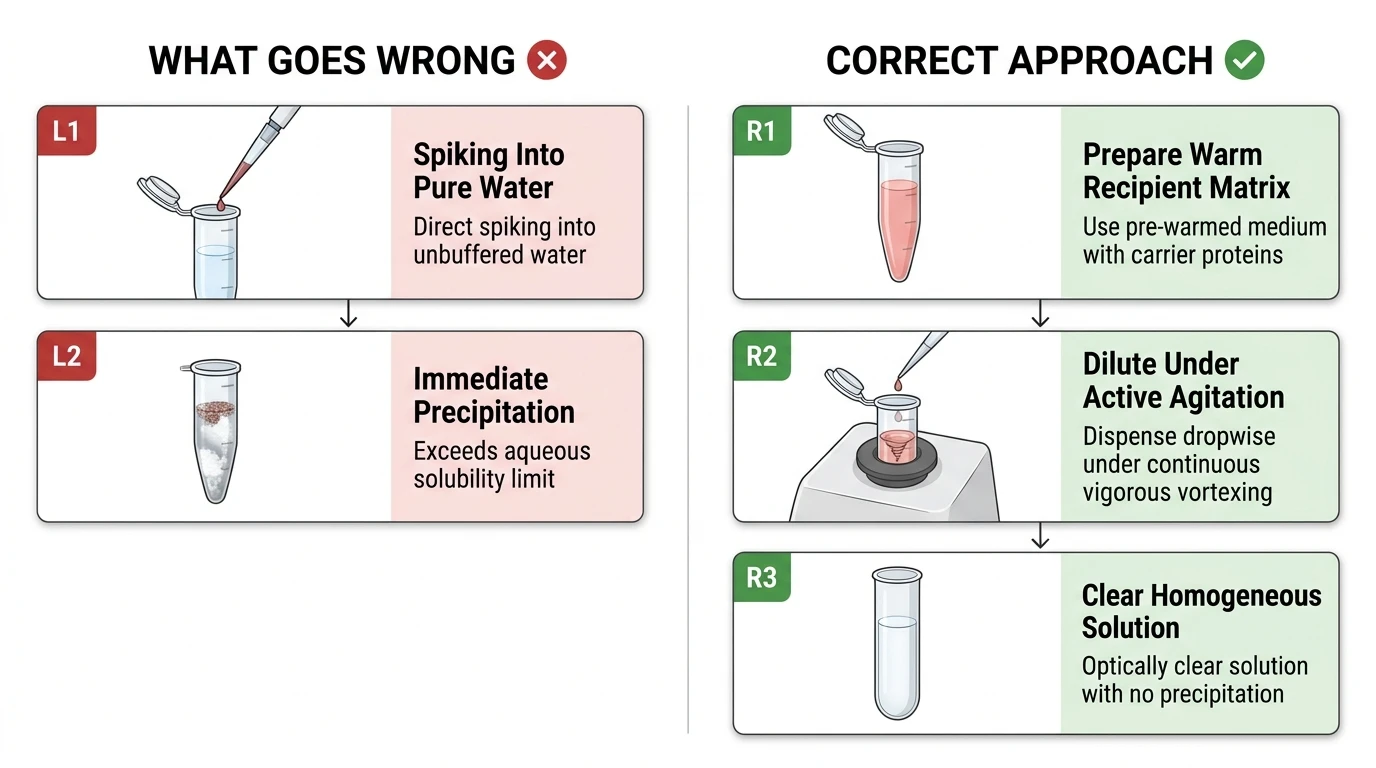
Recommended ApproachTo prevent precipitation, serially dilute the 10 mM DMSO stock into pre-warmed complete culture medium or protein-containing physiological buffer under continuous, vigorous vortexing to ensure rapid mixing without exceeding aqueous solubility limits.
Common CausesDirectly spiking the concentrated stock into pure water caused immediate crash-out because MG132 is hydrophobic and practically insoluble in pure water (<1 mg/mL), creating localized supersaturation at the droplet interface.
How Should It Be Done Correctly?
Copy code to add this image to your page Copy Code
Physicochemical Specifications and Dilution Parameters
MG132 is a hydrophobic tripeptide aldehyde that relies on organic polar aprotic solvents like DMSO for dissolution [1]. Preparing working solutions requires adherence to validated solvent limits and storage boundaries.
Step-by-Step Aqueous Dilution Protocol
To introduce MG132 into aqueous systems without precipitation, follow this standardized working dilution workflow:
-
Equilibrate Aliquot to Room Temperature: Retrieve a single-use 10 mM stock aliquot from -80°C or -20°C storage. Allow it to equilibrate completely to 20°C–25°C before opening the tube. Opening cold vials draws atmospheric moisture into the hygroscopic DMSO, which progressively degrades compound solubility and hydrolyzes peptide aldehydes over time.
-
Inspect the DMSO Stock: Verify that the thawed stock solution is completely clear, transparent, and devoid of particulate crystallization or Phase separation. If microcrystals are visible due to cold storage, sonicate in a room-temperature water bath for 1–2 minutes or vortex briefly until clarity is fully restored.
-
Prepare the Aqueous Recipient Matrix: Use pre-warmed (37°C) complete cell culture medium or physiological buffer (e.g., PBS containing carrier protein or serum) rather than unbuffered pure water. The inclusion of trace proteins, cyclodextrins, or lipids dramatically improves hydrophobic peptide stabilization.
-
Dispense Dropwise Under Active Agitation: While continuously vortexing or vigorously swirling the recipient vessel, deliver the 10 mM stock dropwise into the vortex center. Rapid turbulent convection prevents the formation of localized, high-concentration solvent-solute boundaries.
-
Perform Serial Intermediates for Sensitive Assays: For experiments requiring low final working concentrations (e.g., 0.5–20 µM) [2, 4, 5], prepare an intermediate dilution in pre-warmed medium (e.g., a 1:100 dilution to 100 µM) before adding to culture vessels. Ensure that the total vehicle concentration across all experimental and control wells remains normalized to 0.1%–0.5% DMSO [2, 3, 4].
-
Final Visual and Microscopic Quality Check: Hold the final dilution against an oblique light beam to check for Tyndall scattering or haziness. Under an inverted microscope, verify that no microcrystalline rods or amorphous aggregates have settled before applying the media to cultured cells.
| Parameter | Official Specification / Recommended Value | Practical Lab Note |
|---|---|---|
| Stock Concentration | 10 mM in DMSO | Standard stock concentration (4.7562 mg/mL in anhydrous DMSO) |
| Solubility in DMSO | 95 mg/mL | High dissolution capacity; completely soluble at room temperature |
| Solubility in Ethanol | 95 mg/mL | Alternative organic vehicle for solvent-sensitive assays |
| Solubility in Pure Water | <1 mg/mL (practically insoluble) | Direct aqueous reconstitution or concentrated aqueous dilution precipitates |
| Final DMSO Working Range | ≤0.1%–0.5% (v/v) | Well-tolerated in cellular culture media [2, 3, 4] |
| Stock Storage (-80°C) | 1 year shelf life | Store as small single-use aliquots under anhydrous conditions |
| Stock Storage (-20°C) | 1 month shelf life | Avoid repeated freeze-thaw cycles; protect from moisture condensation |
| Powder Storage (-20°C) | 3 years shelf life | Desiccated, tightly sealed container protected from light |
What Went Wrong?
The Operational Mistake: Direct Aqueous Spiking
The immediate precipitation occurred because a 10 mM DMSO stock solution was introduced directly into a vessel containing pure water without carrier matrices or sufficient solvent mixing dynamics. In addition, pipetting directly into a static volume creates an unmixed high-concentration pocket at the liquid interface.
The Proximate Cause: Phase Separation and Exceeded Solubility Limits
MG132 exhibits exceptional solubility in DMSO (95 mg/mL) but is practically insoluble in pure water, with a saturation threshold below 1 mg/mL (<2.1 mM). When the concentrated 10 mM stock (4.7562 mg/mL) enters pure water, the local concentration at the contact boundary vastly exceeds aqueous solubility limits [1]. Even if the nominal global concentration calculated across the total vessel volume appears dilute, the initial droplet encounters pure water before convective dispersion can occur, leading to instantaneous phase separation and visible cloudiness or microparticulate precipitation [Source: ResearchGate].
Molecular and Physicochemical Mechanism of Crash-Out
The fundamental driving force behind this crash-out is the differential solvation thermodynamics between DMSO, water, and the hydrophobic peptide backbone of MG132:
- Rapid DMSO-Water Miscibility vs. Slow Solute Dispersion: DMSO is an organic polar aprotic molecule that exhibits extreme miscibility and negative enthalpy of mixing with water, rapidly forming strong hydrogen bonds with aqueous molecules [1]. When the droplet contacts pure water, DMSO molecules instantaneously diffuse away into the aqueous bulk.
- Hydrophobic Desolvation and Micro-Aggregation: As the DMSO solvating cage rapidly dissolves into the surrounding water, the hydrophobic MG132 peptide molecules (consisting of bulky leucine and phenylalaninal residues) are abruptly stripped of organic solvation [4]. Because water molecules form rigid, entropically unfavorable clathrate-like structures around the non-polar moieties, the system minimizes free energy by driving the hydrophobic MG132 molecules to self-associate.
- Nucleation and Irreversible Crystallization: Once localized supersaturation crosses the spinodal decomposition threshold at the droplet boundary, spontaneous nucleation occurs within milliseconds. The resulting amorphous or crystalline aggregates have a significantly higher kinetic activation barrier for re-dissolution in water, rendering the precipitation irreversible under ambient stirring.
How Can I Avoid This in Future Experiments?
- Always prepare working dilutions fresh on the day of experimentation; never store diluted aqueous working solutions of MG132 long-term, as peptide aldehydes are susceptible to hydration, chemical instability, and surface adsorption in low-solute aqueous media.
- When running cellular assays, pre-mix the stock directly into warm complete culture medium (containing FBS or BSA) rather than plain water or serum-free basal salt solutions, leveraging carrier proteins to sequester hydrophobic residues.
- Maintain solvent control consistency by preparing matching vehicle controls with identical final concentrations of DMSO (typically 0.1%–0.5%), ensuring that observed phenotypic responses stem strictly from proteasome inhibition rather than solvent artifacts [1, 2, 4].
References
- [1]Wójcik S, et al. PloS one. 2015 Jan;10(10):e0140536.[IF: 3.057]
- [2]Aktas Z, et al. Investigative ophthalmology & visual science. 2018 Jan;59(1):298-310.[IF: 3.812]
- [3]Selvaprakash K, et al. Biotechnology journal. 2024 Nov;19(11):e202400413.[IF: 3.1]
- [4]Xu M, et al. Scientific reports. 2025 Apr;15(1):14731.[IF: 4.9]
- [5]Zhu Y, et al. BMC pulmonary medicine. 2021 Nov;21(1):379.[IF: 3.32]