
-
 Argentina
-
 Australia
-
 Austria
-
 Belgium
-
 Brazil
-
 Canada
-
 China
China
-
 Czech Republic
-
 Denmark
-
 Finland
-
 France
-
 Germany
-
 Greece
-
 Hong Kong
-
 Hungary
-
 Iceland
-
 India
India
-
 Ireland
-
 Israel
-
 Italy
Italy
-
 Japan
Japan
-
 Korea
Korea
-
 Luxembourg
-
 Malaysia
-
 Netherlands
-
 New Zealand
-
 Norway
-
 Poland
-
 Qatar
Qatar
-
 Romania
-
 Saudi Arabia
-
 Singapore
-
 Spain
Spain
-
 Sweden
-
 Switzerland
-
 Taiwan
-
 Turkey
-
 United Kingdom
-
 United States
Proteasome Inhibitors
| Cat.No. | Product Name | Information | Product Use Citations | Product Validations |
|---|---|---|---|---|
| S7933 | VR23 | VR23 is a potent proteasome inhibitor with IC50 of 1 nM, 50-100 nM, and 3 μM for trypsin-like proteasomes, chymotrypsin-like proteasomes, and caspase-like proteasomes, respectively. |
|
|
| S7462 | PI-1840 | PI-1840 is a reversible and selective chymotrypsin-like (CT-L) inhibitor with IC50 of 27 nM with little effects on the other two major proteasome proteolytic activities, trypsin-like (T-L) and postglutamyl-peptide-hydrolysis-like (PGPH-L). |
|
|
| S7504 | Marizomib (Salinosporamide A) | Marizomib (Salinosporamide A) is a novel marine derived proteasome inhibitor which inhibits CT-L β5, C-L β1, and T-L β2 proteasome activities in human erythrocyte-derived 20S proteasomes with IC50 of 3.5 nM, 430 nM, 28 nM. |
|
|
| E7414 | MG-115 | MG-115 is a potent and reversible inhibitor of proteasomes with ki of 21 nM and 35 nM for the 20S and 26S proteasomes, respectively. It also induces apoptosis in Rat-1 and PC12 cells by selectively inhibiting the chymotrypsin-like activity of the proteasome. |
|
|
| E1214 | KSQ-4279 (USP1-IN-1) | KSQ-4279 (USP1-IN-1) is an orally bioavailable selective inhibitor of the ubiquitin specific protease 1 (USP1) with anti-proliferative activity. KSQ-4279 also exhibits synergistic activity in combination with PARP inhibitors. |
|
|
| S5813 | Isoginkgetin | Isoginkgetin is a naturally derived biflavonoid with anti-tumor activity. This compound directly inhibits the chymotrypsin-like, trypsin-like, and caspase-like activities of the 20S proteasome. It also is a general inhibitor of Pre-mRNA splicing. |
|
|
| S6851 | RA-190 | RA190, a bis-benzylidine piperidon, is a potent, selective and oral effective inhibitor of proteasome ubiquitin receptor RPN13/ADRM1 with anticancer activity. RA190 triggers ER stress response, p53/p21 signaling axis and autophagy in multiple myeloma cells. | ||
| S8279 | (Rac)-Shikonin | (±)-Shikonin, a potent and specific Pyruvate kinase M2 (PKM2) inhibitor, is a major component of zicao (purple gromwell, the dried root of Lithospermum erythrorhizon), a Chinese herbal medicine with various biological activities. It is also an inhibitor of TMEM16A chloride channel activity using cell-based fluorescent-quenching assay. Shikonin exerts an anti-inflammatory effect by inhibiting tumor necrosis factor-α (TNF-α) and prevents activation of nuclear factor-κB (NF-κB) pathway via proteasome inhibition. |
|
|
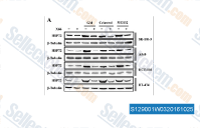
| S1290 | Celastrol (Tripterine) | Celastrol is a potent proteasome inhibitor for the chymotrypsin-like activity of a purified 20S proteasome with IC50 of 2.5 μM. Celastrol induces apoptosis and autophagy via the ROS/JNK signaling pathway. Celastrol inhibits dopaminergic neuronal death of Parkinson's disease through activating mitophagy. |
|
|
| S3269 | Acetylcorynoline | Acetylcorynoline, a major alkaloid component derived from Corydalis bungeana which is a traditional Chinese medical herb, shows anti-inflammatory properties. This compound may decrease egl-1 expression to suppress apoptosis pathways and increase rpn5 expression to enhance the activity of proteasomes. | ||

Products are for research use only. Not for human use. We do not sell to patients.
©Copyright 2013 Selleck Chemicals. All Rights Reserved.