
CAS No. 500577-51-5
Batch:
Purity:99.94
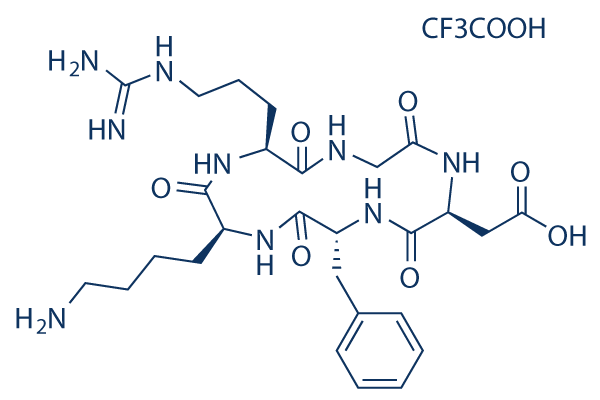
Chemical Structure
Check the
Cyclo(-RGDfK) TFA
product page for in-depth specifications, including solubility, stock solutions, MOA, and working concentrations.
| IUPAC Name | 2-[(2S,5R,8S,11S)-8-(4-aminobutyl)-5-benzyl-11-[3-(diaminomethylideneamino)propyl]-3,6,9,12,15-pentaoxo-1,4,7,10,13-pentazacyclopentadec-2-yl]acetic acid;2,2,2-trifluoroacetic acid | |
|---|---|---|
| CAS Number | 500577-51-5 | |
| Molecular Formula |
C29H42F3N9O9 |
|
| Molecular Weight (MW) | 717.69 | |
| SMILES | C1C(=O)NC(C(=O)NC(C(=O)NC(C(=O)NC(C(=O)N1)CCCN=C(N)N)CCCCN)CC2=CC=CC=C2)CC(=O)O.C(=O)(C(F)(F)F)O | |
| InChIKey | WHCQIPJAWCYHFT-HXSCNMCGSA-N |
Cyclo(-RGDfK) TFA is a cyclic pentapeptide derivative and potent, selective inhibitor of integrin αvβ3. By specifically binding to cell-surface integrin αvβ3 receptors, it disrupts integrin-mediated cell adhesion and extracellular matrix interactions, leading to the suppression of downstream cell survival pathways. This targeted inhibition effectively impairs cancer cell migration and invasion while inhibiting tumor microvessel angiogenesis. [1][2]
|
Concentration
Volume
Mass
|
|---|
Batch:
All in vitro solubility values are batch-tested experimental data (non-literature values).
| Solvent | Solubility & Note |
|---|---|
| DMSO |
100 mg/mL
(139.33 mM)
(Moisture-contaminated DMSO may reduce solubility. Use fresh, anhydrous DMSO. The recommended stock concentration is 10 mM in DMSO.) |
| Water | 100 mg/mL |
| Ethanol | Insoluble |
| Water | 100 mg/mL |
| DMSO |
100 mg/mL
(139.33 mM)
(Moisture-contaminated DMSO may reduce solubility. Use fresh, anhydrous DMSO. The recommended stock concentration is 10 mM in DMSO.) |
| Water | 84 mg/mL |
| Ethanol | Insoluble |
| DMSO |
100 mg/mL
(139.33 mM)
(Moisture-contaminated DMSO may reduce solubility. Use fresh, anhydrous DMSO. The recommended stock concentration is 10 mM in DMSO.) |
| Water | 100 mg/mL |
| Ethanol | Insoluble |
Q: Why does a DMSO stock precipitate in media/saline?
A: It is caused by unheated aqueous media (supersaturation), local solvent shock, or incorrect mixing sequence.
How to fix it?
- Preheat media/saline to 37°C.
- Mix rapidly (pipette/vortex) upon addition.
- For complex mixes, always add the aqueous phase last.
- Re-dissolve minor precipitates with a 37°C water bath and sonication (≤30 min).
Note: Technical data last updated: Sep 1, 2026.