
-
 Argentina
-
 Australia
-
 Austria
-
 Belgium
-
 Brazil
-
 Canada
-
 China
China
-
 Czech Republic
-
 Denmark
-
 Finland
-
 France
-
 Germany
-
 Greece
-
 Hong Kong
-
 Hungary
-
 Iceland
-
 India
India
-
 Ireland
-
 Israel
-
 Italy
Italy
-
 Japan
Japan
-
 Korea
Korea
-
 Luxembourg
-
 Malaysia
-
 Netherlands
-
 New Zealand
-
 Norway
-
 Poland
-
 Portugal
-
 Qatar
Qatar
-
 Romania
-
 Saudi Arabia
-
 Singapore
-
 Spain
Spain
-
 Sweden
-
 Switzerland
-
 Taiwan
-
 Turkey
-
 United Kingdom
-
 United States
Cemiplimab (anti-PD-1)
Synonyms: REGN-2810, cemiplimab-rwlc
Cemiplimab (anti-PD-1) is an intravenous human monoclonal antibody directed against programmed cell death-1 receptor (PD-1) and blocks its interaction with programmed death ligands 1 (PD-L1) and 2 (PD-L2). Cemiplimab blocks T-cell inactivation and enhances the immune system's anti-tumor response.
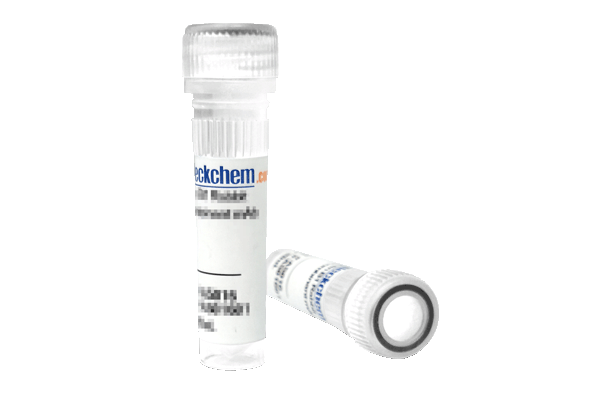
Click to purchase the isotype control of Cemiplimab (anti-PD-1)
1 Citation

17 Nobel Prize winners have used Selleck products
Shimon Sakaguchi
Nature Communications 2025,16, Article number:1325
David Baker
Dev Cell 2023, 58(20):2163-2180.e9.
David Julius
Cell 2017, 185-198.e16
Michael Houghton
Cell Chem Biol, 2020, 27(7):780-792.e5
Charles M. Rice
Cell 2018, 172(3):423-438.e25
Quality Control
| Featured Inhibitors | Y-27632 Dihydrochloride SB431542 CHIR-99021 (Laduviglusib) RMC-7977 RMC-6236 (Daraxonrasib) MRTX1133 MG132 Z-VAD-FMK VT3989 IAG933 |
|---|
Specificity
| Name | Citation | PD-1/PD-L1 interaction | PD-1 | PD-L1 | PD-1/PD-L1 | Others |
|---|---|---|---|---|---|---|
| GS-4224 | 0 | |||||
| INCB086550 | 1 | |||||
| BMS-1001 | 0 | |||||
| BMS-1166 | 8 | |||||
| PD-1/PD-L1 Inhibitor 3 | 13 | |||||
| BMS-1 | 13 | |||||
| BMS-202 | 28 | |||||
| CA-170 (AUPM-170) | 0 | |||||
| SR 0987 | 1 | IL17,RORγt | ||||
| Spartalizumab (anti-PD-1) | 3 | |||||
| Camrelizumab (anti-PD-1) | 2 | |||||
| AUNP-12 | 5 |
Mechanism of Action
| Description |
Cemiplimab (anti-PD-1) is an intravenous human monoclonal antibody directed against programmed cell death-1 receptor (PD-1) and blocks its interaction with programmed death ligands 1 (PD-L1) and 2 (PD-L2). Cemiplimab blocks T-cell inactivation and enhances the immune system's anti-tumor response.
|
|---|---|
| Features |
Human IgG4
|
| In vitro |
In cell-based assays, REGN2810 reverses PD-1-dependent attenuation of T-cell receptor signaling in engineered T cells and enhances responses of human primary T cells. |
| Cell Research |
Objective: T cell activation bioassays |
| In vivo |
Cemiplimab (REGN2810) binds the humanized PD-1 receptor and inhibits growth of MC38 murine tumors in human PD-1 knock-in mice. As REGN2810 binds to cynomolgus monkey PD-1 with high affinity, pharmacokinetic and toxicologic assessment of REGN2810 is performed in cynomolgus monkeys. High doses of REGN2810 are well tolerated, without adverse immune-related effects. |
| Animal Research |
Objective: MC38 mouse colon carcinoma |
References |
Product Details
| CAS No. | 1801342-60-8 |
|---|---|
| Isotype | Human IgG4 |
| Source | HEK293 |
| Sterility | 0.2 μM filtered |
| Formulation | PBS buffer. Contains no stabilizers or preservatives |
| Storage (From the date of receipt) |
Store the undiluted solution at 4°C in the dark to avoid freeze-thaw cycles |
Comparison of Clones for
*Literature analysis of various clone (for this target) products available on the market shows that Selleck's selected clones are more frequently applied. (data until September 2024)
Tech Support
Tel: +1-832-582-8158 Ext:3
If you have any other enquiries, please leave a message.

Products are for research use only. Not for human use. We do not sell to patients.
©Copyright 2013 Selleck Chemicals. All Rights Reserved.