
CAS No. 65666-07-1
Batch:
Purity:99
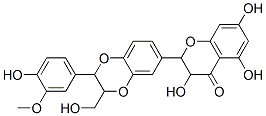
Chemical Structure
Check the
Silymarin
product page for in-depth specifications, including solubility, stock solutions, MOA, and working concentrations.
Chemical Information
| IUPAC Name | 3,5,7-trihydroxy-2-[3-(4-hydroxy-3-methoxyphenyl)-2-(hydroxymethyl)-2,3-dihydro-1,4-benzodioxin-6-yl]-2,3-dihydrochromen-4-one | |
|---|---|---|
| CAS Number | 65666-07-1 | |
| Molecular Formula |
C25H22O10 |
|
| Molecular Weight (MW) | 482.44 | |
| SMILES | COC1=C(C=CC(=C1)C2C(OC3=C(O2)C=C(C=C3)C4C(C(=O)C5=C(C=C(C=C5O4)O)O)O)CO)O | |
| InChIKey | SEBFKMXJBCUCAI-UHFFFAOYSA-N |
Biological Activity
Silymarin is a polyphenolic flavonoid derived from milk thistle that functions as a potent antioxidant and free radical scavenger. It inhibits TNF-induced activation of the NF-kB and JNK signaling pathways, thereby suppressing oxidative stress and downstream inflammatory responses. Through these mechanisms, silymarin exerts marked hepatoprotective, anti-inflammatory, and cytoprotective effects in preclinical cell and tissue models. [1][2]
Solubility
Batch:
All in vitro solubility values are batch-tested experimental data (non-literature values).
| Solvent | Solubility & Note |
|---|---|
| DMSO |
96 mg/mL
(198.98 mM)
(Moisture-contaminated DMSO may reduce solubility. Use fresh, anhydrous DMSO. The recommended stock concentration is 10 mM in DMSO.) |
| Ethanol | 96 mg/mL |
| Water | Insoluble |
| DMSO |
96 mg/mL
(198.98 mM)
(Moisture-contaminated DMSO may reduce solubility. Use fresh, anhydrous DMSO. The recommended stock concentration is 10 mM in DMSO.) |
| Ethanol | 96 mg/mL |
| Water | Insoluble |
| DMSO |
96 mg/mL
(198.98 mM)
(Moisture-contaminated DMSO may reduce solubility. Use fresh, anhydrous DMSO. The recommended stock concentration is 10 mM in DMSO.) |
| Ethanol | 1 mg/mL |
| Water | Insoluble |
Q: Why does a DMSO stock precipitate in media/saline?
A: It is caused by unheated aqueous media (supersaturation), local solvent shock, or incorrect mixing sequence.
How to fix it?
- Preheat media/saline to 37°C.
- Mix rapidly (pipette/vortex) upon addition.
- For complex mixes, always add the aqueous phase last.
- Re-dissolve minor precipitates with a 37°C water bath and sonication (≤30 min).
Reference
Jump to
Note: Technical data last updated: Sep 1, 2026.